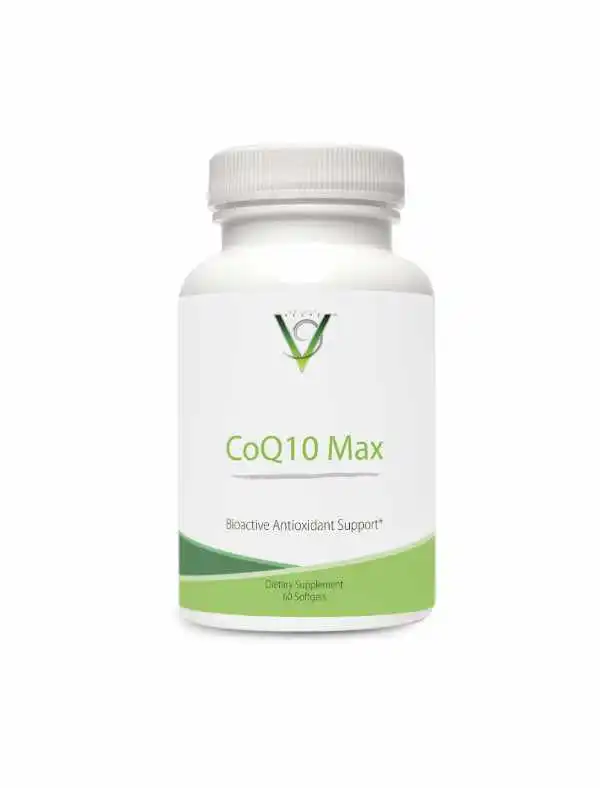
CoQ10 Max is built around a single, clinically meaningful distinction: ubiquinol versus ubiquinone — and why that difference matters at the cellular level.
- Features Kaneka Ubiquinol® — the patented, fully reduced, biologically active form of CoQ10*
- Lipid-stabilized delivery in MCT oil maintains ubiquinol stability through the GI environment for superior absorption*
- Supports mitochondrial ATP (cellular energy) production — CoQ10 is an essential electron carrier in the electron transport chain*
- Supports healthy cardiovascular function — the heart is the most CoQ10-demanding tissue in the body*
- Provides antioxidant protection against free radical activity in lymph, blood, and cell membranes*
- Supports regeneration of vitamins C and E from their oxidized forms, extending the body’s antioxidant network*
- Conversion of ubiquinone to ubiquinol declines with age — supplementing ubiquinol directly bypasses this age-related decline*
- Particularly relevant for individuals on statin medications, which deplete endogenous CoQ10 through the mevalonate pathway*
The CoQ10 Cycle Coenzyme Q10 exists in two interconvertible forms in the body. Ubiquinone is the oxidized form — produced in the mitochondria, where it directly participates in energy production by accepting electrons in the electron transport chain (Complex I and Complex II to Complex III). Through the action of an oxidoreductase enzyme, ubiquinone is rapidly converted to ubiquinol — the fully reduced, lipid-soluble form — which then circulates throughout the body performing its antioxidant functions before being recycled back to ubiquinone to re-enter the energy production cycle.*
Why Ubiquinol Rather Than Ubiquinone
The majority of CoQ10 supplements on the market provide ubiquinone — the oxidized form — because it is cheaper to produce and more chemically stable. To perform its biological functions, ubiquinone must be converted to ubiquinol within the body. This conversion is enzyme-dependent and becomes progressively less efficient with age, particularly after age 40, and under conditions of oxidative stress and mitochondrial compromise. Studies comparing ubiquinol and ubiquinone at equivalent doses consistently demonstrate that ubiquinol achieves significantly higher plasma concentrations — meaning more of each dose reaches the tissues that need it.*
CoQ10 Max delivers ubiquinol directly — bypassing the conversion step entirely — in the Kaneka Ubiquinol® form, produced by Kaneka Corporation, the world’s leading CoQ10 manufacturer. Until recently, supplementing ubiquinol directly was not practical because the reduced form is chemically unstable and easily oxidized back to ubiquinone in the GI environment. Kaneka’s patented technology solves this problem: the lipid-stabilized formulation (using medium-chain triglycerides, ascorbyl palmitate, and sunflower lecithin — with the ascorbyl palmitate use covered by US patent 6,740,338) maintains ubiquinol’s structural integrity and bioactive reduced state throughout absorption.*
Mitochondrial Energy Production CoQ10 is an indispensable component of the mitochondrial electron transport chain — the biochemical pathway responsible for the vast majority of cellular ATP production. It serves as the mobile electron carrier between Complex I/II and Complex III, shuttling electrons through the inner mitochondrial membrane. Without adequate CoQ10, this process is impaired at a fundamental level regardless of how much substrate (glucose, fatty acids) is available. Every cell that depends on mitochondrial energy — which is to say, virtually every cell in the body — requires CoQ10.*
The heart is the most CoQ10-demanding organ in the body, operating continuously without rest and deriving nearly all of its energy from mitochondrial oxidative phosphorylation. Cardiac muscle cells contain the highest density of mitochondria of any tissue, reflecting the heart’s extraordinary energy demands. Supporting healthy cardiac tissue CoQ10 levels is a well-established focus in integrative cardiovascular medicine.*
Antioxidant Defense Ubiquinol is the body’s primary lipid-soluble antioxidant operating in the cellular membrane environment — protecting mitochondrial membranes, cell membranes, and circulating lipoproteins from oxidative damage. Research indicates that ubiquinol supports antioxidant activity including the regeneration of vitamins C and E from their oxidized forms, helping to maintain healthy free radical balance throughout the body. Researchers have also identified a possible role for CoQ10 in redox control of cell signaling and gene expression.*
Statin Medications and CoQ10 Depletion HMG-CoA reductase inhibitors (statins) block the mevalonate pathway — the same biosynthetic route through which the body produces endogenous CoQ10. Statin use reliably reduces plasma and tissue CoQ10 concentrations, increasing the physiological need for exogenous CoQ10 supplementation. Individuals on statin therapy are a population for whom CoQ10 Max is particularly clinically relevant.*
CoQ10 Max Does Not Contain
Wheat, gluten, corn, yeast, soy, dairy products, fish, shellfish, peanuts, tree nuts, egg, ingredients derived from genetically modified organisms (GMOs), artificial colors, artificial sweeteners, or artificial preservatives.
How To Take CoQ10 Max
Take one to two soft gels daily, or as directed by your healthcare practitioner.
Consult your healthcare practitioner prior to use.
Individuals taking medication should discuss potential interactions with their healthcare practitioner. Do not use if tamper seal is damaged.
Quality, Purity, Potency Guaranteed
All Unique Verve Formulas Meet or Exceed cGMP Quality Standards
cGMP = Current Good Manufacturing Practice certification means that every aspect of all Unique Verve manufacturing process has been examined, including laboratory/testing methods (for stability, potency and product formulation)
Made and Packaged in the USA
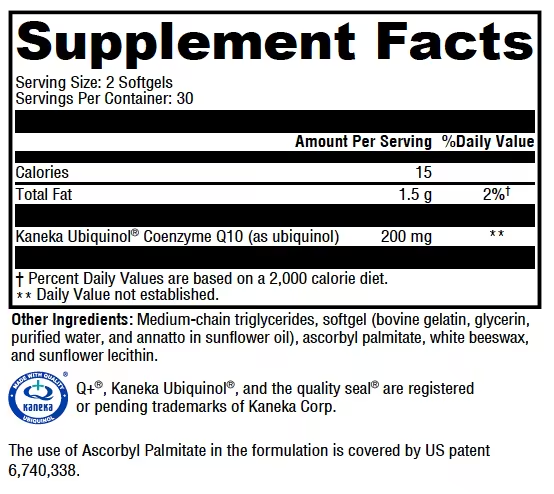
CoQ10 Max Supplement Facts & Ingredients
Serving Size 2 Softgels
Servings Per Container: 30
Percent Daily Values (DV) are based on a 2,000 calorie diet.
** Daily Value (DV) not established.
Calories : 15
Total Fat : 1.5 g 2%
Kaneka Ubiquinol® Coenzyme Q10 (as ubiquinol) 200 mg **
Other Ingredients
Medium-chain triglycerides, softgel (bovine gelatin, glycerin, purified water, and annatto in sunflower oil), ascorbyl palmitate, white beeswax, and sunflower lecithin.
Q+®, Kaneka Ubiquinol®, and the quality seal® are registered or pending trademarks of Kaneka Corp
The use of Ascorbyl Palmitate in the formulation is covered by US patent 6,740,338.
Legal disclaimer
*These statements have not been evaluated by the Food and Drug Administration. This product is not intended to diagnose, treat, cure, or prevent any disease. Consult your healthcare practitioner prior to use. Individuals taking medication should discuss potential interactions with their healthcare practitioner.
Reviews
There are no reviews yet