
The foods that can cause eczema are not always the obvious ones. My clients have almost always already tried the obvious dietary changes by the time they find me. They’ve eliminated gluten, dairy, and eggs. They’ve switched to anti-inflammatory eating. They’re doing everything right — and their eczema is still there. What most of them haven’t considered is that the healthy foods they replaced the problem foods with may now be the new trigger. This post explains exactly how that happens and what to do about it.
Why Standard Allergy Testing Misses Food-Triggered Eczema
When a conventional doctor tests for food reactions, they test for IgE antibodies. IgE is the immune pathway involved in classic allergies — peanuts, shellfish, bee stings — where the reaction is immediate and unmistakable.
Most people with food-triggered eczema do not have IgE reactions to their trigger foods. Their reactions run through the IgG and IgA antibody pathways, which are delayed by up to 72 hours. So the broccoli you ate on Tuesday might not show up on your skin until Thursday or Friday. There is no obvious connection, and standard allergy testing will tell you nothing is wrong.
This is why conventional testing fails so many eczema patients. It’s not that food isn’t involved — it’s that the test isn’t looking for the right mechanism.
IgG and IgA food sensitivity reactions are delayed — symptoms may appear up to 72 hours after exposure, making the food-to-flare connection difficult to identify without targeted functional testing.
How Food Ends Up on Your Skin: The Mechanism
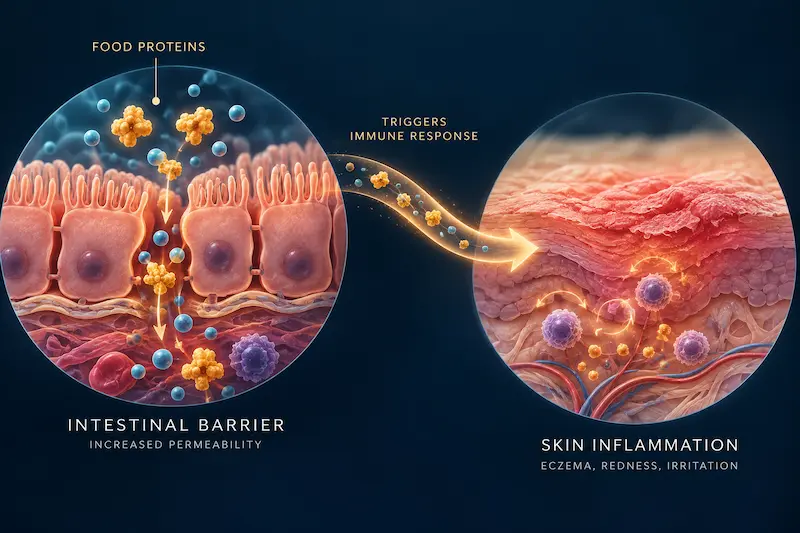
The path from food to eczema runs through the gut. Here’s what the research shows:
1. Gluten and Zonulin
Gluten specifically triggers the release of zonulin, a protein that regulates the tight junctions in your intestinal lining. When zonulin is elevated, those junctions loosen — and partially digested food proteins can cross the gut barrier and enter the bloodstream. This is the mechanism behind leaky gut, and leaky gut is consistently present in people with eczema.
2. The Inflammatory Cascade
Once food proteins cross the gut barrier, newly infiltrating inflammatory monocytes release destructive signals — TNF-alpha and IL-6 — that further damage the gut lining. This creates a self-perpetuating loop: the more the gut leaks, the more inflammation is produced, and the more inflammation is produced, the more the gut leaks.
3. The Gut-Skin Connection
Cortisol, elevated in response to chronic immune activation, spikes blood sugar — which drives the production of advanced glycation end-products (AGEs). AGEs are corrosive to skin proteins, further degrading the structural integrity of the barrier.
Dysbiosis-driven SCFA deficiency has been shown to precede eczema symptom onset — making gut microbiome restoration a key upstream intervention, not an adjunct one.
The Craving Paradox: Why You Want the Foods That Hurt You
One of the most disorienting aspects of food-triggered eczema is that patients often crave the exact foods driving their inflammation. This is not random — it has a physiological explanation.
Food sensitivities can trigger an endorphin response from the pituitary gland and hypothalamus. Endorphins block pain signals and create a temporary sense of well-being — which means the reactive food gives you a brief lift, reinforcing the craving. This mechanism is driven by exorphins, opioid-like peptides derived from partially digested food proteins, most notably gliadin (from gluten) and casomorphin (from dairy).
From the body’s perspective, this makes sense. Everything the body does, it does from a protective mechanism — the endorphin hit is the body trying to manage the inflammatory stress the food is creating. But recognizing this pattern is the first step to breaking it.
Identifying the specific foods that can cause eczema in your case — rather than following a generic elimination list — is what breaks this cycle.
Which Foods Can Cause Eczema — Including the Ones You’d Never Suspect
The known triggers that I recommend eliminating in a structured intervention include:
• Gluten (wheat, rye, barley, spelt)
• Dairy
• Eggs
• Grains
• Soy
• Nightshade vegetables (tomatoes, peppers, eggplant)
• Pork
• Shellfish
• Tree nuts
• Pineapple
• Oranges
• Yeast
• Lentils and beans
But here’s what makes eczema particularly tricky: the foods driving the most inflammation may not be on this list at all. They may be the healthiest foods in your diet.
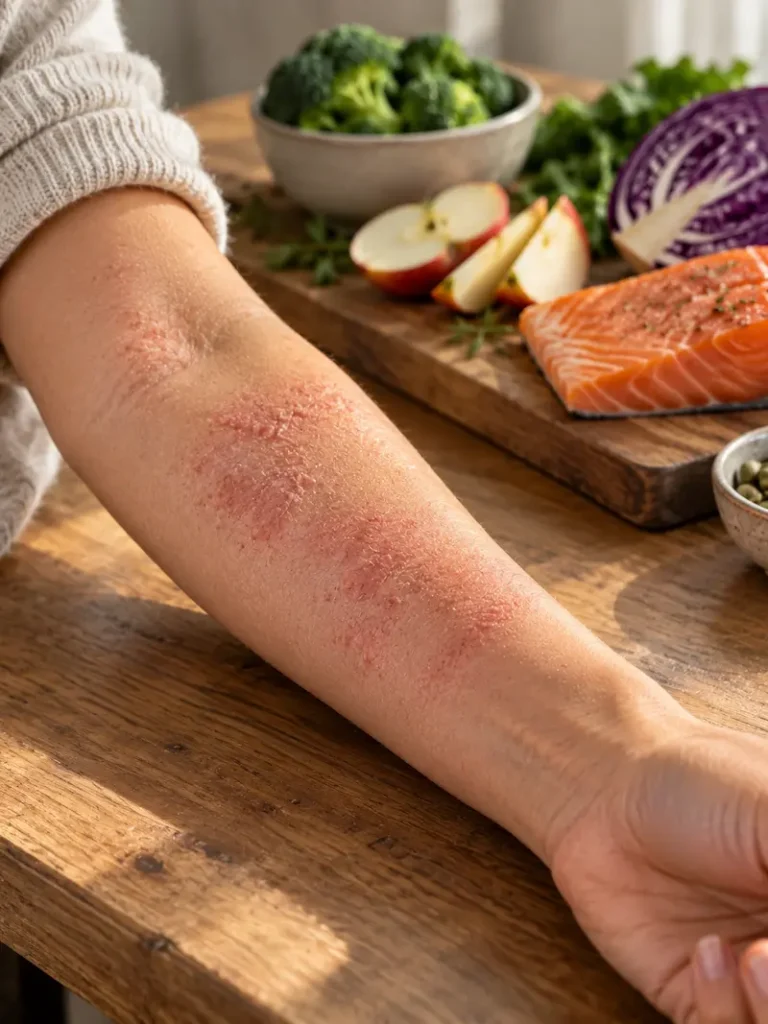
Wild salmon. Broccoli. Apples. Cabbage. When the gut lining is compromised, the immune system can develop a sensitization to any food that crosses it frequently enough. A person who has been eating broccoli every day for two years on an anti-inflammatory diet can develop a genuine IgG and/or IgA reaction to broccoli — and every time they eat it, they’re adding fuel to the fire they’re trying to put out.
This is not a reason to fear healthy food. It’s a reason to test before assuming.
How I Identify Food Triggers in My Practice
When I work with an eczema patient, I use the Vibrant Wellness Comprehensive Food Sensitivity Panel — a 209-item panel that tests for IgG and IgA reactions to whole foods, as well as food additives, preservatives, artificial sweeteners, emulsifiers, food dyes, and glyphosate. It’s the most comprehensive panel available, and in my experience it’s the only one that catches the full picture.

For patients where testing isn’t immediately accessible, I use a cold-turkey elimination protocol based on the known trigger list above. Either way, the next step is a food rotation protocol — rotating food choices every one to two days to prevent new sensitizations from forming while the elimination intervention is underway. This is a detail most elimination diet protocols overlook.
Clinical Note: Food rotation is as important as elimination. Eating the same replacement foods every day — even anti-inflammatory ones — is how new sensitizations form when the gut is already compromised.
Why Digestion Is Part of the Solution
One of the interventions I introduce from day one — in parallel with addressing food sensitivities — is digestive support. When the gut is dysbiotic and intestinal permeability is elevated, digestive capacity is already compromised. Low thyroid function, which is common in eczema patients, further reduces digestive secretions.
Hydrochloric acid (HCl) support plays two roles: it denatures proteins so the immune system is less likely to recognize them as foreign antigens, and it creates an acidic environment that reduces H. pylori and SIBO — two common drivers of dysbiosis.
Digestive enzyme support takes the process further by breaking larger proteins down to smaller amino acids. A fully digested protein no longer looks like a foreign invader to the immune system — which reduces the antigen load that’s driving the inflammatory response in the first place.
These are not supplements I add later. They are foundational from the beginning, because every meal eaten without adequate digestive support is another opportunity for the immune system to react.
Why Eliminating Foods Alone Won’t Clear Your Eczema
I want to be direct about this: food sensitivity work is one piece of the puzzle, not the solution. In the patients I work with, by the time food sensitivities have developed, there is almost always a cascade of interconnected imbalances already in place:
• Dysbiosis (altered gut microbiome)
• Elevated cortisol affecting sex hormones and thyroid function
• Low thyroid function (impaired barrier repair, reduced digestive secretions)
• Compromised gut lining (leaky gut)
• Nutrient insufficiencies (zinc, vitamin D3, vitamin A, B vitamins)
• Dysregulated immune function
Removing the reactive foods removes one tack. But the rest of the tacks are still there, continuing to drive the cycle. Sustainable resolution requires identifying and addressing each of them. This is the work I do with eczema clients in my functional medicine practice — and it’s why results from food elimination alone tend to be partial and temporary.
Case Study: What a Comprehensive Approach Can Do
One of the clearest examples from my practice involves a patient who came to me with severe eczema — full-body blistering, raw and weeping skin — that had not responded to topical steroids. She also had lichen sclerosus, osteoporosis, diffuse hair loss, heart palpitations, and night sweats.
Testing revealed: low free T3 (hypothyroid), multiple reactive foods, severe intestinal permeability, and high mycotoxin load. Each of those findings was connected to the others — and each one was connected to her skin.
After three months on a comprehensive functional medicine protocol — she had full resolution of her eczema, lichen sclerosus symptoms, hair loss, palpitations, and night sweats.
This is what’s possible when you treat the whole picture. The food piece was critical — but it was one piece.
Frequently Asked Questions
1. Is my eczema caused by a food allergy?
Not necessarily — and this distinction matters. A food allergy involves IgE antibodies and usually causes an immediate reaction within minutes. Food sensitivities involve IgG and IgA antibodies and can take up to 72 hours to trigger a symptom, which is why the connection to food often goes unrecognized. Most people with food-triggered eczema test negative on standard allergy panels because those panels only look for IgE.
2. Is eczema related to food sensitivity?
Yes, and this is one of the most underrecognized drivers of chronic eczema. IgG and IgA food sensitivities trigger a delayed inflammatory immune response that feeds the same systemic inflammation responsible for skin barrier breakdown. The gut-skin connection is direct: when the gut lining is compromised, partially digested food proteins cross into the bloodstream, provoking an immune reaction that eventually surfaces on the skin.
3. Why does my eczema worsen after eating?
If you notice worsening eczema after meals, it may be a delayed IgG/IgA reaction to something you ate — but because the delay can be up to three days, the trigger is rarely obvious. The immune response to reactive foods also elevates cortisol (a stress hormone), which can spike blood sugar and produce advanced glycation end-products (AGEs) that degrade skin proteins and compromise your barrier further.
4. Does sugar make eczema worse?
Yes, in two ways. Dietary sugar directly raises blood glucose, which increases AGE production and accelerates tissue damage including skin barrier proteins. Sugar also feeds dysbiosis — the overgrowth of harmful gut bacteria — which reduces short-chain fatty acid production, weakens keratinocyte metabolism, and shifts the immune system toward the Th2 inflammatory response associated with eczema.
5. Can gluten worsen eczema symptoms?
Gluten is uniquely problematic because it triggers the release of zonulin, a protein that acts as a gatekeeper for intestinal tight junctions. When zonulin is elevated, tight junctions loosen — allowing food proteins, bacteria, and toxins to cross the gut lining and enter the bloodstream. This is the core mechanism behind leaky gut, and leaky gut is consistently present in people with eczema.
6. How does gut health connect to food-triggered eczema?
The gut and the skin share the same immune system. When gut bacteria are imbalanced (dysbiosis), the production of short-chain fatty acids — especially butyrate — drops. Butyrate is essential for keratinocyte metabolism and ceramide production in the skin. Without it, the skin barrier weakens, and the immune system shifts toward the Th2 pathway that drives eczema flares. Restoring gut health is not optional when food triggers are present — it is the foundation.
7. Does dairy really trigger eczema flares?
For many people, yes. Dairy is one of the most common IgG and IgA reactive foods, and it is also a common cross-reactor for those with leaky gut. Casein (dairy protein) behaves similarly to gluten in its ability to provoke an immune response in sensitized individuals. In my practice, dairy and gluten are the first two foods I recommend eliminating in a structured food sensitivity intervention.
8. Why do certain foods trigger my eczema but not others?
Because food sensitivity is individual — shaped by your gut microbiome, the integrity of your intestinal lining, your immune system history, and which proteins your body has been exposed to most frequently. Ironically, the foods you eat most often are the most likely to become reactive over time, especially when leaky gut is present. This is why healthy, anti-inflammatory foods — salmon, broccoli, apples — can become triggers for someone who has been eating them daily for years.
Ready to Find Out What’s Actually Driving Your Eczema?
If you’ve eliminated the usual suspects and your skin hasn’t cleared, the answer is likely upstream of what you’ve been looking at. The place to start is a thorough look at your full health picture — gut function, immune patterns, thyroid, cortisol, and food sensitivity — not just a list of foods to avoid.
I offer an Initial Comprehensive Health History Assessment where I review your full history, map the interconnected drivers contributing to your skin, and discuss what a complete root-cause approach would look like for you. This is a virtual appointment, available nationwide.
→ Book your Initial Comprehensive Health History Assessment:
Written by Natalie Maibenko – a Certified Functional Medicine Practitioner and Master Esthetician with 23+ years of experience and founder of Unique Verve

Natalie Maibenko
Functional Medicine & Skincare Expert – Helping You Take Control of Your Health and Achieve Lasting Skin Results Nationwide — Virtual Practice
As a Certified Functional Medicine Practitioner my Expertise Encompasses:
- Immune System: frequent illness, UTIs, yeast infections
- Allergies, Asthma
- Skin Problems: acne, cystic acne, rosacea, eczema, dermatitis, ichthyosis, psoriasis, vitiligo, melasma
- Inflammation: arthritis, rhinitis, joint & muscle pain, migraines, headaches
- Sleep Disturbunces, Insomnia
- Gut Problems: IBS/IBD, bloating, acid reflux, gas, constipation, diarrhea, parasites, fungal/yeast overgrowths
- Hormonal Imbalances: PCOS, PMS symptoms, weight problems/inability to lose weight, thyroid problems
- Hair Loss, Alopecia
- Mood Imbalances: anxiety, depression, irritability
- Metabolic Dysfunction, Insulin Resistance, Type 2 Diabetes
- Optimizing Wellness for Successful Pregnancy
- Autoimmune Conditions: Hashimoto’s thyroiditis, grave’s disease, reumatoid arthritis (RA), lupus, etc
- Bone Health: osteopenia/ osteoporosis
- Effective Anti-Aging Strategies without Injectables with the inside-out & outside-in approach
- Detoxification of Heavy Metals, Mycotoxins, Environmental Toxins
- Reversing Breast Implant Illness
- Preparation for the Explant Surgery and Optimization of Wellness & Vitality Post-Explant
