
Can eczema be cured? If you’ve asked that question, you’ve almost certainly gotten the same answer: no.
You can manage it, control it, or suppress it — but not cure it. Dermatologists are consistent on this point, and most people who come to me have already internalized it as a fact about their body.
I want to challenge that framing. Not because I have a miracle cure — I don’t — but because “no cure” is not a statement about your biology. It’s a statement about what pharmaceutical medicine can offer. And the question it avoids answering is the only one that matters: what is actually driving your eczema? When that question is answered, and the drivers are genuinely addressed, resolution becomes possible. I see it regularly in my practice.
Here is what functional medicine says about eczema and cures — and why the conversation your dermatologist is having with you is the wrong one.

What “No Cure” Actually Means — and What It Doesn’t
When a dermatologist says there is no cure for eczema, they mean there is no pharmaceutical intervention that permanently eliminates the condition without ongoing use. This is accurate, as far as it goes. Topical steroids work while you use them. Immunosuppressants suppress while you take them. Even the newer biologics require continued administration to maintain their effect. Stop the medication, and the condition returns — because the underlying cause was never addressed.
This is a feature of suppression-based medicine, not a statement about the disease. The question conventional dermatology is implicitly asking is: “what drug can we use to stop this immune response?” The question functional medicine asks is: “why is the immune system responding this way, and what would need to change for it to stop?”
These are different questions with different answers. The answer to the first is: there is no drug that permanently changes the terrain. The answer to the second is where resolution lives.
Immune dysregulation in eczema — the Th2-skewed inflammatory signaling, the barrier dysfunction, the elevated IgE — does not arise from nothing. It arises from an environment: gut dysfunction, food sensitivities, histamine overload, nutritional insufficiencies, toxic burden, hormonal imbalances. When that environment is changed, the immune system responds accordingly.
Immune dysregulation in atopic dermatitis involves multiple interconnected pathways — Th2 skewing, barrier dysfunction, and gut-immune crosstalk — each of which represents an addressable driver, not an immutable biological fate.
Managed vs. Suppressed vs. Resolved: Three Different Outcomes
Managed means reducing how often and how severely eczema flares, usually through a combination of triggers avoidance, topical treatments, and lifestyle adjustments. The condition is still present. Management is ongoing. Many people live here for decades.
Suppressed means using medication — steroids, biologics, immunosuppressants — to stop the immune response that’s causing the flares. The medication is doing the work. When it stops, the inflammation returns. The underlying drivers remain unchanged.
Resolved means the immune system is no longer responding at the same threshold because the triggers and the biological environment sustaining the reaction have genuinely changed. This requires identifying what has been driving the dysregulation — which is different for every patient — and correcting it systematically. Resolution is not maintenance. You are not managing something that’s still there. The condition has actually shifted.
Most people have only been offered the first two options. The third is what functional medicine is working toward.
Are Biologics a Cure? What the Research Actually Shows
The biologics conversation comes up constantly in my practice, because patients are increasingly being offered dupilumab as a “breakthrough” treatment. I want to address this directly, because the clinical picture is more complicated than most patients are told.
There are two distinct drug classes being used in eczema, and they have different risk profiles that need to be understood separately.
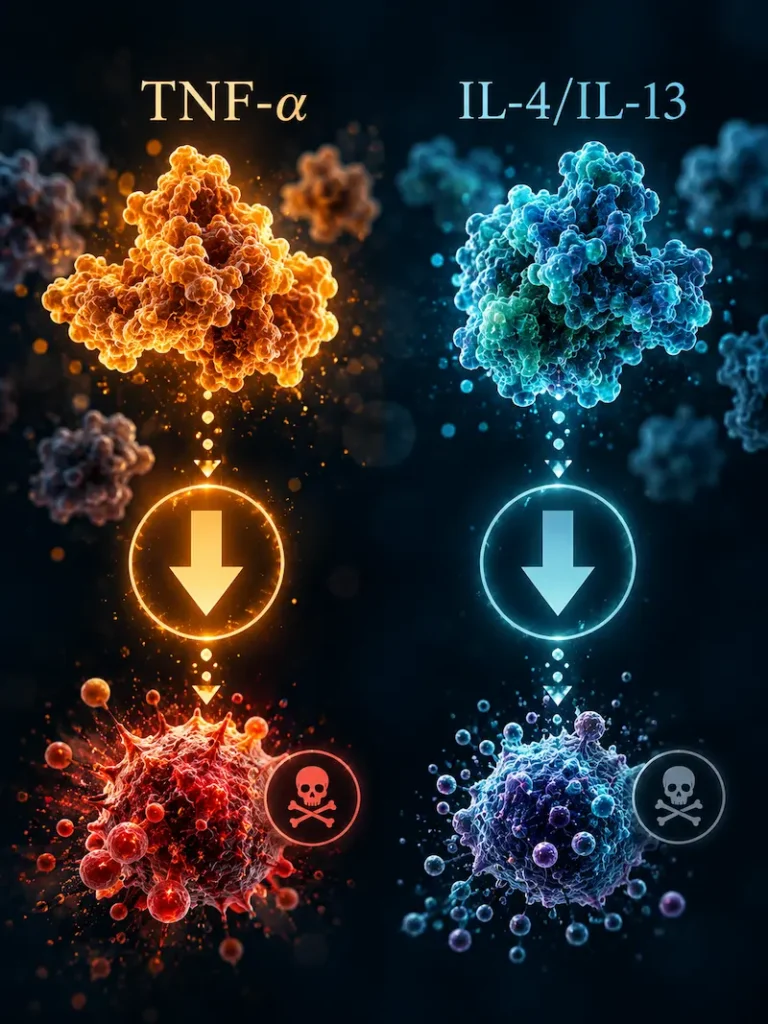
TNF-Alpha Inhibitors (infliximab, adalimumab)
Tumor necrosis factor-alpha inhibitors like infliximab and adalimumab work by blocking TNF-alpha, a cytokine involved in the inflammatory cascade. They are used more commonly in psoriasis and other autoimmune conditions than in eczema, but they appear in the conversation. What the research clearly shows: these medications significantly increase the risk of reactivating latent tuberculosis into active disease. The immune signal they suppress is the same one that keeps latent TB contained. Blocking it opens a pathway the body has been successfully holding closed. This is not a rare or theoretical risk — it is well-documented and is why TB testing is required before initiating these medications.
Dupilumab (IL-4/IL-13 inhibitor)
Dupilumab works differently — it blocks IL-4 and IL-13, the Type 2 cytokines at the center of the allergic/atopic inflammatory response. This is why it is effective at reducing eczema symptoms: it directly interrupts the signaling pathway that produces them. The problem is that these same cytokines — IL-4, IL-13, and IgE — play a central role in how the body expels and controls helminths (parasitic infections). Blocking them impairs that clearance mechanism. The clinical literature documents both eosinophilia and parasitic infection risk in patients on dupilumab, because the immune activity that was driving eczema was also performing a protective function.
Neither of these medications is a cure. Both suppress a specific immune pathway and in doing so trade one immune vulnerability for another. From a functional medicine perspective, continuously suppressing the immune system to stop an allergic or autoimmune reaction — which eczema shares a continuum with — is not a resolution strategy. It is a management strategy with downstream consequences that may be worse than the condition being managed.
Clinical note: This is not an argument against all pharmaceutical intervention for severe presentations. It is an argument for having an accurate and complete picture of what these medications do — so the decision is informed on both sides.
The Food Habituation Pattern: What I See Almost Universally
One of the most consistent clinical patterns I see in patients with persistent eczema is what I call the food habituation pattern: a narrow, highly repetitive food rotation that has become the daily default. The same small set of foods, eaten regularly, over months or years.
This matters for a specific biological reason. When the gut lining is compromised — which it consistently is in eczema patients — the immune system can develop sensitizations to any food protein it encounters repeatedly enough. The process is not limited to the known problem foods like gluten and dairy. It extends to whatever foods that person is eating most often, regardless of how anti-inflammatory those foods are supposed to be. Salmon every day. Broccoli at every meal. Apples as the daily snack. Each of these can become a genuine immunological driver.
The other component of this pattern is incompleteness. A partial dietary change produces partial results. If someone eliminates gluten but continues eating grains, eliminates dairy but continues with goat cheese, or removes the obvious categories but keeps eating the foods they eat most habitually — those remaining foods are often the ones driving the persistent inflammation. I see this constantly: a patient who is “doing everything right” but hasn’t eliminated the specific categories their immune system has been most chronically exposed to.
What I observe in practice: complete elimination of the reactive food categories — not partial, not with exceptions — is the most common single driver of eczema resolution. The patients who achieve full resolution are those who make the complete change. Those who make a partial change get partial improvement and then plateau.
Gut microbiome dysbiosis and intestinal permeability are consistently present in atopic dermatitis, creating the environment in which food sensitivities develop and perpetuate the inflammatory cycle.
Why Elimination Diets Fail: The Histamine Bucket
Even among patients who successfully eliminate gluten, dairy, eggs, and the other common food triggers, a significant number reach a point of partial improvement and then stall. They feel better, but they don’t fully clear. This is the histamine piece, and it is almost always the missing link in a stalled elimination protocol.
Histamine is a molecule with important physiological functions — it’s involved in immune signaling, stomach acid secretion, and neurotransmitter activity. In eczema patients, the histamine bucket is typically already overloaded: elevated mast cell activity generates endogenous histamine as part of the ongoing immune response, and estrogen upregulates mast cell function further, adding to that load.
The enzyme that breaks down dietary histamine is diamine oxidase (DAO), which is produced by the epithelial cells lining the gut. Here is the problem: a compromised gut lining produces less DAO. So the patients who most need to clear dietary histamine — the ones with the leakiest guts and the highest immune activation — have the least capacity to do so.
When these patients continue eating high-histamine foods and histamine liberators — fermented foods, vinegar, alcohol, aged cheeses, certain fruits, legumes, beans and mushrooms — they are continuously refilling a bucket that cannot drain. Every addition tips the balance. In my practice, I often describe this as the “tiny straw” phenomenon: in someone with severe eczema and a fully loaded histamine bucket, a single small additional trigger can precipitate a significant flare, because they are already at threshold. There is no reserve.
The solution is a low-histamine dietary approach implemented alongside the elimination protocol, not as a separate intervention. Addressing the gut lining to restore DAO capacity is the longer-term fix — but removing the histamine inputs is the immediate one that allows the inflammation to begin subsiding.
Clinical note: Partial improvement followed by a clear plateau — even when the elimination protocol appears to be followed correctly — is the most reliable signal that the histamine piece is still missing. This is where I look first when a patient reports that they’ve “done the diet” but aren’t seeing full resolution.
The Genetics Question: Epigenetics Changes the Answer
The most common reason patients accept “no cure” is the genetics argument. Eczema runs in families. There may be a filaggrin gene mutation. An atopic triad in the family history. The implication is that this is written into their DNA and cannot be changed.
Epigenetics tells a more accurate story. Genes do not operate as fixed switches — they are expressed or suppressed depending on the biological environment they are sitting in. The same gene variant that increases susceptibility to eczema may remain dormant in one person and be fully activated in another, depending on their diet, their gut microbiome, their toxic exposures, their stress level and their food sensitivities.
The way I explain this to patients: genes load the gun. Food choices, food sensitivities, toxins, and dysbiosis pull the trigger — by turning on those unfavorable gene variants that would otherwise remain silent. This is not a theoretical framework; it is the mechanism behind epigenetic inheritance, and it has been documented in atopic dermatitis in the research on cord blood DNA methylation patterns.
What follows from this is significant: if dietary and lifestyle factors turn those variants on, dietary and lifestyle interventions can turn them off. Restoring immune regulation, correcting gut dysfunction, reducing the toxic and inflammatory load — these are not attempts to override your genetics. They are interventions that change the terrain in which your genes are being expressed. The susceptibility may remain. The active expression of it does not have to.
Epigenetic mechanisms — including cord blood DNA methylation patterns — demonstrate that atopic disease susceptibility is transmitted not as fixed genetic fate but as environmentally modifiable gene expression.
What Resolution Actually Looks Like — and How Long It Takes
Patients who are fully dedicated — complete dietary changes, targeted nutritional and supplement support, gut restoration — typically see transformative results within a few months. This is not a small improvement. I mean resolution of the eczema that had been present for years. Skin that is no longer flaring, no longer itching, no longer compromising quality of life.
Patients who make partial changes tend to get partial results: initial improvement, then a plateau. The plateau is information — it tells you that something is still driving the inflammation, and the work is to find what it is.
Severity matters. Severe eczema reflects a highly activated immune system and, almost always, a histamine bucket that is operating at or near full capacity. In these patients, the threshold for a flare is genuinely low — something that would be completely inconsequential for someone with a lower baseline load can trigger a significant response. This is not evidence that the condition cannot resolve. It is evidence that it requires more sustained effort, and that for some patients, repeated intervention cycles are needed — each one clearing more of the accumulated immune burden — before the threshold rises to a point where the system has genuine resilience.
Probiotics are one component of the gut restoration work and their effect on eczema severity is measurable. A recent meta-analysis of randomized controlled trials found that probiotic supplementation produced a statistically significant reduction in atopic dermatitis severity (SMD −0.72, p=0.015) — confirming that the gut-skin connection operates in a direction that is clinically useful to intervene on.
The Path Forward
If eczema resolution is your goal — not management, not suppression, but the actual condition no longer driving your symptoms — the path runs through understanding what is specifically driving yours. That is not a generic question with a generic answer. It is an individual clinical picture.
In my practice, the foundational assessment covers:
• Food sensitivities (IgG and IgA) — the complete picture, not just the standard triggers
• Gut function — microbiome integrity, intestinal permeability, DAO capacity
• Histamine load and clearance capacity
• Thyroid function — often suppressed in eczema patients and directly relevant to barrier repair
• Hormonal balance — estrogen metabolism and its effect on mast cell activation
• Nutritional insufficiencies — zinc, vitamins A, D, and B-complex, all essential to immune regulation
• Toxic burden — mycotoxins, heavy metals, xenoestrogens that accumulate and drive systemic inflammation
Each of these is an addressable driver. When they are identified and systematically corrected — not one at a time, but as the integrated picture they represent — the immune environment changes. The skin reflects that change.
Dermatology is not wrong that there is no pharmaceutical cure. But the absence of a pharmaceutical cure is not the same as the absence of a path to resolution. Those are different things, and the distinction matters for every person who has been told to manage this condition for the rest of their life.
Frequently Asked Questions
1. Can eczema be completely cured permanently?
For many people, yes — though dermatology doesn’t use this language, and that matters. “No cure” in conventional medicine means there is no pharmaceutical intervention that permanently eliminates the condition. From a functional medicine perspective, when the underlying drivers — immune dysregulation, gut dysfunction, food sensitivities, histamine overload, nutritional insufficiencies — are genuinely identified and addressed, eczema can resolve completely. I see this regularly in my practice. The distinction is that resolution requires finding and correcting what is actually driving the inflammation, not suppressing the response.
2. Is eczema a lifelong condition I’ll always have?
Not necessarily, and the genetics argument is more nuanced than it sounds. Genetics loads the gun — certain gene variants increase susceptibility. But food choices, food sensitivities, toxins, and dysbiosis pull the trigger by turning those unfavorable gene variants on. Epigenetics research shows that dietary, lifestyle, and targeted supplemental interventions can genuinely change gene expression — turning off the variants driving the immune dysregulation. Eczema being “in your genes” does not mean it is permanent. It means the terrain that’s activating those genes needs to be changed.
3. Can adult eczema be cured or just managed?
Adult eczema responds to root-cause intervention in exactly the same way as childhood eczema — the biology is the same, even if the history is longer. In my clinical experience, adults who commit fully to the dietary changes, address gut dysfunction and histamine overload, and support their immune biochemistry nutritionally can achieve the same resolution I see in younger patients. The timeline may be longer when the immune system has been activated for years, and repeated intervention cycles are sometimes needed for severe presentations, but the mechanism for resolution is the same at any age.
4. What’s the difference between curing and controlling eczema?
Managing or controlling eczema means reducing symptoms enough to live with — through topical steroids, antihistamines, biologics, or avoidance behaviors that require ongoing maintenance. The moment you stop the intervention, the symptoms return, because the underlying drivers are still there. Resolution means the immune system is no longer reacting at the same threshold because the triggers and the biochemical environment that was sustaining the reaction have been changed. You’re not in a holding pattern — the condition has genuinely shifted. That’s the distinction I work toward with every patient.
5. Can eczema be cured without steroids?
Yes, and for most of the patients I work with, steroids are not part of the resolution path at all. Topical steroids thin the skin barrier over time and suppress the immune signal without addressing what’s generating it. They have a role in acute management of severe flares, but they are not a path to resolution. The functional medicine approach — identifying food sensitivities, correcting gut dysfunction, addressing histamine accumulation, supporting immune regulation and skin restoration nutritionally — produces genuine resolution without the long-term skin barrier compromise that comes with chronic steroid use.
6. Can diet changes actually cure eczema?
Diet is the single most powerful lever in eczema resolution — but “try going gluten-free” is not the same as a comprehensive dietary intervention. What I see in practice is that partial dietary changes produce partial results. The patients who achieve full resolution are the ones who eliminate the full categories their immune system has been reacting to, not just the obvious ones. Histamine-rich foods and histamine liberators are also critical and almost always overlooked. Diet addresses the primary drivers, but nutritional support — to correct insufficiencies in zinc, vitamin D, vitamin A, and other cofactors the immune system requires — is part of the same picture.
7. Can eczema be cured at any age?
Age is less of a factor than severity and the degree of dedication to the intervention. Severe, long-standing eczema reflects a highly activated immune system and often a deeply overloaded histamine bucket — which means the threshold for a flare is very low, and recovery takes longer. But the mechanisms that produce resolution are the same regardless of age: reducing the immune load, correcting gut dysfunction, addressing the histamine piece, and supporting the body’s nutritional infrastructure. I have seen patients in their 50s and 60s achieve resolution they did not think was possible.
8. Does eczema skin return to normal after treatment?
Yes, in most cases. When the underlying inflammation is no longer being driven, the skin barrier regenerates. Ceramide production recovers as gut function improves and butyrate availability increases. Chronic eczema can leave some textural changes in heavily affected areas, particularly in severe presentations, but the active inflammation — the itch, the redness, the weeping, the barrier breakdown — resolves when the immune dysregulation is addressed. Many of my patients describe their skin as feeling fundamentally different, not just less reactive.
Ready to Find Out What’s Actually Driving Your Eczema?
If you’ve been told there is no cure and have been managing your eczema for years without resolution, the question worth asking is whether anyone has looked carefully at what is actually driving it. That is the conversation I have with every patient I work with.
I offer an Initial Comprehensive Health History Assessment where I review your full health history, map the interconnected drivers contributing to your skin condition, and discuss what a root-cause approach would look like for your specific picture. This is a virtual appointment, available nationwide.
→ Book your Initial Comprehensive Health History Assessment:
