
One of my clients came to me managing three conditions she had been treating as entirely separate problems. Eczema that had been flaring on and off for years. Hashimoto’s thyroiditis that her endocrinologist was monitoring with TSH checks and a “watch and wait” approach. And lichen sclerosus that her gynecologist had diagnosed but couldn’t explain. Three specialists. Three treatment plans. Three conditions she had never been told were connected.
They were. And understanding why changes everything about how you approach eczema — including whether “is eczema an autoimmune disease?” is even the right question to be asking.

Why This Question Matters More Than the Textbook Answer
If you search “is eczema an autoimmune disease,” every result gives you the same technically correct answer: no. Classical autoimmune conditions — Hashimoto’s thyroiditis, lupus, rheumatoid arthritis, lichen sclerosus — are defined by the immune system producing antibodies or activating T cells that attack the body’s own tissue. Eczema does not involve that kind of targeted self-attack. On those terms, it doesn’t qualify as autoimmune, and that is what the dermatology literature and every top-ranking website will tell you.
That answer is accurate. It is also almost entirely beside the point for anyone trying to understand what is actually happening in their body and where it is headed.
Eczema and autoimmune conditions do not belong in separate boxes. They belong on the same continuum of progressive immune dysregulation. The binary classification debate — autoimmune or not? — is the wrong frame. The clinically meaningful question is: where on that continuum are you right now, and what is sustaining the dysregulation that put you there?
Eczema as Early-Stage Immune Dysregulation: Understanding the Continuum
Autoimmune conditions do not appear overnight. The research consistently shows that autoimmune disease typically takes five to ten years to develop — years during which the immune regulatory system is progressively losing its capacity to self-regulate, the body’s brake systems are becoming less effective, and the upstream conditions driving the dysfunction are accumulating load. By the time a condition like Hashimoto’s or lichen sclerosus becomes diagnosable, the immune environment that produced it has usually been disrupted for years.
Eczema shows up earlier on that timeline.
The chronic Th2 immune dominance and regulatory T cell insufficiency that drive eczema are early expressions of the same immune regulatory failure that, given enough time and enough unaddressed upstream drivers, progresses toward the loss of self-tolerance that defines autoimmune disease. The immune system in eczema is not attacking the body’s own tissue — yet. But it is already demonstrating that it cannot regulate itself out of a chronic inflammatory state. That is the same fundamental regulatory failure, at an earlier stage.
My client with eczema, Hashimoto’s, and lichen sclerosus was not unfortunate enough to develop three separate conditions. She was one person with one immune system that had been dysregulated long enough — and from enough unaddressed root causes — that the dysregulation was expressing across multiple tissues simultaneously. The eczema was not separate from the Hashimoto’s. It was part of the same progression.
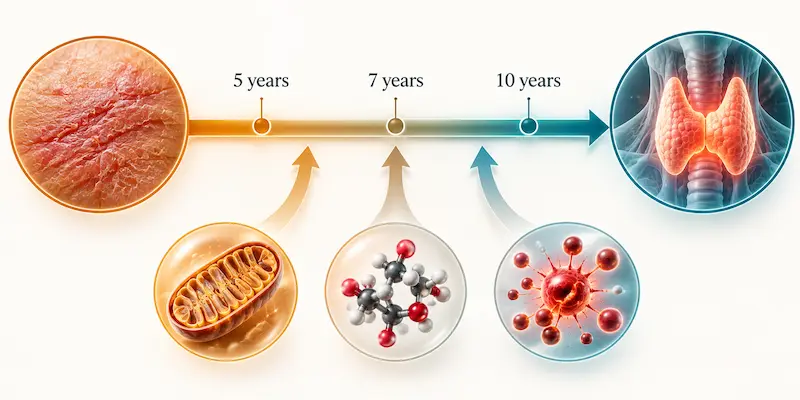
The research confirms what I see clinically. A 2023 case-control study published in the Journal of the American Academy of Dermatology found that patients with atopic dermatitis had more than three times the odds of Hashimoto’s thyroiditis compared to those without AD (OR 3.04, 95% CI 2.17–4.25). That association was confirmed at scale in a 2025 systematic review and meta-analysis of 26 studies involving over 1.6 million atopic dermatitis patients, which found a 44% higher hazard of thyroid dysfunction (HR 1.44, 95% CI 1.24–1.66) — with an even stronger association in children (HR 1.60). And a 2025 retrospective population-level study analyzing over 118 million patient records found that atopic dermatitis produced the strongest association with lichen sclerosus of any atopic condition tested: more than double the odds in females (OR 2.34, 95% CI 2.18–2.51, p<0.0001) and more than triple in males (OR 3.58, 95% CI 2.66–4.83, p<0.0001).
These are not minor co-occurrences. They are epidemiological confirmation of what the immune continuum and progression model predicts: the same dysregulated immune terrain produces more than one condition when given enough time and enough unaddressed upstream load.
This is the clinical implication of understanding eczema as a continuum condition rather than a binary classification: your eczema is not just a skin problem. It is a signal about where your immune system is and where it is headed if the underlying drivers are not addressed.
The Shared Root Causes That Nobody Is Naming
What eczema and autoimmune conditions have in common is not a diagnostic category. What they share is an upstream biological terrain — specific disruptions that create and sustain the immune dysregulation both conditions express. When I see eczema and Hashimoto’s in the same client, I am not looking at two separate problems requiring two treatment plans. I am looking at two expressions of the same disrupted terrain.
The three shared root causes that I find most consistently in both eczema and autoimmune conditions are ones you will not find in any of the mainstream content about this topic:
Mitochondrial Dysfunction
The mitochondria are the cell’s energy-producing organelles, and they are also central to immune regulation. Dysfunctional mitochondria produce excess reactive oxygen species, impair the development of regulatory T cells that function as the immune system’s brake system, and drive the kind of low-grade cellular stress that keeps the immune system in a state of chronic vigilance. Mitochondrial dysfunction is documented in atopic dermatitis and in the autoimmune conditions that most commonly occur alongside it. It is also directly impaired by the toxic burden — heavy metals, mycotoxins, environmental toxins — that I see consistently in the eczema population.
Blood Sugar Dysregulation
Chronically elevated blood sugar activates NF-κB, one of the primary molecular switches for inflammatory gene expression in the immune system. It drives glycation of skin proteins that further impairs barrier function. It reduces immune cell responsiveness to regulatory signals that should dampen ongoing inflammation. And it creates the elevated cortisol environment that simultaneously impairs gut barrier repair and reduces regulatory T cell function. In my practice, I rarely see a chronic eczema case without some degree of blood sugar dysregulation contributing to the inflammatory terrain — and blood sugar instability is an equally consistent driver in the autoimmune conditions that share terrain with eczema.
Oxidative Stress
Excess reactive oxygen species relative to the body’s antioxidant capacity drives both the inflammatory signaling and the tissue damage seen in eczema and autoimmune conditions. It depletes glutathione — the primary antioxidant the body uses to process toxic load — which in turn impairs the detoxification capacity that keeps the immune environment from becoming overwhelmed. And it amplifies the cell danger response: the cellular stress signal that tells the immune system to remain on high alert even when the original threat is no longer present. Oxidative stress is both a consequence of chronic immune activation and a driver of it — a self-amplifying loop that both eczema and autoimmune conditions are sustained within.
These three root causes are the shared substrate. They are why eczema and autoimmune conditions so often coexist in the same person. And they are why addressing them produces benefits for both simultaneously — not because you are treating two conditions, but because you are finally addressing the terrain both conditions grew from.
The Anti-Inflammatory Diet Paradox — and Why Doing Everything Right Can Make It Worse
Of all the things I see in my eczema clients, this is the most counterintuitive: many of them are already doing everything right nutritionally. They are following anti-inflammatory dietary protocols. They are eating clean, avoiding processed food, prioritizing whole foods, vegetables, and what every reputable source describes as an anti-inflammatory diet. And yet the eczema persists. In some cases it is worse.
Here is what is happening.
In a chronically dysregulated immune environment, the immune system’s capacity to distinguish between friend and threat becomes progressively impaired. Foods that are genuinely nutritious — foods that would be anti-inflammatory in a well-regulated immune environment — can be tagged by an overloaded immune system as foreign antigens. Once tagged, every exposure to that food is treated as a threat: stress hormones are released, blood sugar is elevated, the gut lining’s capacity to repair itself is impaired, and the immune system is held in a state of constant surveillance and hyper-vigilance.
The result is a client who is eating a genuinely healthy diet and inadvertently maintaining the very immune activation that is destroying her skin. The foods she is eating to reduce inflammation have become the triggers her immune system is responding to as danger. The harder she works to eat well, the more consistently she is providing the antigenic signal that keeps the immune system on alert.
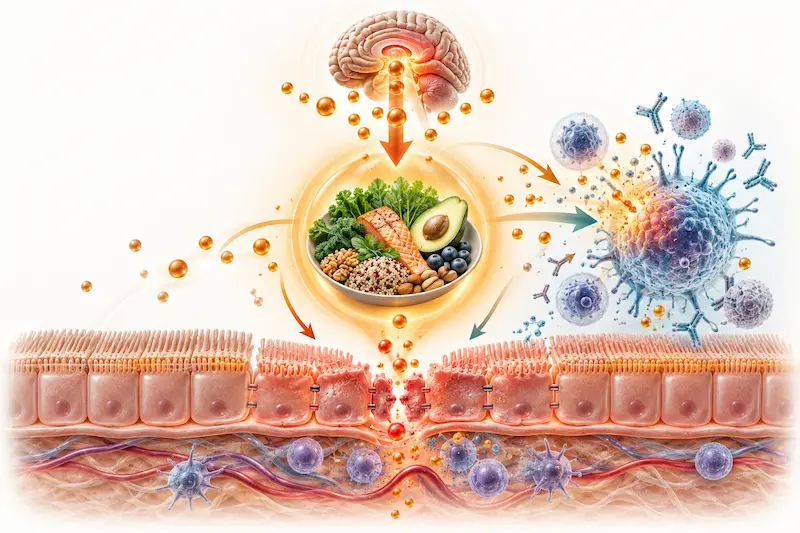
This is not about any specific food being inherently problematic. Any food can become an antigen in a sufficiently dysregulated immune environment — and which foods have been tagged as threats is entirely individual. It depends on the specific history of that person’s immune dysregulation, the integrity of their gut barrier, and the accumulated load their immune system has been managing. Generic elimination diets produce inconsistent results in this population precisely because they are not identifying the individual antigenic load that specific person’s immune system is responding to. And that antigenic load is then amplified by the toxic burden that further compromises both the gut barrier and the immune regulatory capacity that would otherwise help the immune system re-establish tolerance.
What I Look Upstream For: The Three Promoters of Immune Hyper-Vigilance
In every eczema case I work with, the investigation starts with three upstream contributors to chronic immune dysregulation and hyper-vigilance:
Food Sensitivities
As I described above, food sensitivities in the eczema population are not the same as classical food allergies — they are a product of immune dysregulation, not a cause of it, and they perpetuate the immune activation that produced them. Identifying the individual antigenic load through comprehensive food sensitivity testing, rather than generic elimination protocols, is the starting point for removing the input that is maintaining 24/7 immune surveillance.
Toxic Burden
Heavy metals, mycotoxins and environmental toxins are among the most potent promoters of the Th2 immune skewing that characterizes eczema. Mercury directly promotes Th2 cytokine production while simultaneously impairing regulatory T cell function — a dual mechanism that makes it particularly efficient at sustaining the eczema immune pattern. Mycotoxins from mold exposure activate mast cells directly and promote IgE sensitization, extending the range of triggers the immune system reacts to. Both sources also drive mitochondrial dysfunction and oxidative stress — feeding directly into the shared root causes I described above. In clients where the gut picture and nutrient status are being addressed but the immune pattern is not improving as expected, toxic burden is almost always the missing piece.
Dysbiosis
The gut is where the majority of immune regulation happens — roughly 70% of the immune system is gut-associated — and the microbiome composition directly determines the regulatory immune capacity of the entire body. Beneficial bacteria, particularly those that produce short-chain fatty acids like butyrate, drive the induction of intestinal regulatory T cells through pathways that are impaired when those bacterial populations are reduced by dysbiosis. Gram-negative bacterial fragments entering the bloodstream through a compromised gut barrier activate inflammatory signaling that further skews the immune environment toward reactivity. And the gut motility changes that dysbiosis produces impair the clearance of the toxic load that drives oxidative stress and mitochondrial dysfunction. Dysbiosis is not just a gut problem in the eczema population — it is a central driver of the systemic immune environment that eczema requires to persist.
Why Topicals Cannot Reach Any of This
Topical steroids, topical immunomodulators, and biologic medications like dupilumab work by suppressing or modulating the downstream expression of immune dysregulation — the inflammatory signaling and cytokine production that produces the visible skin condition. For some patients, they produce significant and meaningful symptom relief. What they do not do is reach the mitochondrial dysfunction, the blood sugar dysregulation, the oxidative stress, the food sensitivities, the toxic burden, or the dysbiosis that are sustaining the immune environment the skin condition requires to persist.
This is why eczema comes back after steroids. It is why dupilumab produces relief while it is active but does not change the underlying immune regulatory capacity when it is stopped. And it is why, in the case of my client with eczema, Hashimoto’s, and lichen sclerosus, managing each condition’s surface expression with its respective specialist left the shared immune terrain — the actual driver of all three — entirely unaddressed.
The immune environment that produced the eczema is the same environment that is sustaining the Hashimoto’s and the lichen sclerosus. Treating each condition as a separate problem requiring separate suppression is the clinical equivalent of addressing smoke detectors without looking for the fire.
The 5-to-10-Year Window Is an Opportunity — Not a Sentence
The five-to-ten years between immune dysregulation and the development of full autoimmune disease is not a timeline to accept passively. It is a window of opportunity. If your immune system is currently expressing its dysregulation as eczema, you are earlier on the spectrum than Hashimoto’s, or lupus, or rheumatoid arthritis — and the upstream work that prevents the progression is exactly the same work that resolves the eczema.
Addressing the shared root causes — mitochondrial dysfunction, blood sugar dysregulation, oxidative stress — while removing the upstream promoters of immune hyper-vigilance — food sensitivities, toxic burden, dysbiosis — is not two separate treatment goals. It is one investigation with one coherent clinical direction. The skin condition and the autoimmune risk are downstream of the same terrain.
The question that matters is not whether eczema is technically classified as autoimmune. The question is what is sustaining the immune dysregulation you are currently in — and whether you are working on that, or on the surface expression of it.
What a Functional Medicine Investigation Actually Looks Like
In my functional medicine practice, the eczema investigation I run looks directly at the upstream terrain: a comprehensive stool analysis to evaluate microbiome composition and gut barrier integrity, a Total Tox Burden panel to assess heavy metal and mycotoxin load, a full thyroid panel including antibodies (because the epidemiological association between atopic dermatitis and thyroid autoimmunity makes screening clinically warranted), functional nutrient status, and metabolic markers that reflect mitochondrial function and oxidative stress. This is the picture that tells me what is actually sustaining the immune environment — and what needs to change for it to recover.
→ Book your Initial Functional Medicine Health and Skin Assessment
P.S. Flexible payment options available through Cherry — no interest, no credit impact, quick approval. Apply on our website.
Frequently Asked Questions
Is my eczema actually autoimmune?
Not technically — but that distinction may matter less than you think. Eczema is not a classical autoimmune disease: it does not involve the immune system attacking the body’s own tissue the way Hashimoto’s attacks the thyroid or lichen sclerosus attacks mucocutaneous tissue. But eczema and autoimmune conditions share the same underlying immune dysregulation mechanism, the same upstream root causes — mitochondrial dysfunction, blood sugar dysregulation, oxidative stress — and the same progressive trajectory when those causes go unaddressed. The more clinically useful question is not “is this autoimmune?” but “where am I on the immune dysregulation continuum, and what is sustaining the dysregulation I am in?”
Is eczema a sign of immune problems?
Yes — and a specific kind. Eczema is a sign that the immune system is persistently dysregulated in the direction of Th2 dominance and cannot self-regulate out of a reactive state. It is not a sign of a weak immune system; it is a sign of one that has lost its capacity for self-regulation. In practice, I consistently find one or more upstream contributors maintaining that dysregulation — food sensitivities that are keeping the immune system in a state of 24/7 hyper-vigilance, toxic burden from heavy metals, environmental toxins or mycotoxins that are driving Th2 skewing, gut dysbiosis that is impairing the regulatory T cell induction the immune system needs to re-establish balance, or some combination of all three alongside mitochondrial dysfunction and blood sugar instability.
Can eczema lead to other diseases?
Research confirms that people with atopic dermatitis have significantly elevated rates of Hashimoto’s thyroiditis, lichen sclerosus, and other autoimmune conditions. A 2023 JAAD case-control study found that AD patients had more than three times the odds of Hashimoto’s thyroiditis (OR 3.04, 95% CI 2.17-4.25), confirmed by a 2025 meta-analysis of 26 studies and over 1.6 million patients showing a 44% increased hazard of thyroid dysfunction. A separate 2025 population-level study of over 118 million patients found that atopic dermatitis produced the strongest association with lichen sclerosus of any atopic condition: more than double the odds in females (OR 2.34) and more than triple in males (OR 3.58). These are not coincidences. They reflect the shared upstream terrain and shared immune regulatory dysfunction that eczema and these conditions have in common. Eczema developing before these conditions is not separate from them — it is earlier on the same continuum. This is why I include full thyroid antibody screening (TPO-Ab and TG-Ab) in the standard workup for eczema patients, even when thyroid symptoms are not part of the presenting complaint. The five-to-ten-year window between immune dysregulation and established autoimmune disease is the window in which intervention changes the trajectory.
Why won’t my eczema go away?
Because the approach most people are using — topicals, antihistamines, steroids, biologics — addresses the downstream expression of immune dysregulation, not the upstream terrain that is sustaining it. The mitochondrial dysfunction, blood sugar dysregulation, oxidative stress, food sensitivities, toxic burden, and gut dysbiosis that create and maintain the immune environment eczema requires to persist are not reached by any topical or systemic suppressant. Until those upstream contributors are identified and addressed, the immune environment remains in place — and the condition returns regardless of how consistently the surface symptoms are managed. If you have been managing eczema for years and it keeps coming back, the most likely explanation is that the upstream terrain has never been directly investigated.
Do I have autoimmune disease or eczema?
These are not mutually exclusive. Many people have both — eczema alongside Hashimoto’s, lichen sclerosus, vitiligo, or other autoimmune conditions — because they share the same upstream root causes and the same progressive immune dysregulation mechanism. If you have eczema and are wondering whether autoimmune disease may also be developing, a thorough workup is clinically warranted: full thyroid panel including both antibodies, inflammatory markers, and a functional medicine investigation of the shared upstream terrain. I would rather find those markers early — when the five-to-ten-year window is still open — than discover them after the progression has become established.
Can the immune dysfunction in eczema be reversed?
Yes — and the same upstream work that reverses it also reduces the risk of autoimmune progression. The Th2 dominance and regulatory T cell insufficiency driving eczema are sustained by addressable root causes. When gut dysbiosis is addressed and microbiome diversity is restored, regulatory T cell induction improves. When toxic burden is reduced, the Th2 skewing from mercury and mycotoxin exposure decreases. When mitochondrial function and blood sugar regulation are supported, the shared terrain that both eczema and autoimmune conditions grow from becomes less hospitable to chronic immune dysregulation. This process takes time — meaningful immune regulatory restoration typically requires three to six months of consistent upstream work — but it produces resolution rather than management, and it addresses the autoimmune risk at the same time. This is the outcome I work toward in my functional medicine eczema program.
If you have been managing eczema for months or years and the question you keep coming back to is why — why does it keep returning, why isn’t the treatment working, why does it feel like something deeper is going on — that instinct is worth trusting. Eczema that persists despite consistent management is an immune system telling you that the upstream terrain has not been addressed. I work with clients on exactly that investigation: the gut environment, the toxic load, the mitochondrial and metabolic picture, and the immune history that explains where the dysregulation started. If you are ready to look upstream, I would like to help.
→ Book your Initial Functional Medicine Health and Skin Assessment
Written by Natalie Maibenko – a Certified Functional Medicine Practitioner and Master Esthetician with 23+ years of experience and founder of Unique Verve

As a Certified Functional Medicine Practitioner my Expertise Encompasses:
- Immune System: frequent illness, UTIs, yeast infections
- Allergies, Asthma
- Skin Problems: acne, cystic acne, rosacea, eczema, dermatitis, ichthyosis, psoriasis, vitiligo, melasma
- Inflammation: arthritis, rhinitis, joint & muscle pain, migraines, headaches
- Sleep Disturbunces, Insomnia
- Gut Problems: IBS/IBD, bloating, acid reflux, gas, constipation, diarrhea, parasites, fungal/yeast overgrowths
- Hormonal Imbalances: PCOS, PMS symptoms, weight problems/inability to lose weight, thyroid problems
- Hair Loss, Alopecia
- Mood Imbalances: anxiety, depression, irritability
- Metabolic Dysfunction, Insulin Resistance, Type 2 Diabetes
- Optimizing Wellness for Successful Pregnancy
- Autoimmune Conditions: Hashimoto’s thyroiditis, grave’s disease, reumatoid arthritis (RA), lupus, etc
- Bone Health: osteopenia/ osteoporosis
- Effective Anti-Aging Strategies without Injectables with the inside-out & outside-in approach
- Detoxification of Heavy Metals, Mycotoxins, Environmental Toxins
- Reversing Breast Implant Illness
- Preparation for the Explant Surgery and Optimization of Wellness & Vitality Post-Explant
