
Can stress cause eczema? Yes — but how stress causes eczema is a question most people never get a satisfying answer to — and that gap matters clinically. If you’ve ever managed your stress, gotten through a hard season, and still found yourself flaring, the explanation isn’t that you need to relax more. There’s a deeper mechanism at work.

As a functional medicine practitioner, I get asked can stress cause eczema almost every week — and the honest answer is yes, but the mechanism runs far deeper than most explanations go. What I look for isn’t just whether stress is present — it’s whether the body’s stress response system has become dysregulated in a way that keeps the immune system in a chronic state of activation, long after the stressor itself has passed.
What Happens in Your Body When You’re Under Stress
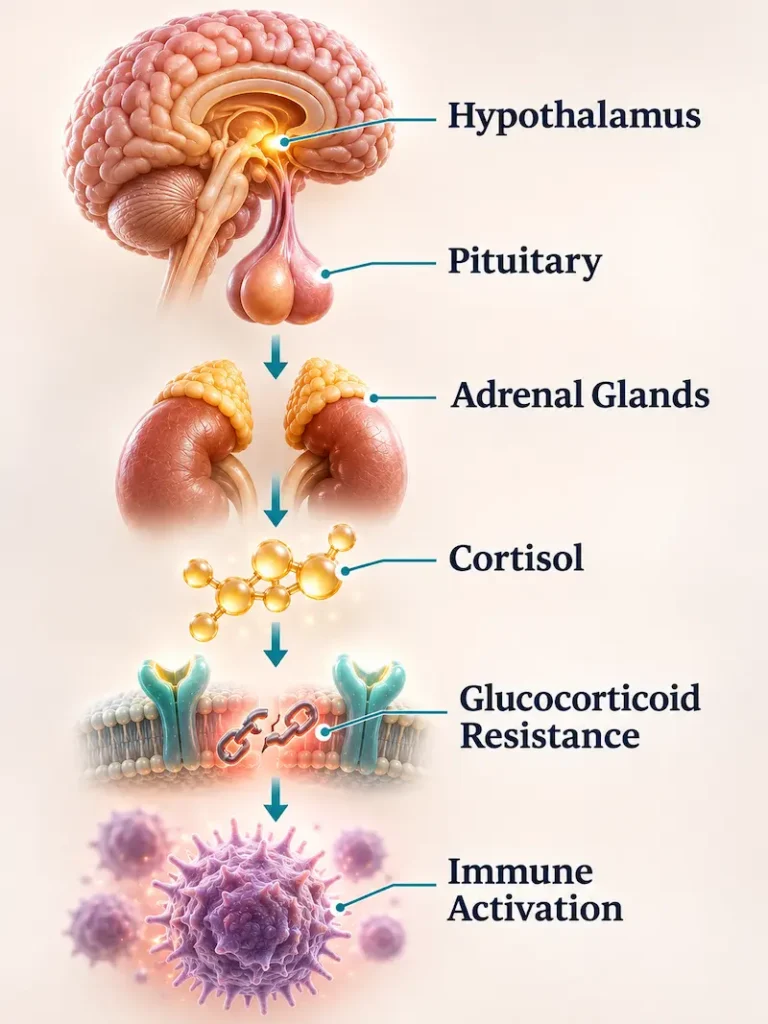
When the brain perceives a threat — a deadline, a conflict, a period of poor sleep, or even ongoing physical strain — it activates a cascade through the hypothalamic-pituitary-adrenal (HPA) axis. The hypothalamus signals the pituitary gland, which signals the adrenal glands to release cortisol.
Cortisol’s role, in theory, is anti-inflammatory. It’s designed to act as a brake on immune activation once the threat has passed. But one of the earliest things stress triggers is the release of pro-inflammatory immune messengers called cytokines — including interleukin-6 (IL-6), which has been shown to be significantly elevated in patients with atopic dermatitis. Research has found that IL-6 levels rise with disease severity — the more active the eczema, the higher the IL-6.
In acute, short-term stress, this is a manageable and reversible process. The cytokine load spikes, cortisol rises to counter it, and the system restores balance. The problem begins when stress becomes chronic. This is the more precise answer to can stress cause eczema: not a single cortisol spike, but a cascade that compounds over months.
Why More Cortisol Doesn’t Always Mean Less Inflammation
Here is where the mechanism becomes more nuanced — and where the conventional explanation of stress-triggered eczema falls short.
With ongoing psychological or physiological stress, the HPA axis undergoes a gradual shift. Cells that regulate inflammation are constantly exposed to cortisol signals. Over time, they begin to downregulate their cortisol receptors — a process called glucocorticoid resistance. The cells become less responsive to cortisol’s anti-inflammatory message.
Research on the HPA axis in atopic dermatitis confirms that AD patients already show an attenuated glucocorticoid response — their cortisol levels rise less than expected under stress, and the regulatory capacity of the system is reduced. The immune system, deprived of cortisol’s modulating signal, gets stuck in an activated state. Inflammatory cytokines continue circulating. The skin barrier, which depends on a regulated immune environment to maintain itself, begins to break down.
This is why many patients tell me: “I’ve dealt with the stress. I changed jobs. I’m sleeping. Why am I still flaring?” The stressor may be gone, but the HPA axis dysregulation it created can persist. The system needs more than the absence of stress — it needs active restoration.
Research: AD patients demonstrate blunted glucocorticoid rise in response to stressors compared with healthy controls. A chronic Th2-dominant cytokine profile — characteristic of atopic dermatitis — may act as negative feedback that further suppresses HPA responsiveness. Prolonged stress is associated with impaired skin barrier recovery and weakened innate immunity.
The Cortisol-Cortisone Paradox
One of the most common questions I hear from eczema patients is: “If cortisol triggers my eczema, why does cortisone cream fix it? Aren’t they the same thing?”
It’s a genuinely good question, and the distinction is important.
The problem in chronic stress isn’t excess cortisol per se — it’s that the regulatory system using cortisol has broken down. Cells are no longer responding to cortisol’s signal as they should. The brake isn’t working.
Topical cortisone (a synthetic glucocorticoid) works by binding directly to glucocorticoid receptors in high concentrations, bypassing the systemic signaling problem and suppressing the local immune response in the skin — blocking the release of pro-inflammatory chemicals at the tissue level.
But this suppression has a cost. Both chronic psychological stress and chronic corticosteroid use — through different pathways — can leave the immune system in a vulnerable state: more susceptible to infection, less able to maintain healthy microbial balance on the skin, slower to repair the barrier, and in some cases contributing to altered thyroid function.
This is part of why steroid dependency cycles develop. The suppression relieves the flare temporarily, but without addressing the underlying immune and HPA dysregulation, the inflammatory pressure remains — and often rebounds when the steroid is withdrawn.
What Chronic Stress Does to the Skin: Beyond Inflammation
The effects of ongoing HPA axis dysregulation extend well beyond the inflammatory cascade. In clinical practice, chronic stress in eczema patients is associated with a cluster of downstream effects:
- Barrier dysfunction. Elevated or dysregulated cortisol impairs the production of ceramides and other lipids that maintain the skin’s water barrier, increasing transepidermal water loss and allowing allergens and irritants to penetrate more easily.
- Microbiome disruption. A dysregulated immune environment reduces antimicrobial peptide production, creating conditions where Staphylococcus aureus can colonize and overgrow — worsening both inflammation and barrier breakdown.
- Innate immune suppression. Downregulation of innate immune function is a recognized feature of the pathophysiology of atopic dermatitis, creating a vulnerable skin environment. Chronic stress compounds this by further blunting the pathways that would normally defend the barrier against microbial threat.
- Thyroid interference. Sustained corticosteroid exposure — both endogenous (from prolonged stress) and exogenous (from topical or oral steroid use) — can suppress TSH and interfere with peripheral thyroid hormone conversion. Low thyroid function is associated with slower skin cell turnover and impaired barrier repair.
The Vagus Nerve: A Functional Medicine Approach to the Stress-Skin Cycle
Conventional care addresses the stress-eczema connection with two tools: topical steroids for the flare, and general advice to manage stress for prevention. Functional medicine looks at a different lever — the vagus nerve.
The vagus nerve is the longest cranial nerve in the body and the primary driver of the parasympathetic nervous system — the “rest and digest” counterpart to the stress-driven fight-or-flight response. It plays a central role in innate immune regulation through the cholinergic anti-inflammatory pathway: when the vagus nerve sends acetylcholine signals, those signals suppress pro-inflammatory cytokine production and modulate immune activation at the tissue level.
In a person under chronic stress, vagal tone is typically poor. The parasympathetic brake on immune activation is weak. The body stays primed for threat rather than shifting into repair and regulation mode. This isn’t just metaphorical — vagus nerve stimulation has been shown to significantly attenuate inflammatory markers in models of eczema by acting through precisely this mechanism.
This is why vagus nerve education and activation is where I start with stress-eczema patients — before supplements, before protocol, before anything else. Two foundational supports that directly affect vagal tone:
- Sleep quality. The vagus nerve carries out significant immune regulation and tissue repair signaling during deep sleep stages. Poor sleep — whether from chronic stress, nighttime itching, or HPA dysregulation that disrupts the cortisol rhythm — creates a direct feedback loop that compounds the inflammatory state.
- Magnesium. Magnesium supports parasympathetic nervous system function and vagal tone, and is frequently depleted in chronic stress. It also supports sleep quality and smooth muscle relaxation. Malate forms offer additional benefits in supporting cellular energy production that may be relevant to barrier repair. Low magnesium levels are scientifically linked to increased mast cell activation and histamine release.

What This Means in Practice
Can stress cause eczema? Yes — and it can keep it active long after the original stressor has resolved. That’s the pattern I see clinically, and it’s why stress management alone rarely closes the loop. The investigation has to go deeper.
When a patient comes to me with eczema that tracks stress — flares before events, flares during difficult seasons, or flares that persist long after the stressor has resolved — I’m not asking them to relax more. I’m looking at whether the HPA axis has become chronically dysregulated, which downstream pathways have been most affected, and what functional interventions can help restore the feedback system rather than simply suppress the symptoms.
The goal is to address the immune dysregulation from the inside out — not to manage the surface while the underlying system remains stuck in activation.
If any of this maps to your experience with eczema — if stress is a consistent pattern in your flares, or if you’ve done everything right and still can’t get clear — I’d encourage you to look at the functional picture. There is a way through it.
Can stress cause eczema? Yes — but more precisely, chronic stress changes the terrain in which eczema lives. Managing the stress alone rarely resolves the pattern once HPA axis dysregulation has set in. That’s where functional medicine investigation begins.
→ Book your Initial Functional Medicine Health and Skin Assessment — virtual, nationwide.
Frequently Asked Questions About Can Stress Cause Eczema
Q: Can stress cause eczema?
Yes. Can stress cause eczema in a way that outlasts the stressor itself? That’s what makes this pattern clinically significant. Stress triggers the immune system to release pro-inflammatory cytokines, including IL-6, while simultaneously activating the HPA axis. In chronic stress, the body develops glucocorticoid resistance — cells stop responding to cortisol’s anti-inflammatory signal — leaving the immune system in a sustained activated state that can manifest as eczema or worsen existing atopic dermatitis.
Q: Does cortisol cause eczema to flare?
Cortisol itself is anti-inflammatory. The problem with chronic stress is not that cortisol levels are too high, but that cells become resistant to cortisol’s regulatory signal — a process called glucocorticoid resistance. When this happens, cortisol can no longer act as an effective brake on immune activation, and inflammatory signaling in the skin goes unchecked.
Q: If cortisol triggers eczema, why does cortisone cream help?
This is one of the most common points of confusion. Cortisol and cortisone are related but work differently in this context. The problem in chronic stress is a broken cortisol signaling system. Topical cortisone bypasses that system by applying a synthetic glucocorticoid at high local concentration, directly suppressing inflammation in the skin tissue. It works despite the resistance — temporarily — but does not address the underlying HPA dysregulation.
Q: Why do I still flare even after the stress is gone?
HPA axis dysregulation does not resolve the moment a stressor is removed. Glucocorticoid resistance, blunted cortisol signaling, and the downstream effects on the skin barrier and immune system can persist for weeks or longer. Recovering from chronic stress requires active restoration of nervous system and immune regulation — not just removal of the stressor.
Q: Can anxiety cause eczema the same way acute stress does?
Anxiety functions as a sustained low-grade stress signal rather than an acute spike, which in some ways makes it more relevant to the chronic stress mechanism described here. The HPA axis remains partially activated, vagal tone is typically low, and the immune system does not fully shift into repair and regulatory mode. This creates a persistent background condition that can drive eczema flares even without a single identifiable stressful event.
Q: What does the vagus nerve have to do with eczema?
The vagus nerve is the primary driver of the parasympathetic nervous system and plays a direct role in regulating innate immune function. Through the cholinergic anti-inflammatory pathway, vagus nerve signals suppress pro-inflammatory cytokine production. Poor vagal tone — common in chronic stress — weakens this immune brake and contributes to the sustained inflammatory state seen in atopic dermatitis.
Q: Can relaxation techniques actually reduce eczema?
Practices that improve vagal tone — including diaphragmatic breathing, yoga, cold water exposure, humming, and consistent sleep — have measurable effects on the parasympathetic nervous system and may reduce the background inflammatory load that contributes to eczema. Relaxation alone is rarely sufficient to resolve eczema driven by HPA dysregulation, but it is a meaningful part of a functional approach that also addresses sleep, nutrition, and immune support.
