
Introduction: Why Seasonal Allergies Make Skin Worse
Why seasonal allergies make skin worse is one of the most common questions I hear every spring. The pattern is consistent: someone comes in frustrated — their allergies are worse than ever, and so is their skin. Their rosacea is flaring. Their eczema is angrier. Their acne is breaking out in places it usually doesn’t. And they want to know: why now? Why both at once?
It isn’t a coincidence. Seasonal allergies and inflammatory skin conditions like rosacea, eczema, contact dermatitis, and acne share the same root-cause terrain: an overloaded immune system, a permeable gut, a burdened liver, and chronic low-grade inflammation that was already simmering before pollen season arrived.
Spring doesn’t cause these conditions. It exposes them. And that distinction matters enormously for how we respond.
In this post, I’m going to walk you through the clinical picture of why these conditions converge seasonally, what’s happening at the cellular and immune level when they do, and how a targeted functional medicine approach — rather than another antihistamine or topical cream — addresses the shared upstream drivers.
The Shared Root: Why Allergies and Skin Flares Are the Same Problem
Conventional medicine treats allergies and skin conditions as a respiratory and sinus issue, and inflammatory skin conditions as dermatological problems. They’re managed by different specialists using different drugs. But at the biochemical level, they are expressions of the same underlying dysfunction.
Here’s what they have in common:
1. Immune Dysregulation — The Th2 Dominance Problem
Both seasonal allergies and inflammatory skin conditions involve a shift in immune balance — specifically, a dominance of what’s called Th2 immunity. Th2-dominant immune states favor the production of immunoglobulin E (IgE) antibodies and drive mast cell activation and histamine release. This is what produces sneezing, runny nose, itchy eyes — and also flushing, hives, itching, and reactive skin.
When your immune system is already running in this Th2-skewed pattern, any additional trigger — pollen, a food, a chemical and/or toxic exposure, stress — can push it over threshold. This is why spring can simultaneously worsen your sinus symptoms and your skin.
2. Histamine Overload — The Bucket That’s Already Full
Histamine is produced not only by immune cells responding to allergens, but also by gut bacteria, certain foods, and in response to estrogen fluctuation. This chronic elevation — sometimes called histamine intolerance — means that many of my clients who struggle most with spring allergies and skin flares are walking around with a histamine bucket that is nearly full before allergy season even begins.
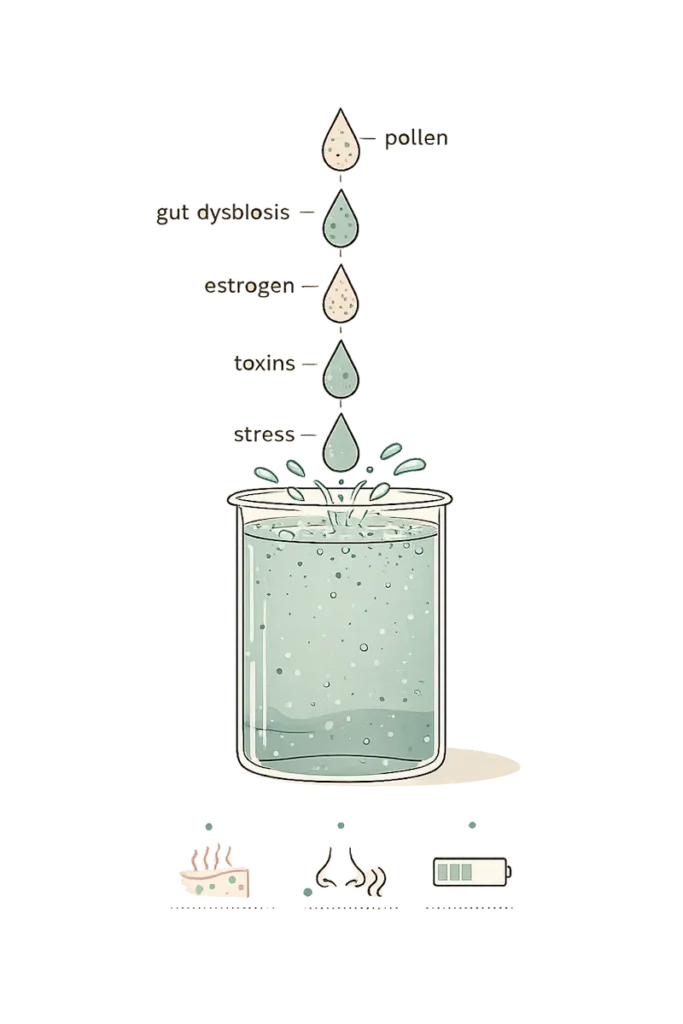
If your gut microbiome is imbalanced, your DAO enzyme (the one that breaks down histamine) is compromised. If your liver is sluggish and not clearing histamine and excess estrogen efficiently, the burden compounds. By the time pollen hits, even a small additional load overflows the bucket — producing symptoms across multiple systems simultaneously.
This is why antihistamines provide only partial, temporary relief. They block one receptor. They don’t empty the bucket. And for people with histamine intolerance, skin conditions like rosacea, eczema, and acne are often the most visible sign that the bucket has overflowed.
3. Leaky Gut — The Gateway to Systemic Inflammation
Intestinal permeability — commonly called leaky gut — is a foundational driver of both allergic conditions and inflammatory skin disease. When the tight junctions of the gut lining are compromised, partially digested food particles, bacterial endotoxins, and environmental chemicals enter the bloodstream and trigger an immune response.
This systemic immune activation increases baseline inflammation throughout the body — including in the skin. Research on the gut-skin axis and seasonal allergies has consistently shown that individuals with rosacea, eczema, psoriasis, and acne have significantly higher rates of gut dysbiosis and intestinal permeability than healthy controls.
Spring often coincides with post-winter gut stress: months of heavier foods, potential alcohol increase, disrupted sleep, and reduced sunlight have already compromised the gut lining. Then allergen season arrives.
4. Liver Burden — The Detox Bottleneck
Your liver is responsible for processing and eliminating histamine, excess estrogen, environmental toxins, and inflammatory metabolites. When it is under burden — from accumulated chemical exposures, sluggish Phase II detoxification pathways, or nutritional cofactor deficiencies — these compounds recirculate rather than being cleared.
Excess estrogen, in particular, both worsens histamine responses (estrogen upregulates mast cell activity) and drives inflammatory skin conditions. This is one of the reasons conditions like rosacea, eczema, and hormonal acne often spike in spring for women in perimenopause, when estrogen fluctuation is already significant.
5. Toxic Load — The Invisible Trigger
Environmental toxins — heavy metals, mycotoxins, phthalates, glyphosate, BPA, VOCs — accumulate in tissue over time and dysregulate immune function, impair mitochondrial energy production, and burden liver detox pathways. They don’t announce themselves. They create a state of chronic immune activation and oxidative stress that makes every other trigger hit harder.
When I run Total Tox Burden testing on clients who are struggling with persistent seasonal symptoms and inflammatory skin conditions, the results are rarely surprising: mycotoxin burden, heavy metal accumulation, and endocrine disruptor exposure are almost invariably elevated.
What This Looks Like by Skin Condition
Rosacea
Rosacea is driven by neurovascular reactivity, mast cell activation, and immune dysregulation — all of which are amplified in a high-histamine, high-inflammation state. The TRPV1 nerve pathway that produces flushing is exquisitely sensitive to histamine. This is the core mechanism behind why rosacea gets worse in spring: allergen exposure increases histamine burden, and histamine directly triggers flushing and reactivity. Allergies making rosacea worse is not an isolated observation — it is a predictable biochemical outcome. Add the vasodilating effects of pollen and mold, and the compounding is significant.
Gut dysbiosis — especially H. pylori and SIBO — has been consistently linked to rosacea in research, further connecting the gut-immune pathway to what appears to be a purely vascular skin condition.
Eczema
Eczema (atopic dermatitis) is one of the most clearly immune-mediated skin conditions, and the eczema flare allergy season pattern is well established clinically. What is less commonly discussed is the role of gut permeability: when the intestinal barrier is compromised, systemic inflammation increases, mast cell activation becomes more widespread, and eczema flares become both more frequent and more severe. Environmental toxins and heavy metal burden further impair the skin barrier function that eczema patients already struggle with.
Contact Dermatitis
Understanding why seasonal allergies make skin worse becomes especially clear with contact dermatitis. Both allergic and irritant contact dermatitis become more reactive in high-immune-activation states. When baseline inflammation is elevated and the skin barrier is compromised, the threshold for reaction to topical irritants, fragrances, metals, and environmental chemicals drops significantly. Spring cleaning products, gardening exposures, and shifting skincare routines often trigger contact dermatitis precisely because the immune system is already on high alert.
Acne
The connection between acne and seasonal allergen exposure is less intuitive, but clinically significant. Histamine stimulates sebaceous glands and increases sebum production. Elevated androgens — which are often driven by insulin resistance, cortisol dysregulation, and impaired liver clearance — increase in periods of immune stress. The inflammatory cascade that allergen exposure triggers also aggravates the micro-inflammatory environment at the follicular level that drives comedonal and inflammatory acne.
Women using spironolactone for hormonal acne often notice spring flares regardless — because the drug manages one hormonal pathway without addressing the gut, liver, and immune upstream drivers that spring stress amplifies.
The Functional Medicine Approach: Addressing the Shared Root
The clinical goal is not to suppress symptoms across each condition independently. It is to reduce the total burden on the immune system, restore gut barrier integrity, support liver detox pathways, and lower systemic inflammation — so the threshold for triggering is raised across all conditions simultaneously.
This is what a functional medicine seasonal allergies root-cause approach achieves that antihistamines, topical steroids, and symptom-directed medications cannot.
In my practice, the core interventions for the spring allergy and inflammatory skin convergence include:
- Restoring gut barrier integrity through targeted anti-inflammatory, gut-healing nutrition and specific mucosal support supplements
- Supporting liver Phase I and Phase II as well as gut Phase III detoxification to clear histamine, excess estrogen, and environmental toxin load
- Rebalancing the gut microbiome to improve DAO enzyme activity and reduce histamine-producing bacteria
- Reducing total toxic burden — particularly mycotoxins, heavy metals, and endocrine disruptors — that dysregulate immune function at baseline
- Addressing nutrient cofactor deficiencies (B vitamins, zinc, magnesium, quercetin) that impair histamine metabolism and skin barrier function
- Calming mast cell reactivity through dietary and supplement protocols rather than pharmacological blockade
The 9-Day Functional Medicine Detox: A Clinical Reset for Spring
My 9-Day Cellular Detox Program was designed around exactly this framework. It’s the same protocol I use with functional medicine clients to address the upstream drivers of chronic symptoms — and for many people, spring is the most clinically impactful time to run it.
The program targets:
- Toxic load reduction — including heavy metals, mycotoxins, endocrine disruptors, phthalates, glyphosate, BPA, and VOCs
- Liver detox pathway support — both Phase I and Phase II, with specific nutritional cofactors
- Hepatic-biliary tree and gut Phase III support with specific nutritional cofactors
- Gut microbiome and barrier restoration
- Blood sugar and insulin regulation (a driver of inflammatory acne, eczema, dermatitis, psoriasis, rosacea)
- Systemic anti-inflammatory reset
- Mitochondrial support and energy restoration
It is not a juice cleanse. It is a science-backed, clinically structured protocol using pharmaceutical-grade supplements — the same approach that has produced measurable reductions in mycotoxins, heavy metals, and endocrine disruptors on Total Tox Burden testing, and visible skin improvements confirmed by VISIA Skin Scanner analysis.
| What clients report after completing the program: “I’ve never seen my skin so clear and glowing.” — M. Palienko, verified buyer “Breakouts disappeared, zero bloating, consistent digestion, improved mood, and steady energy.” — Allegra Mondillo, verified buyer “My brain fog lifted, my anxiety and moodiness went away… my eyes and skin became brighter.” — Elizabeth V., verified buyer “My skin texture and pores had a big improvement… I am definitely going to do this again.” — Cfulk4, verified buyer |
If you’ve been wondering why seasonal allergies make skin worse every year, this is the answer — and the reset. Your body is telling you it is carrying too much. The 9-Day Detox is designed to reset that burden in a clinically meaningful, measurable way.
→ Learn more and enroll in the 9-Day Functional Medicine Detox Program
The Bottom Line: Why Seasonal Allergies Make Skin Worse
Now you know why seasonal allergies make skin worse — and it has nothing to do with bad luck. Seasonal allergies and inflammatory skin flares arising at the same time are not two separate problems requiring two separate treatments. They are two expressions of the same underlying immune and detox burden, surfacing because your threshold has been reached.
A functional medicine approach asks why that threshold is so low — and what can be done to raise it. The answer almost always involves the gut health, the liver, the toxic load, and the immune reset.
Understanding why seasonal allergies make skin worse is the first step toward addressing both at the root rather than managing them season after season. Spring is an excellent time to do this work. Not because you should wait for symptoms to start — but because the seasonal timing creates both the clinical urgency and the motivation to reset.
Frequently Asked Questions about Why Seasonal Allergies Make Skin Worse
Why do seasonal allergies make skin worse?
Seasonal allergies make your skin worse because they share the same root causes: histamine overload, immune dysregulation, gut permeability, and liver burden. When allergen exposure increases histamine in spring, it doesn’t just trigger nasal symptoms — it also activates mast cells in the skin, drives flushing in rosacea, worsens eczema flares, and increases sebum production in acne-prone skin. The immune system and the skin are responding to the same internal burden simultaneously.
Why does rosacea get worse in allergy season?
Rosacea gets worse in allergy season because histamine directly activates the TRPV1 nerve pathway responsible for flushing and facial reactivity. When allergen exposure increases histamine burden in spring, rosacea patients — who already tend toward Th2-dominant immune patterns and mast cell hyperreactivity — experience a predictable amplification of flushing, redness, and inflammation. Addressing histamine load and gut dysbiosis at the root is more effective than managing flares topically.
Can allergies cause eczema flares?
Yes. Seasonal allergens increase systemic IgE production and mast cell activation, both of which directly worsen eczema. When gut permeability is also present — which is common in eczema patients — the inflammatory load compounds further. Spring is one of the most common times for eczema flares precisely because the immune system is already under heightened allergen stress, lowering the threshold for skin reactivity across the board.
What is the connection between histamine intolerance and skin conditions?
Histamine intolerance occurs when the body produces or ingests more histamine than it can break down — typically due to impaired DAO enzyme function driven by gut dysbiosis or nutritional deficiencies. In the skin, excess histamine triggers mast cell activation, increases vascular permeability, and drives the inflammation underlying rosacea, eczema, contact dermatitis, and acne. Reducing histamine load through gut restoration and liver support is a central part of the functional medicine approach to inflammatory skin conditions.
Why do antihistamines not fully clear my skin during allergy season?
Antihistamines block one histamine receptor. They do not address the gut dysbiosis that impairs histamine breakdown, the liver burden that slows clearance, the accumulated toxic load that dysregulates immune function, or the intestinal permeability that drives systemic inflammation. For people whose skin worsens with allergies, this is why topical and pharmaceutical treatments provide only partial, temporary relief — the upstream drivers remain unaddressed.
What role does gut health play in allergies?
Approximately 70–80% of the immune system resides in the gut, which makes gut health one of the most significant — and most overlooked — factors in both seasonal allergies and inflammatory skin conditions. When the gut microbiome is imbalanced, beneficial bacteria that produce DAO enzyme (which breaks down histamine) are reduced, histamine-producing bacteria increase, and the gut lining becomes more permeable. This allows inflammatory compounds to enter the bloodstream and amplify immune reactivity throughout the body, including in the skin. Restoring the gut is not just a digestive intervention — it is an immune intervention.
What is a low histamine diet and does it help with allergies?
A low histamine diet reduces intake of foods that are naturally high in histamine — including aged cheeses, fermented foods, alcohol, processed meats, vinegar, and certain fish — as well as foods that trigger histamine release, such as citrus, tomatoes, and strawberries. For people whose histamine bucket is already full from gut dysbiosis, seasonal allergen exposure, and estrogen fluctuation, reducing dietary histamine load can meaningfully reduce both allergy symptom severity and inflammatory skin flares. It is most effective as part of a broader protocol that addresses gut repair and liver detox pathways, rather than as a standalone dietary restriction.
Can chronic inflammation lead to more allergies?
Yes — and this is one of the most clinically important patterns I see. Chronic low-grade inflammation progressively lowers the immune threshold, meaning the immune system becomes reactive to triggers it previously tolerated. This is why allergies often compound over time: someone who was mildly allergic to pollen begins reacting to foods, fragrances, or chemicals they never had issues with before. The underlying driver is not exposure — it is an immune system that has been under sustained burden for too long. Reducing total inflammatory load is the only way to genuinely raise that threshold back up.
Can functional medicine treat allergies differently?
Yes. Conventional allergy treatment focuses on managing the immune response — suppressing histamine, reducing inflammation, or desensitizing via immunotherapy. Functional medicine asks why the immune system became dysregulated in the first place. The investigation typically includes gut microbiome analysis, intestinal permeability markers, toxic burden testing (heavy metals, mycotoxins, endocrine disruptors), hormone metabolism, and nutrient cofactor assessment. When the underlying drivers are identified and addressed, many clients see significant and lasting reduction in both allergy symptoms and inflammatory skin conditions — not because the allergy was suppressed, but because the immune system was restored. If you’d like to explore this approach, you can book an Initial Functional Medicine Health and Skin Assessment to understand what is driving your specific pattern.
Written by Natalie Maibenko – a Certified Functional Medicine Practitioner and Master Esthetician with 22+ years of experience and founder of Unique Verve

As a Certified Functional Medicine Practitioner my Expertise Encompasses:
- Immune System: frequent illness, UTIs, yeast infections
- Allergies, Asthma
- Skin Problems: acne, cystic acne, rosacea, eczema, dermatitis, ichthyosis, psoriasis, vitiligo, melasma
- Inflammation: arthritis, rhinitis, joint & muscle pain, migraines, headaches
- Sleep Disturbunces, Insomnia
- Gut Problems: IBS/IBD, bloating, acid reflux, gas, constipation, diarrhea, parasites, fungal/yeast overgrowths
- Hormonal Imbalances: PCOS, PMS symptoms, weight problems/inability to lose weight, thyroid problems
- Hair Loss, Alopecia
- Mood Imbalances: anxiety, depression, irritability
- Metabolic Dysfunction, Insulin Resistance, Type 2 Diabetes
- Optimizing Wellness for Successful Pregnancy
- Autoimmune Conditions: Hashimoto’s thyroiditis, grave’s disease, reumatoid arthritis (RA), lupus, etc
- Bone Health: osteopenia/ osteoporosis
- Effective Anti-Aging Strategies without Injectables with the inside-out & outside-in approach
- Detoxification of Heavy Metals, Mycotoxins, Environmental Toxins
- Reversing Breast Implant Illness
- Preparation for the Explant Surgery and Optimization of Wellness & Vitality Post-Explant
With love and gratitude,
Natalie Maibenko
Functional Medicine & Skincare Expert – Helping You Take Control of Your Health and Achieve Lasting Skin Results Nationwide — Virtual Practice
Disclaimer: Information and content on this website is provided for educational purposes only, and is not intended to diagnose, treat and to be a substitute for the advice provided by your physician or other healthcare professional. No information offered here should be interpreted as a diagnosis of any disease, nor an attempt to treat or prevent or cure any disease or condition. If you have any concerns or questions about your health, you should always consult with a physician or other healthcare professional. Do not disregard, avoid, or delay obtaining medical or health-related advice from your healthcare professional. Always speak with your healthcare professional before taking any medications, supplements or pursuing any wellness programs. Information provided on this website does not create a doctor-patient relationship between you and any professional affiliated with this website.
