
Introduction
Why does my eczema keep coming back? If you have asked this question — after the steroid cream worked and then stopped working, after the course of antibiotics cleared it and then it returned, after the ointments helped temporarily and then the skin flared worse than before — the most important thing to understand is this: eczema coming back is not a failure of your skin. It is a predictable consequence of treating the downstream expression of a condition whose upstream cause was never identified or addressed.
Eczema keeps coming back because the internal environment producing it has never changed. The topical treatments that provide temporary relief address what is visible on the surface. They do not touch the gut dysbiosis, the toxic burden, the nutrient insufficiencies, or the immune dysregulation that are sustaining the eczema from within. When treatment stops, the internal environment is unchanged — and the eczema returns. Often more resistant, more widespread, and more difficult to suppress than it was the time before.

This post explains why eczema keeps recurring despite conventional treatment, what the topical treatments are actually doing to the skin barrier over time, and what the functional medicine investigation finds that changes the pattern from perpetual relapse to genuine resolution.
The Steroid Cream That Stops Working
One of the most consistent patterns I see in my functional medicine practice is the patient who tells me that steroid creams worked well when she first started using them. They cleared the eczema quickly. She was relieved. But over time — months, then years — something shifted. The same cream that cleared her skin in a week now takes three weeks. Then it does not clear it completely. Then the eczema comes back faster after each course than it did before. And eventually she is using a stronger steroid, more frequently, for diminishing results.
This pattern is not a coincidence. It has a clinical explanation — and it involves what topical corticosteroids are doing to the skin barrier with every course of use.
Topical steroids reduce inflammation visibly and quickly by suppressing the immune response in the skin. This is genuinely useful in the short term as a triage. The problem is that the same mechanism that suppresses inflammation also inhibits the genes responsible for building and maintaining the skin barrier — the structural proteins and lipid-processing enzymes that produce the acid mantle protecting the skin from external triggers. Research has confirmed that continued steroid use reduces skin barrier function and thins the epidermis compared to healthy controls — and that treating affected skin with potent topical steroids over six months can reduce the stratum corneum thickness by up to 70 percent.
The rebound flare that occurs when steroid treatment is stopped is not the eczema ‘coming back.’ It is the barrier damage accumulated during steroid use becoming visible once the anti-inflammatory suppression is removed. The skin is thinner. The acid mantle is more impaired. The capacity for self-repair is more compromised than it was before treatment began. And the internal drivers producing the eczema have continued to build throughout the entire treatment period, completely untouched.
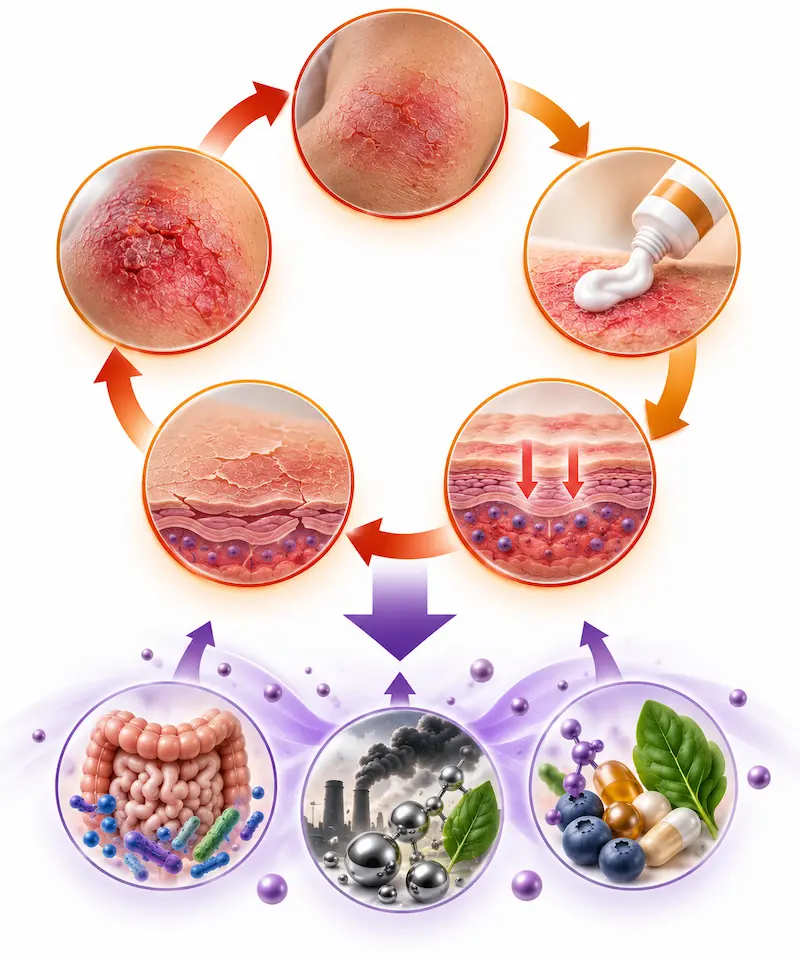
This is why the same steroid cream produces less result over time. It is not that the skin has become pharmacologically tolerant. It is that the skin it is being applied to is progressively more compromised with each course — and the internal environment producing the eczema is progressively more entrenched. The same intervention on a worse baseline produces a lesser outcome.
The Problem With What You Are Putting on Open Skin
There is a second layer to why eczema keeps coming back that is almost never discussed in conventional dermatology: the topical preparations applied to eczema skin — the ointments, creams, and moisturizers recommended alongside or instead of steroids — frequently contain ingredients that further compromise the barrier they are intended to support.
Most topical preparations contain emulsifiers — the compounds that keep oil and water mixed together in a cream or ointment. On healthy intact skin, emulsifiers are largely tolerated. On the open, inflamed, compromised skin of an active eczema flare, the picture is different. Research has confirmed that emulsifiers can be absorbed into the skin’s lipid bilayer through compromised barrier skin, increasing transepidermal water loss and further disrupting the acid mantle architecture that is already impaired in eczema. The skin becomes more permeable. More triggers penetrate. The inflammatory response is amplified rather than resolved.
This is particularly significant because eczema skin — with its already-compromised acid mantle and impaired stratum corneum lipid structure — is significantly more susceptible to emulsifier penetration than healthy skin. The product applied to an open eczema lesion is not behaving the same way it would on intact skin. And the emulsifiers, preservatives, and fragrances that most topical preparations contain are being delivered through a barrier that is actively unable to resist them.
A patient applying a conventional moisturizer or steroid cream to an active eczema flare may be simultaneously suppressing inflammation, impairing barrier repair, and introducing additional irritants through a barrier that is too compromised to exclude them. Each application makes the next application necessary — not because the skin is healing, but because the surface is becoming progressively more dependent on topical management while becoming progressively less capable of maintaining its own protective integrity.
What Years of Topical Management Looks Like — and What Three Months of a Different Approach Produces
A client came to my practice after years of dyshidrotic eczema on her hands. She had used steroid creams and topical ointments throughout — with some success initially, then diminishing returns, then a skin that had become dependent on treatment while never genuinely improving. By the time she arrived at functional medicine, the same treatments that had once provided relief were no longer producing meaningful improvement.
Her functional medicine investigation found the upstream picture that had been driving her eczema throughout those years and that no topical treatment had ever touched: elevated mercury, nickel, and mycotoxin burden on Total Tox Burden testing, active H. Pylori and SIBO in her gut, and genetic variants affecting her ability to utilize vitamin A, zinc, and B vitamins — with suboptimal nutrient levels confirming what her genetics predicted. Her omega-6 to omega-3 ratio was significantly elevated, reflecting the chronic pro-inflammatory internal environment that her skin had been expressing for years.
Three months into her functional medicine program — addressing the toxic burden, restoring the gut microbiome, and repleting the nutrients her skin had been asking for throughout the years of topical management — her hands looked like the image below.
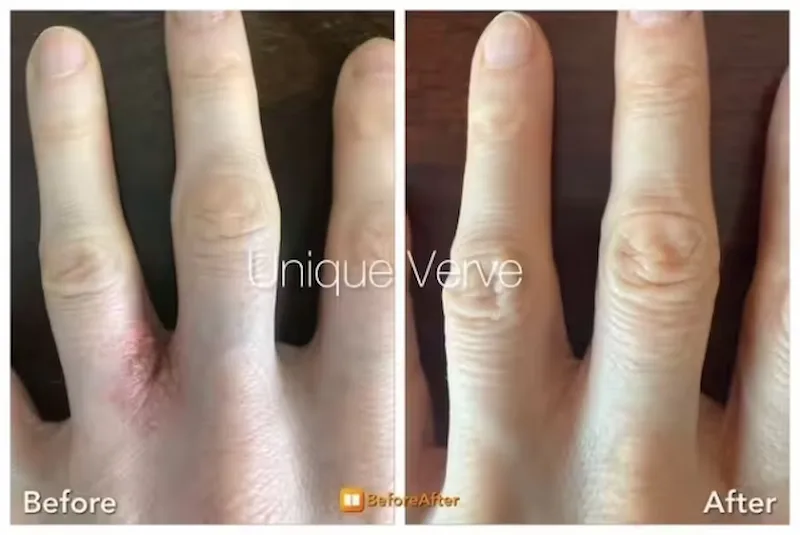
This is not a cosmetic outcome. It is what happens when the internal environment producing the eczema finally changes — when the gut is restored, the toxic burden cleared, and the nutrients the skin has been asking for are finally available at cellular level. The skin did not need a better topical. It needed the upstream investigation that had been missing throughout years of surface management.
Dyshidrotic eczema — the intensely itchy, fluid-filled blisters that appear on the hands and feet — deserves particular mention here. In conventional dermatology, dyshidrotic eczema is typically managed with the same topical steroids and ointments applied to other eczema presentations. What is less commonly investigated is the specific upstream picture that drives this presentation: nickel sensitivity is one of the most consistently documented drivers of dyshidrotic eczema, and it operates through two simultaneous pathways. The first is external contact with nickel-containing objects — jewellery, metal tools, coins. The second is systemic dietary nickel from foods including whole grains, legumes, nuts, seeds, and dark chocolate, which triggers flares from within regardless of external contact avoidance. A patient who avoids nickel jewellery but has elevated systemic nickel burden confirmed on Total Tox Burden testing will continue to flare — because the exposure driving her eczema is internal, not external.
What Is Actually Causing Your Eczema to Keep Coming Back
The answer to why eczema keeps coming back is not in the skin. It is in the internal environment that has been producing the eczema throughout every course of treatment — building, compounding, and progressing behind the scenes while the surface expression was temporarily suppressed.
In functional medicine practice, the upstream picture behind recurrent eczema almost always involves some combination of the following:
Gut Dysbiosis and Bacterial Overgrowth
The gut microbiome is where a significant proportion of immune regulation happens — where the microbial signals that calibrate the immune system’s reactivity are generated, and where the short-chain fatty acids that regulate inflammatory responses are produced. When the gut is dysbiotic — when beneficial bacteria are depleted and pathogenic or opportunistic organisms overgrow — the immune system loses its primary regulatory input and becomes progressively more prone to the hyperreactive responses that eczema expresses. Research confirms that small intestinal bacterial overgrowth is present in up to 24 percent of patients with atopic dermatitis — and that the toxic metabolites SIBO produces increase intestinal permeability, driving systemic immune activation that sustains the eczema from within regardless of what is applied to the surface.
Toxic Burden
Heavy metals, mycotoxins from mold exposure, and environmental chemicals including BPA and glyphosate maintain the immune system in a state of chronic hypervigilance that lowers the threshold for eczema expression. They accumulate slowly, over months and years, and the immune system compensates — until it cannot. In patients with recurrent, treatment-resistant eczema, Total Tox Burden testing almost always reveals a toxic burden that standard dermatological assessment never looks for. Nickel specifically — through both contact and systemic dietary exposure — is one of the most consistent findings in dyshidrotic eczema patients.
Nutrient Insufficiencies
Zinc is essential for skin barrier integrity and immune regulation. Vitamin A — when deficient — has been shown in research to exacerbate atopic dermatitis by potentiating the Th2 immune response and mast cell activation that drive the condition. Magnesium is required for mast cell stabilization and stress hormone clearance. B vitamins are cofactors for the enzymes that degrade histamine. Omega-3 fatty acids are the anti-inflammatory building blocks that barrier repair depends on. When these nutrients are depleted by gut dysbiosis, poor absorption, or genetic variants impairing their conversion and utilization, every upstream driver of eczema is amplified simultaneously. The skin cannot repair what it does not have the materials to repair.

HPA Axis and Stress Dysregulation
Cortisol elevation — from emotional stress, physiological stress from gut dysbiosis and blood sugar instability, or toxic burden maintaining immune hypervigilance — activates mast cells, increases histamine release, worsens gut permeability, and depletes the nutrients that every regulatory system depends on. The stress axis and the eczema picture sustain each other in a cycle that no topical treatment can interrupt, because both the stress axis dysregulation and its downstream skin consequences are entirely internal.
The Pattern I See
Across patients who come to me with recurrent or treatment-resistant eczema — including dyshidrotic eczema that has persisted through years of steroid treatment — the functional medicine investigation almost always reveals the same picture: an internal environment that has been accumulating burden for years, progressively depleting the compensatory capacity that was keeping the eczema partially controlled, until the topical treatments that once worked no longer produce adequate relief and the skin has become more compromised than when treatment began.
The toxins have been building. The gut dysbiosis has been progressing, compounded by each antibiotic course for secondary infections and each steroid-induced microbiome disruption. The nutrients have been depleting, drawn down by the demands of chronic inflammation and impaired absorption. And the HPA axis has been sustaining elevated cortisol in response to physiological stressors that were never identified as such — because nobody investigated the internal picture.
What changes the trajectory is not a better topical. It is the upstream investigation that asks what internal environment has been producing the eczema — and then addresses that environment in the right sequence, with the right support, so that the skin can finally do what it was always capable of doing: heal.
Your Eczema Is Not Coming Back Because It Is Incurable. It Is Coming Back Because the Cause Has Never Been Found.
Eczema that keeps coming back is not a skin condition that needs a stronger topical. It is a systemic signal from a body whose internal burden has never been identified or addressed. The gut, the toxic load, the nutrients, the immune and stress picture — these are the upstream drivers that every course of steroid cream left completely unchanged. The investigation that identifies them, and the restoration that addresses them in the right order and in synergy, is what changes the pattern from indefinite relapse to genuine resolution.
If your eczema keeps coming back despite every topical treatment you have tried, the most important next step is not another prescription. It is the upstream investigation that asks why — what internal environment has been producing the eczema, what has never been identified in any previous clinical appointment, and what that environment needs in order to change.
→ Book your Initial Functional Medicine Health and Skin Assessment
P.S. Flexible payment options available through Cherry — no interest, no credit impact, quick approval. Apply on our website.
Frequently Asked Questions About Why Does My Eczema Keep Coming Back
Q1: Why does my eczema keep coming back after steroids?
Steroid creams suppress the visible inflammation temporarily while inhibiting the genes responsible for building the skin barrier — reducing the structural proteins and lipid-processing enzymes that form the acid mantle. Research confirms that continued steroid use thins the skin barrier significantly over time, and that the flare that returns after stopping steroids reflects the barrier damage accumulated during treatment rather than simply the eczema returning. Meanwhile, the upstream internal drivers — gut dysbiosis, toxic burden, nutrient insufficiencies — continue building throughout every course of steroid treatment, untouched and unaddressed. This is why the same steroid produces less result over time: the skin it is applied to is progressively more compromised, and the internal environment producing the eczema is progressively more entrenched.
Q2: Why does eczema keep coming back in the same spot?
Eczema recurring in the same location typically reflects a combination of localized barrier impairment that has been progressively worsened by repeated steroid courses, and an internal upstream driver that has not been addressed. In dyshidrotic eczema — the blistering eczema that appears on the hands and feet — recurring presentation in the same area often reflects a sustained systemic driver such as nickel burden, mycotoxin exposure, or gut dysbiosis that keeps the immune threshold low enough for the same area to flare repeatedly. The location is where the skin expresses the internal picture. Changing the internal picture changes the pattern.
Q3: Does eczema ever go away permanently?
Eczema managed through topical treatment alone rarely resolves permanently — because the upstream internal environment producing it has not changed. What the functional medicine investigation consistently produces is genuine, lasting improvement in patients who address the gut, toxic burden, thyroid, hormonal, and nutrient picture that was driving the eczema. This is not cure in a pharmaceutical sense — it is resolution of the internal environment that was producing the eczema, alongside the understanding and tools to maintain that environment. When the upstream picture changes, the eczema no longer has the internal conditions it needs to sustain itself.
Q4: Why does my eczema get worse after antibiotics?
Antibiotics prescribed for secondary eczema skin infections disrupt the gut microbiome whose diversity and integrity are already insufficient in most eczema patients. The beneficial bacteria that regulate immune reactivity, produce the short-chain fatty acids that calibrate inflammatory responses, and maintain the intestinal lining integrity that prevents systemic immune activation are depleted with each antibiotic course. The infection clears. The gut dysbiosis worsens. The immune dysregulation that was already driving the eczema deepens. And the next flare arrives in a gut that is more dysbiotic and an immune system that is more reactive than they were before the antibiotic was prescribed.
Q5: Can diet make eczema stop coming back?
Dietary changes — reducing high-histamine foods, eliminating inflammatory triggers, supporting gut microbiome diversity through nutrient-dense whole foods — can meaningfully reduce the frequency and severity of eczema flares. For patients with specific sensitivities such as nickel in dyshidrotic eczema or high-histamine foods in histamine-driven eczema, dietary management is particularly impactful. Diet alone, however, rarely resolves recurrent eczema completely — because dietary changes address one upstream driver while the others continue. The gut dysbiosis, toxic burden, and nutrient insufficiencies that sustain recurrent eczema require the comprehensive upstream investigation that identifies all of the drivers simultaneously and addresses them in the right order and in synergy.
Q6: What is the functional medicine approach to recurrent eczema?
The functional medicine investigation for recurrent eczema begins with the question that conventional dermatology is not designed to ask: what internal environment has been producing this eczema throughout every course of treatment? The investigation examines the gut microbiome (dysbiosis, SIBO, intestinal permeability), toxic burden (heavy metals including mercury and nickel, mycotoxins from mold, environmental chemicals), nutrient status at cellular level (magnesium, zinc, vitamin A, B vitamins, omega-3 fatty acids), thyroid function beyond standard TSH testing, and hormonal and stress hormone picture. When the drivers are identified and addressed in the right order — addressing the gut and toxic burden before focusing on nutrient repletion — the eczema that kept coming back despite every topical treatment often resolves with a completeness and durability that topical management never achieved.

Natalie Maibenko
Functional Medicine & Skincare Expert – Helping You Take Control of Your Health and Achieve Lasting Skin Results Nationwide — Virtual Practice
As a Certified Functional Medicine Practitioner my Expertise Encompasses:
- Immune System: frequent illness, UTIs, yeast infections
- Allergies, Asthma
- Skin Problems: acne, cystic acne, rosacea, eczema, dermatitis, ichthyosis, psoriasis, vitiligo, melasma
- Inflammation: arthritis, rhinitis, joint & muscle pain, migraines, headaches
- Sleep Disturbunces, Insomnia
- Gut Problems: IBS/IBD, bloating, acid reflux, gas, constipation, diarrhea, parasites, fungal/yeast overgrowths
- Hormonal Imbalances: PCOS, PMS symptoms, weight problems/inability to lose weight, thyroid problems
- Hair Loss, Alopecia
- Mood Imbalances: anxiety, depression, irritability
- Metabolic Dysfunction, Insulin Resistance, Type 2 Diabetes
- Optimizing Wellness for Successful Pregnancy
- Autoimmune Conditions: Hashimoto’s thyroiditis, grave’s disease, reumatoid arthritis (RA), lupus, etc
- Bone Health: osteopenia/ osteoporosis
- Effective Anti-Aging Strategies without Injectables with the inside-out & outside-in approach
- Detoxification of Heavy Metals, Mycotoxins, Environmental Toxins
- Reversing Breast Implant Illness
- Preparation for the Explant Surgery and Optimization of Wellness & Vitality Post-Explant
