
Introduction
Why does eczema come back after steroids? If you have been through this cycle — steroid cream clears the eczema, you stop using it, the eczema comes back, you apply the cream again, it works less well this time, you stop, it comes back faster — you are not imagining the pattern. You are experiencing a predictable clinical consequence of what steroid cream is doing to the skin it treats and to the internal environment it never touches.
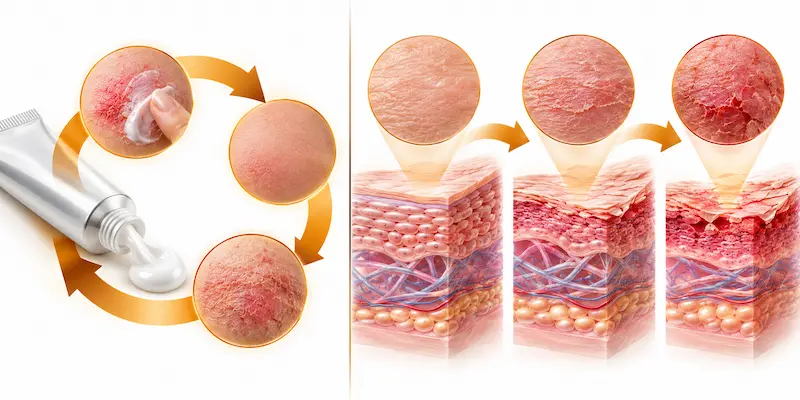
Steroid cream does not treat eczema. It suppresses the visible inflammatory expression of eczema — temporarily, at the surface — while leaving the upstream internal environment that is producing the eczema completely unchanged. And each course of steroid cream leaves the skin more compromised than it was before the first prescription was written. This is the clinical reason the cycle accelerates: the steroid is doing the same pharmacological thing it always did, but the skin it is applied to is progressively worse, and the internal environment producing the eczema is progressively more entrenched.
This post explains the three documented mechanisms that make steroid cream produce diminishing returns over time, why the re-introduction cycle accelerates, and what the functional medicine investigation addresses instead.
What Steroid Cream Is Actually Doing
Topical corticosteroids suppress inflammation by binding to glucocorticoid receptors inside skin cells, reducing the production of the inflammatory cytokines that produce the redness, swelling, and itch of eczema. This is genuinely useful in the short term. The problem is that the same mechanism that suppresses inflammation also inhibits other genes in the same cell — genes that are responsible for building and maintaining the skin barrier that eczema has already compromised.
Research has confirmed that continued topical steroid use inhibits the genes encoding the structural proteins and lipid-processing enzymes that produce the acid mantle and the ceramide-rich stratum corneum that healthy skin depends on for barrier function. The result: six months of potent topical steroid use can reduce stratum corneum thickness by up to 70 percent. The treatment suppresses the inflammation. The same treatment progressively impairs the barrier that the inflammation was damaging.
When the steroid cream is stopped, the inflammatory picture that was suppressed becomes visible again. But the barrier it re-emerges onto is significantly more compromised than it was before treatment began. The rebound flare that appears when steroid cream is discontinued is not simply the eczema returning. It is the accumulated barrier damage of repeated steroid courses becoming visible once the anti-inflammatory suppression is removed — in skin that is thinner, more permeable, and less capable of self-repair than it was at the start of the treatment cycle.
The Three Mechanisms That Make the Cycle Accelerate
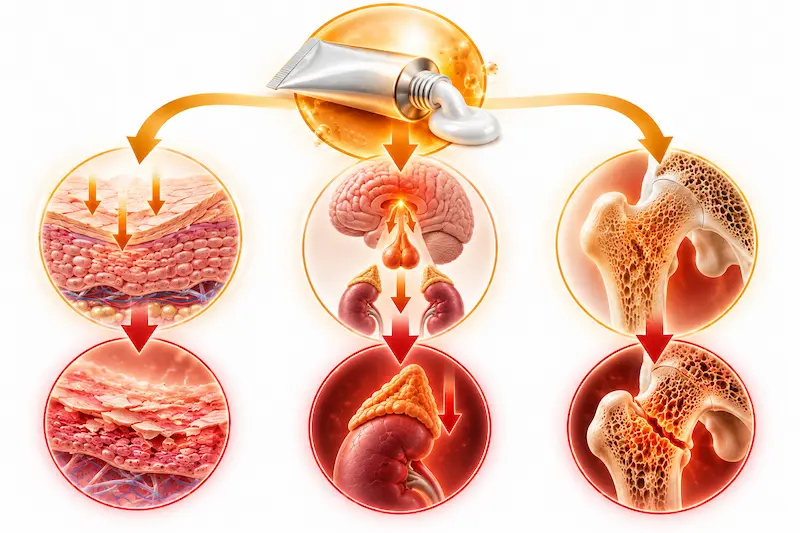
1. Progressive Barrier Damage With Every Course
Each course of steroid cream suppresses inflammation while simultaneously inhibiting barrier-building gene expression. The skin that enters the next course is more compromised than the skin that entered the last one. The barrier is thinner. Transepidermal water loss is higher. The acid mantle — the skin’s protective pH layer — is more impaired. The same steroid cream producing the same pharmacological suppression of inflammation is doing so in progressively more compromised skin. It produces less result each time not because the drug is failing but because the baseline it is treating has worsened with every previous course.
This is the clinical explanation for the pattern most eczema patients recognize: the first course worked quickly and cleared completely. The second course took longer and cleared less completely. The third course produced only partial improvement. The fourth barely moved the dial. At no point did the pharmacological action of the steroid change. What changed was the skin it was applied to.
2. HPA Axis Suppression — Deepening the Stress Dysregulation That Was Already Driving the Eczema
Topical corticosteroids are absorbed through the skin. In healthy intact skin, this absorption is modest. In the inflamed, compromised, barrier-impaired skin of an eczema patient, absorption increases two to tenfold. The systemic cortisol that enters circulation from topical steroid application on large areas of compromised eczema skin is clinically significant — and its consequence is HPA axis suppression.
The HPA axis — the hypothalamic-pituitary-adrenal system responsible for the body’s own cortisol production and stress hormone regulation — is one of the upstream drivers of eczema itself. In many patients, chronic stress, gut dysbiosis, and blood sugar instability maintain cortisol elevation that was already impairing immune regulation and skin barrier repair long before a steroid prescription was written. A treatment that suppresses the HPA axis further through systemic absorption compounds the stress axis dysregulation that was already sustaining the eczema from within. The patient’s own capacity to produce and regulate cortisol appropriately is reduced. The stress axis that was already insufficient becomes more insufficient. The eczema that was driven partly by HPA dysregulation is now treated with something that deepens the HPA dysregulation driving it.
3. Osteoporosis Risk — The Consequence Nobody Discloses
The third mechanism is the one most patients are never informed of. Research published in JAMA Dermatology confirmed that prolonged use of potent topical corticosteroids increases the risk of osteoporosis and major osteoporotic fracture — with a particularly stronger association in women under fifty. A subsequent large-scale study of over 129,000 osteoporosis patients confirmed a clear dose-response relationship: the higher the cumulative topical steroid exposure, the higher the osteoporosis and fracture risk.
Topical corticosteroids interact with bone remodeling through the same glucocorticoid pathway as systemic steroids — reducing osteoblast activity, impairing calcium absorption, and reducing bone mineral density in patients using potent steroids on large body areas over extended periods. This is the bone consequence of a treatment whose skin consequences are already inadequate. And it is occurring in patients who have been told that topical steroids are safe for long-term use, in a patient population — women with chronic eczema — who are precisely the group for whom the osteoporosis risk is most clinically significant.
Why the Re-Introduction Gets Harder Each Time
The cycle of steroid re-introduction — using the cream when the eczema flares, stopping when it clears, restarting when it returns — is not a neutral or stable management approach. It is a progressively worsening one, because each re-introduction occurs on a skin that is more compromised and in an internal environment that is more entrenched than it was at the previous re-introduction.
Behind every course of steroid cream, the gut dysbiosis driving systemic immune activation continues to progress. The toxic burden maintaining immune hypervigilance continues to accumulate. The nutrient insufficiencies depleting the Treg function and barrier repair capacity continue to compound. The HPA axis suppressed by each course continues to impair the stress hormone regulation that was already insufficient. And the skin dysbiosis that eczema produces — the shift toward Staphylococcus aureus dominance in the low-diversity skin microbiome of active eczema — deepens with each course that depletes the commensal populations that were providing the last remaining ecological resistance to S. aureus overgrowth.
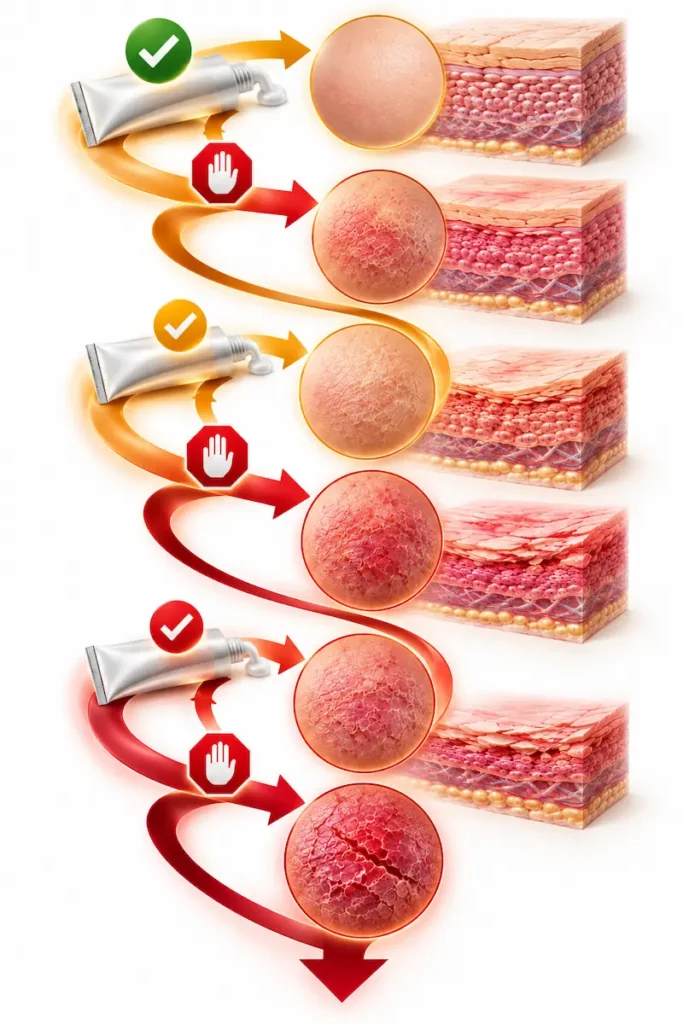
The steroid cream works less on re-introduction not because of pharmacological tolerance. It is because the entire internal and external landscape it is being applied to has worsened throughout every course that preceded it. The course that was most effective was the first one — because it was applied to the least compromised skin and the least entrenched upstream environment. Each subsequent course is fighting a progressively more difficult battle with a tool that is simultaneously contributing to the conditions making the battle harder.
Every course of steroid cream that suppresses the visible inflammation without addressing the internal environment producing it leaves the skin more compromised and the upstream picture more entrenched than it was before. The treatment that was most effective in year one is the same treatment that is least effective in year five — because the five years of intervening courses have compounded precisely the damage that makes it less effective.
What Topical Irritants Are Adding to the Picture
In patients with hand eczema or eczema affecting the hands — the population for whom the steroid re-introduction cycle is most common — there is an additional layer of barrier insult that compounds the steroid-driven damage: the topical irritants of daily hand hygiene.
Research confirms that repeated hand washing with soap and water increases transepidermal water loss and disrupts the skin barrier — with a magnified impact in patients who already have barrier dysfunction from atopic dermatitis. Hand sanitizers with high alcohol content produce similar barrier disruption, denaturing the lipids that form the acid mantle and removing the natural moisturizing factor that the stratum corneum depends on for water retention. For a patient whose skin barrier is already significantly compromised by years of steroid-driven structural protein inhibition, the repeated exposure to soap, hot water, and alcohol-based sanitizers throughout each day is not a minor additional insult. It is a daily mechanical barrier disruption compounding the pharmacological barrier damage of the steroid courses.
The clinical pattern of hand eczema patients who work in environments requiring frequent hand hygiene — healthcare, food service, childcare — reflects this compounding: the steroid cycle produces diminishing returns faster than in patients with eczema in other locations, because the barrier is being damaged by both the treatment and the daily occupational exposures simultaneously, with no interval for the barrier to attempt recovery between them.
What the Functional Medicine Investigation Finds
When a client comes to my practice after years of the steroid re-introduction cycle, the functional medicine investigation almost always finds the same upstream picture that the steroid cream was never designed to touch.
The gut microbiome is consistently dysbiotic — depleted of the commensal diversity that was already insufficient before the first antibiotic course for secondary eczema infections and that has been further compromised by each subsequent course. The skin microbiome reflects this gut picture: reduced microbial diversity, S. aureus overgrowth on the skin surface, the barrier impairment that low-diversity skin ecology produces in the absence of the commensal bacteria that would otherwise provide competitive inhibition against pathobionts.
The toxic burden assessment reveals the specific upstream perpetrators that the immune system has been responding to throughout every course of steroid cream: the heavy metals, the mycotoxins from mold exposure, the environmental chemicals whose combined burden has been maintaining immune hypervigilance independently of the gut dysbiosis and the nutrient insufficiencies. Specific findings vary — some patients carry heavy metal burden; some environmental toxin burden; others have significant mycotoxin burden; most carry some combination. What is consistent is that the immune activation these burdens maintain is the picture that no topical treatment was ever equipped to address.
Food sensitivities — often developed or intensified over the years of steroid-driven barrier impairment that has progressively increased the skin’s permeability to antigens — add a dietary immune activation layer to the picture. And the nutrient insufficiencies that the gut dysbiosis and malabsorption have produced — in the vitamin A, zinc, omega-3 fatty acids, and vitamin D that immune regulation and barrier repair both depend on — are consistently present and consistently deficient at the cellular level where they are needed.
What Changes the Trajectory
What I consistently observe in my functional medicine practice when working with eczema clients who have been through years of the steroid re-introduction cycle is that upstream internal restoration — when it addresses all of the drivers simultaneously rather than one at a time — produces visible barrier improvement alongside immune rebalancing, rather than the skin having to wait for complete immune resolution before any physical improvement occurs.
The foundation is immune restoration through targeted nutrient repletion: vitamin A to support Treg cell differentiation and directly address the eczema-aggravating Th2 amplification that vitamin A deficiency produces, zinc to restore skin barrier integrity and immune regulatory capacity, vitamin D to promote Treg function and reduce the Th17 and IL-6 inflammatory signaling that sustains the eczema immune picture, and omega-3 fatty acids to address the pro-inflammatory omega-6 to omega-3 imbalance that is almost universally present in eczema patients and that compounds the inflammatory environment driving both conditions.
Alongside nutrient repletion, the reduction of the physiological threats maintaining immune hypervigilance — the toxic burden, the gut dysbiosis driving skin dysbiosis and S. aureus dominance, the food sensitivities compounding immune activation — addresses the internal environment that the steroid was never designed to reach. As the immune dysregulation and hypervigilance are addressed upstream, clients with severe eczema begin to tolerate topicals that they could not tolerate before — because the immune system is no longer interpreting every external contact as a threat requiring defensive activation. The barrier restoration becomes possible because the immune environment driving barrier breakdown has changed.
Eliminating or significantly reducing the topical irritants compounding the barrier damage — replacing harsh soaps with pH-balanced gentle cleansers, minimizing alcohol-based hand sanitizer use on already-compromised skin, reducing hand washing frequency and temperature — removes the daily mechanical barrier disruption that was undoing whatever recovery the skin was attempting between exposures.
The improvement that results is not the temporary suppression of a steroid course. It is genuine barrier restoration in skin whose immune environment has changed enough to allow the barrier to rebuild what years of steroid courses and upstream neglect had progressively dismantled. The clients who have been through five or ten years of the steroid re-introduction cycle and who commit to the upstream investigation and restoration do not find that the years of steroid damage have made improvement impossible. They find that improvement becomes possible — sometimes dramatically and more quickly than they expected — once the internal environment that was sustaining the cycle is finally addressed.
→ Book your Initial Functional Medicine Health and Skin Assessment
P.S. Flexible payment options available through Cherry — no interest, no credit impact, quick approval. Apply on our website.
Frequently Asked Questions
Q1: Why does eczema come back after steroid cream?
Steroid cream suppresses the visible inflammatory expression of eczema temporarily while leaving the upstream internal environment producing it completely unchanged. Each course simultaneously inhibits the genes responsible for barrier repair, meaning the skin that the eczema returns to after each course is more compromised than it was before. Meanwhile the gut dysbiosis, toxic burden, and nutrient insufficiencies driving the immune dysregulation continue building behind the scenes, untouched by every topical application. The cycle accelerates because each re-introduction occurs on worse skin in a more entrenched internal environment.
Q2: Why is my steroid cream not working anymore for eczema?
Steroid cream produces progressively less improvement over repeated courses not because of pharmacological tolerance but because the skin it is applied to is progressively more compromised with every course. Research confirms that potent topical steroid use can reduce stratum corneum thickness by up to 70 percent over six months. The rebound flare after stopping reflects the barrier damage accumulated during treatment rather than the eczema simply returning. By the third or fourth re-introduction cycle, the skin is significantly thinner, more permeable, and less capable of barrier self-repair than it was at the first prescription — and the upstream internal environment producing the eczema is significantly more entrenched.
Q3: Is it safe to use steroid cream long term for eczema?
Long-term topical steroid use carries three documented consequences that most patients are never told about. First: progressive barrier impairment through inhibition of the structural protein and lipid-processing genes that build the acid mantle and stratum corneum. Second: HPA axis suppression from systemic absorption through compromised eczema skin, deepening the stress axis dysregulation that may already be driving the eczema from within. Third: increased osteoporosis and fracture risk confirmed in research, with a stronger association in women under fifty — the exact eczema demographic most likely to be using potent topical steroids long term. These consequences accumulate with each repeated course and do not reverse when steroid use stops.
Q4: What happens when you stop steroid cream for eczema?
When steroid cream is stopped, the inflammatory picture it was suppressing becomes visible again in skin that has been progressively compromised by the treatment itself. The rebound flare after stopping steroids reflects accumulated barrier damage rather than the original eczema simply returning. If the upstream internal drivers — gut dysbiosis, toxic burden, nutrient insufficiencies — have not been addressed during the steroid course, they are now more entrenched than they were when the course began. The flare that returns is in more compromised skin with a more entrenched upstream picture. This is why each course produces diminishing results and why the interval between flares shortens with each re-introduction cycle.
Q5: Can I heal eczema without steroid cream?
The functional medicine approach to eczema addresses the upstream internal environment that steroid cream was never designed to touch. When the gut microbiome is restored, the toxic burden reduced, and the immune system supported with the key nutrients — vitamin A, zinc, vitamin D, omega-3 fatty acids — that Treg function and barrier repair both depend on, the eczema that returned after every steroid course often improves with a completeness and durability that steroid treatment alone has never been able to achieve. Clients with severe eczema typically begin tolerating topicals when the immune hypervigilance driving their reactivity is addressed upstream. The barrier restoration follows the immune restoration rather than preceding it.
Q6: Does hand washing make eczema worse?
Yes — particularly for patients with hand eczema whose skin barrier is already significantly compromised. Research confirms that repeated hand washing with soap and water increases transepidermal water loss and disrupts the skin barrier in people with atopic dermatitis more severely than in those with healthy skin. Alcohol-based hand sanitizers produce similar barrier disruption by denaturing lipids and removing the natural moisturizing factor the stratum corneum depends on. For patients whose barrier has already been compromised by years of topical steroid use, the daily mechanical disruption of frequent hand washing and sanitizing compounds the pharmacological barrier damage of the steroid courses and contributes to the progressive worsening of the re-introduction cycle.
Written by Natalie Maibenko – a Certified Functional Medicine Practitioner and Master Esthetician with 23+ years of experience and founder of Unique Verve

As a Certified Functional Medicine Practitioner my Expertise Encompasses:
- Immune System: frequent illness, UTIs, yeast infections
- Allergies, Asthma
- Skin Problems: acne, cystic acne, rosacea, eczema, dermatitis, ichthyosis, psoriasis, vitiligo, melasma
- Inflammation: arthritis, rhinitis, joint & muscle pain, migraines, headaches
- Sleep Disturbunces, Insomnia
- Gut Problems: IBS/IBD, bloating, acid reflux, gas, constipation, diarrhea, parasites, fungal/yeast overgrowths
- Hormonal Imbalances: PCOS, PMS symptoms, weight problems/inability to lose weight, thyroid problems
- Hair Loss, Alopecia
- Mood Imbalances: anxiety, depression, irritability
- Metabolic Dysfunction, Insulin Resistance, Type 2 Diabetes
- Optimizing Wellness for Successful Pregnancy
- Autoimmune Conditions: Hashimoto’s thyroiditis, grave’s disease, reumatoid arthritis (RA), lupus, etc
- Bone Health: osteopenia/ osteoporosis
- Effective Anti-Aging Strategies without Injectables with the inside-out & outside-in approach
- Detoxification of Heavy Metals, Mycotoxins, Environmental Toxins
- Reversing Breast Implant Illness
- Preparation for the Explant Surgery and Optimization of Wellness & Vitality Post-Explant
