
Your Eczema Didn’t Start in Perimenopause — It Was Already There
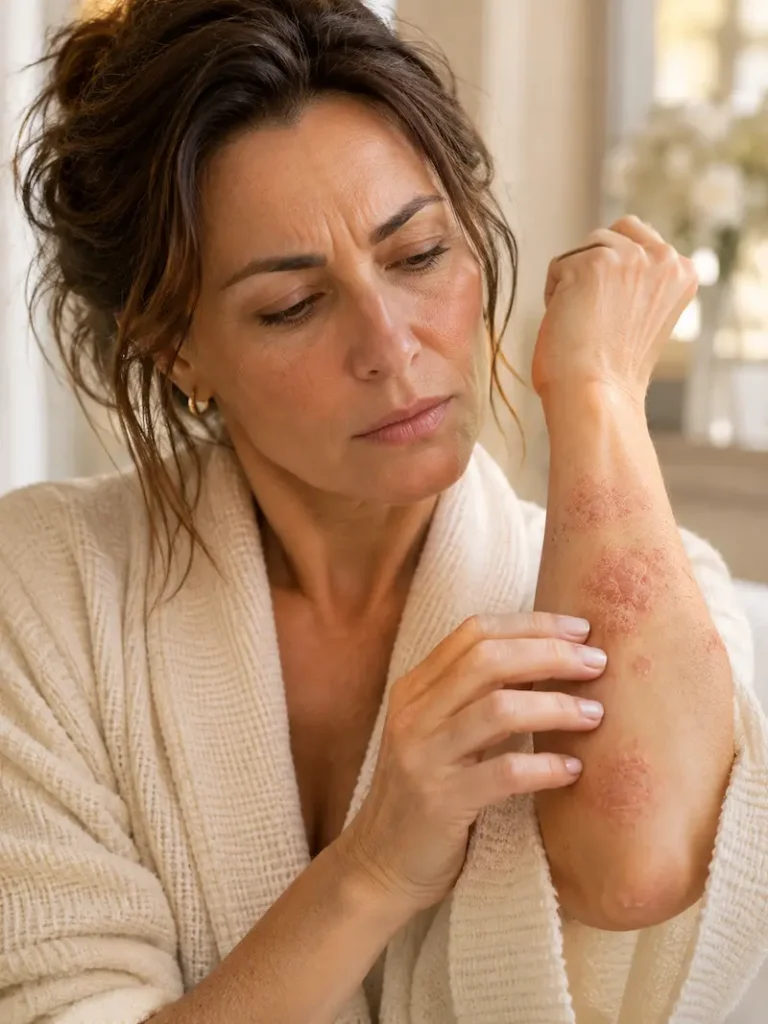
Perimenopause eczema is one of the most confusing presentations I see in clinical practice. Most of my clients who develop eczema during perimenopause are genuinely surprised. They didn’t have skin problems before. They did everything right. And then, seemingly out of nowhere, their skin started breaking down. What I find consistently in clinical practice is that perimenopause wasn’t the cause — it was the last straw.
I see this pattern across health histories again and again. One client had been living with Hashimoto’s for nearly a decade before her eczema started. Another had her amalgam fillings replaced and developed recurrent eczema flares within the same year. In perimenopause patients, the trigger is the hormonal shift — but what it triggers has usually been building for years underneath.
Understanding what’s actually driving your flares requires looking at the full picture: how your body is processing estrogen, what’s happening in your gut, which nutrients are running low, and what your immune system is doing in response to all of it. That’s what this post is about.
What Perimenopause Actually Does to Your Immune System
The standard explanation — estrogen levels drop, skin gets dry — misses the core problem. Yes, estrogen supports skin hydration and barrier function. But the deeper issue is that perimenopause represents a shift toward a more pro-inflammatory state in the body.
Here’s the mechanism that matters: estrogen, in its protective form, supports regulatory T cells (Tregs) that keep immune responses balanced. As hormonal ratios shift in perimenopause, Th2 immune dominance tends to increase — and Th2 dominance is precisely the immune pattern that drives atopic dermatitis.
What makes this worse is that perimenopause doesn’t happen in isolation. The pro-inflammatory shift amplifies every imbalance already present. If you had gut dysbiosis, subclinical hypothyroidism, nutrient insufficiencies, or estrogen dominance, perimenopause accelerates all of it simultaneously.
This is why doing nothing tends to make things worse, not better. The pro-inflammatory dynamic that perimenopause introduces compounds over time if the upstream drivers aren’t addressed.
The Gut Connection — How Dysbiosis Opens the Door
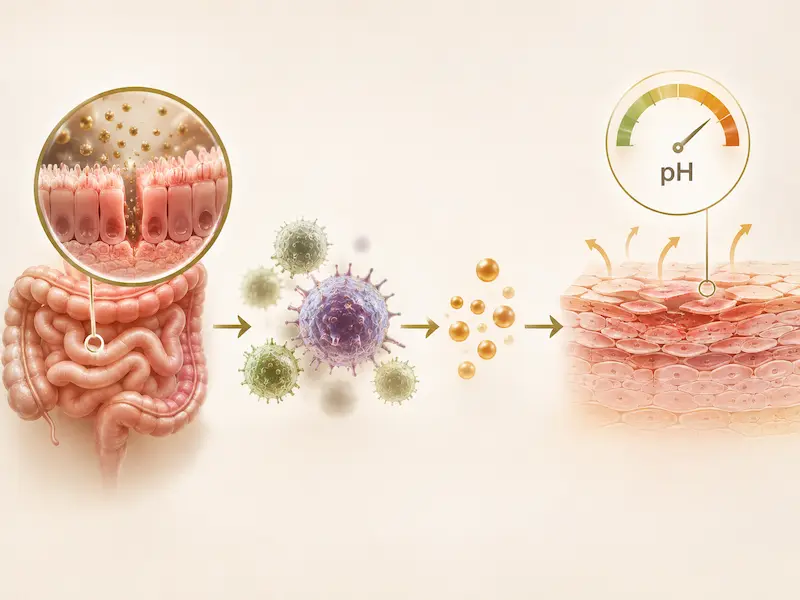
In virtually every perimenopause eczema patient I work with, there is a gut component. This isn’t a coincidence. The gut microbiome directly regulates immune function — and dysbiosis, once established, creates the conditions for Th2 dominance, mast cell activation, and systemic inflammation.
What drives dysbiosis in perimenopause patients?
- Hormonal shifts that alter the gut microbiome composition
- Prior or current antibiotic use
- Toxic burden — xenoestrogens, heavy metals, mycotoxins, agricultural pesticides
- Chronic emotional stress (which independently damages gut lining)
- Medications that deplete gut flora or compromise mucosal integrity
When the gut lining is compromised, immune dysregulation follows. Th2 cells dominate. Mast cells become sensitized. Pro-inflammatory cytokines — particularly IL-4 and IL-13 — are released systemically. And this is where the skin gets directly implicated.
IL-4 and IL-13 suppress the proteins and lipids that maintain your skin’s acid mantle — the mildly acidic surface layer (pH 4.5–5.5) that is essential for barrier integrity, enzyme activity, and microbial defense. When these cytokines are chronically elevated, skin pH shifts toward neutral or alkaline, triggering a self-reinforcing cycle of barrier breakdown and inflammation.
This is why moisturizers and topical steroids stop working over time. They address the barrier at the surface level. They don’t address the cytokine load driving the barrier dysfunction from within.
How Your Body Is Metabolizing Estrogen — And Why It Matters for Your Skin
One of the most revealing aspects of a functional workup in perimenopause eczema patients is the hormone metabolite panel. It shows not just estrogen levels, but how estrogen is being processed — and there are three main pathways it can go down, each with very different inflammatory implications.
The three estrogen metabolite pathways
- 2-OH (2-hydroxyestrone) — the protective, anti-inflammatory pathway. Ideally 55–75% of Phase 1 metabolism.
- 4-OH (4-hydroxyestrone) — the genotoxic pathway. Elevated 4-OH increases DNA damage risk and systemic inflammation.
- 16-OH (16-hydroxyestrone) — the proliferative, pro-inflammatory pathway. Elevated in cases of estrogen dominance and toxic burden.
In the case study I’m sharing here, here is what the panel showed:
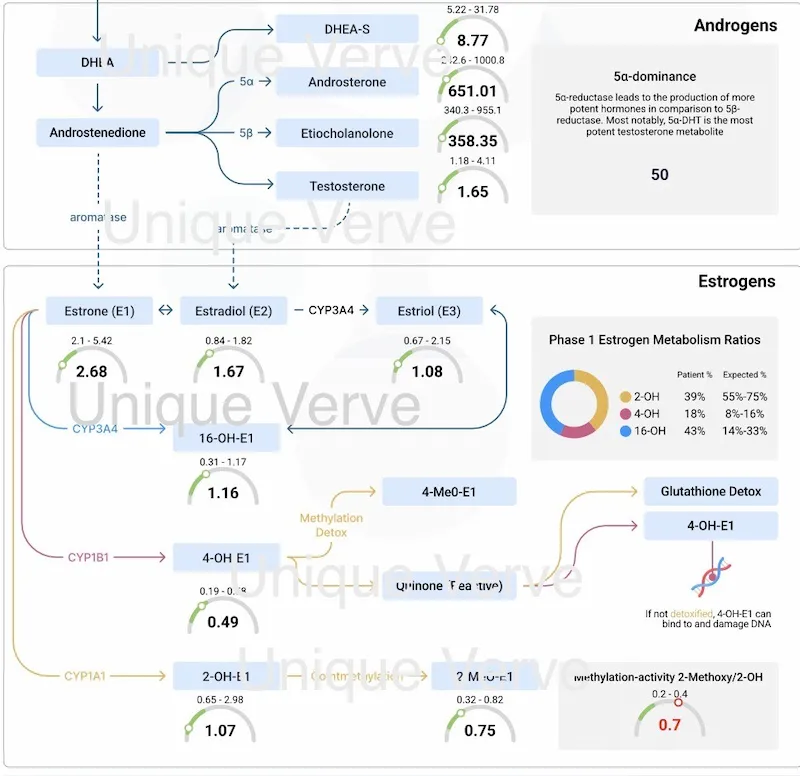
E2 (Estradiol): 1.67 — upper end of range (RR 0.84–1.82)
16-OH-E1: 1.16 — at the ceiling of range (RR 0.31–1.17)
4-OH-E1: 0.49 — upper half of range (RR 0.19–0.58)
2-OH-E1: 1.07 — low-normal (RR 0.65–2.98)
Phase 1 ratios: 2-OH: 39% (expected 55–75%) | 4-OH: 18% (expected 8–16%) | 16-OH: 43% (expected 14–33%)
The protective 2-OH pathway is underperforming. Both pro-inflammatory pathways — 4-OH and 16-OH — are running high or at ceiling. Meanwhile, the 2-methoxy/2-OH ratio of 0.7 (above the reference range of 0.2–0.4) reflects SNP-driven over-activity in the methylation enzyme — but there isn’t enough 2-OH substrate being produced in Phase 1 for methylation to clear effectively. The enzyme is working hard, but the right material isn’t available in sufficient quantity.
This patient also showed DHEA-S at 8.77 (reference range 5.22–31.78) — well below optimal. DHEA-S is suppressed by chronic inflammation, which is consistent with the downstream picture of impaired Phase 1 clearance and elevated pro-inflammatory metabolites. And her testosterone was low — not because of androgen deficiency per se, but because it was being over-converted to estradiol via excess aromatase activity. What was driving that aromatase excess? High fasting insulin.
The Insulin-Aromatase Loop — A Driver Nobody Talks About
Insulin stimulates aromatase — the enzyme that converts testosterone to estrogen. When fasting insulin is chronically elevated, as it was in this patient, the result is excess estrogen production even as ovarian estrogen output is declining. The body compensates by over-converting the testosterone that remains.
The result is a paradox: a perimenopause patient can show estrogen dominance on a panel despite falling ovarian estrogen. The estrogen isn’t coming from the ovaries — it’s being generated from excess androgen conversion driven by insulin.
This matters for eczema because estrogen dominance, particularly when it runs through the 4-OH and 16-OH pathways, sustains the pro-inflammatory cytokine environment that breaks down the skin barrier. Addressing only the hormone picture without addressing fasting insulin misses the driver of the driver.
The Nutrient Layer — Why Eating Well Isn’t Enough
Of all the patterns I see in eczema patients, nutrient insufficiency is probably the most universal — and the most underappreciated. In virtually every eczema client I work with, micronutrient testing reveals suboptimal levels of vitamin A, zinc, and B vitamins.
These aren’t marginal findings. Vitamin A is essential for both immune regulation and skin barrier integrity. Zinc is required for over 300 enzymatic processes, including those governing immune function, skin repair, and inflammatory signaling. B vitamins support methylation — the same process responsible for clearing the 4-OH estrogen metabolites we just discussed; as well as enzymes that degrade histamine in the gut and systemically.
Why diet alone doesn’t fix it
Most patients assume that if they eat well, their nutrient levels will follow. What’s rarely explained is that nutrient availability depends on a chain of steps that can be disrupted at any point: digestion, absorption through the gut lumen, transport through the cell wall, and cellular utilization. Dysbiosis, toxic burden, compromised mucosal integrity — all of these impair this chain before a nutrient ever reaches the tissues that need it.
On top of this, genetic SNPs linked to skin, thyroid, and methylation nutrients — particularly SNPs affecting vitamin C, vitamin A, zinc, B vitamins, and glutathione production — mean that even when nutrients are absorbed, the body may not be able to utilize them efficiently. I see this in my patients consistently: clients with 4-OH dominance almost universally show SNPs to glutathione production enzymes. The pathway is genetically less efficient at clearing the inflammatory estrogen metabolites, regardless of diet.
Interrupting the Itch-Nerve Cycle
Even when upstream drivers are being addressed, the itch-scratch cycle needs to be interrupted directly. Itch signals in eczema are carried by glutamate — an excitatory neurotransmitter that transmits from sensory nerve fibers in the skin to the spinal cord and brain. Elevated glutamate signaling perpetuates the itch response independently of the inflammatory load.
My starting protocol for perimenopause eczema patients addresses both the immune and neurological components simultaneously:
Inside
- Vitamin A — immune regulation and skin barrier gene expression
- Zinc — enzymatic support for immune balance and skin repair
- Omega-3 fatty acids — anti-inflammatory signaling, prostaglandin balance
- Vitamin D3 with K2 — immune modulation, Treg support
- Magnesium — supports GABA (the inhibitory, calming neurotransmitter that counteracts glutamate), reducing itch signal transmission from skin nerve fibers to the brain
Outside
While the internal work begins, I repair the skin barrier topically — eliminating any products or ingredients that further disrupt the acid mantle, and using targeted barrier-repair actives to support the skin’s pH and lipid structure while the systemic drivers are being addressed.
The first signs my patients typically notice: reduced itch intensity, improved sleep (often the first week magnesium is introduced), and gradually less reactive skin. The flares don’t disappear immediately — but their frequency and severity begin to decrease as the inflammatory load reduces.
What Functional Testing Reveals in Perimenopause Eczema Patients
The testing that actually maps this picture is different from a standard hormonal panel. In my practice, the workup for a perimenopause eczema patient typically includes:
- Hormone metabolite panel — to map estrogen Phase 1 and Phase 2 clearance, in particular
- Micronutrient panel — to identify nutrient insufficiencies along with possible genetic variants/ SNPs that allows more personalized customization
- Fasting insulin — to assess the aromatase-driving insulin loop
- Food sensitivity panel — IgA and IgG-mediated reactions that sustain gut inflammation and Th2 activation
- Total toxic burden — to assess xenoestrogen, heavy metal, mycotoxins and other environmental toxins
- Inflammatory markers — CRP, WBC — to establish baseline systemic inflammation
- Full thyroid panel
What surprises most patients is how interconnected the findings are. The gut dysbiosis is feeding the cytokine load. The cytokine load is disrupting the skin and gut barrier. The insulin is driving aromatase, which is producing more pro-inflammatory estrogen metabolites and more systemic inflammation. The nutrient insufficiencies — often anchored in SNPs — are preventing the system from clearing those metabolites. Each piece is connected to the others, and treating only one of them produces, at best, partial results.
Frequently Asked Questions
Can perimenopause cause eczema to suddenly appear for the first time?
Perimenopause can appear to trigger eczema “out of nowhere,” but in my clinical experience, the upstream conditions — gut dysbiosis, nutrient insufficiencies, impaired estrogen metabolism, toxic overload — are usually already present. The hormonal shift in perimenopause acts as the last straw that pushes the system into visible skin breakdown. The eczema didn’t start in perimenopause; it was already building.
Why does my eczema get worse around my cycle in perimenopause?
Estrogen and progesterone fluctuate more erratically in perimenopause than in earlier reproductive years. Progesterone, which supports Treg immune balance and has an anti-inflammatory effect, drops more sharply in perimenopause. The days leading up to menstruation — when both estrogen and progesterone fall — are a common window for flares. PMS severity and mood instability alongside eczema flares are clinical signals I look for in this pattern.
Is perimenopause eczema different from regular eczema?
The underlying mechanism — Th2 immune dominance, skin barrier dysfunction, cytokine-driven inflammation — is the same. What’s different is the hormonal driver: in perimenopause, the shift in estrogen metabolism, the drop in progesterone, the rise in pro-inflammatory estrogen metabolites, and often elevated fasting insulin driving excess aromatase activity all compound the existing eczema burden in ways that are distinct to this life stage.
Can fixing my hormones clear my eczema?
Addressing hormonal imbalances is an important part of the picture, but it’s rarely sufficient on its own. In my practice, the patients who see lasting improvement address the full upstream picture: gut dysbiosis, nutrient insufficiencies, toxic burden, and food sensitivities alongside the hormonal work. Treating hormones while leaving gut inflammation and nutrient gaps in place tends to produce partial, temporary results.
What role does estrogen dominance play in perimenopause eczema?
Estrogen dominance — meaning disproportionately high estrogen relative to progesterone, or high levels of pro-inflammatory estrogen metabolites — sustains the Th2 immune activation that drives eczema. In perimenopause, estrogen dominance can persist or worsen even as ovarian estrogen output declines, particularly when fasting insulin is elevated (driving aromatase conversion of testosterone to estradiol) or when estrogen is being cleared through the 4-OH and 16-OH pathways rather than the protective 2-OH pathway.
What is xenoestrogen exposure and why does it matter for perimenopause eczema?
Xenoestrogens are endocrine-disrupting compounds — found in BPA, agricultural pesticides including glyphosate, phthalates, formaldehyde in hair straightening treatments, mycotoxins, heavy metals — that mimic or amplify estrogen activity in the body. They contribute to estrogen burden, promote pro-inflammatory estrogen metabolite pathways, and are part of why perimenopause is now starting younger. Toxic burden testing is one of the most revealing panels I run in perimenopause eczema patients; most are surprised by their results.
Why do topical steroids and moisturizers stop working in perimenopause eczema?
Topical treatments address the barrier at the surface level. They do not address the cytokine load — primarily IL-4 and IL-13 — that is degrading the acid mantle from within. When pro-inflammatory cytokines are chronically elevated, the skin’s pH shifts toward alkaline, disrupting enzyme activity, lipid organization, and microbial defense in a self-reinforcing cycle. No amount of topical treatment resolves a cytokine-driven process; that requires addressing the immune and gut drivers producing the cytokines.
What does a functional medicine approach to perimenopause eczema actually involve?
It begins with comprehensive review of your health history, symptom checklist, time lines and testing: hormone metabolite panel, micronutrient panel, fasting insulin, food sensitivities, toxic burden, and inflammatory markers. From there, the protocol addresses upstream root causes — gut restoration, nutrient repletion, estrogen metabolite pathway support, blood sugar and insulin regulation, and toxin clearance — alongside targeted topical barrier repair. It is a simultaneous inside-and-outside approach rather than a surface-level symptom management strategy.
Ready to Understand What’s Actually Driving Your Perimenopause Eczema?
If your eczema has worsened in perimenopause and you’re tired of managing symptoms without answers, a functional medicine assessment looks at the full picture — estrogen metabolism, gut health, nutrient status, toxic burden, and the immune drivers that standard dermatology workups don’t test for.
I work with clients virtually, nationwide. The first step is an Initial Functional Medicine Comprehensive Health and Skin Assessment — a comprehensive intake that maps your health history, identifies patterns, and outlines where functional testing is most likely to give you clarity.
→ Book your Initial Functional Medicine Health and Skin Assessment — virtual, nationwide.
