
Introduction
Acne rosacea vs lupus — telling the two apart is one of the most anxiety-producing questions a person with facial redness can search, and an understandable one. Both conditions can produce redness across the cheeks and nose. Both can be dismissed for years before a clear diagnosis is reached. You may have also seen this condition referred to as “acne rosacea” — an older clinical term for the pustule-presenting subtype of rosacea, not a comparison to true acne vulgaris. And both, when investigated through a functional medicine lens, point toward the same upstream territory: an immune system that has been overwhelmed by internal burdens it was never given the support to clear.
This post covers two things about the acne rosacea vs lupus question. First, the practical visual and symptomatic differences between rosacea and lupus — what to look for, what your dermatologist is checking for, and when the distinction matters clinically. Second, and more importantly, what 22+ years of clinical practice has shown me about why these two conditions so often share the same root soil — and why, regardless of which label eventually applies to you, the most important question is never the label itself.
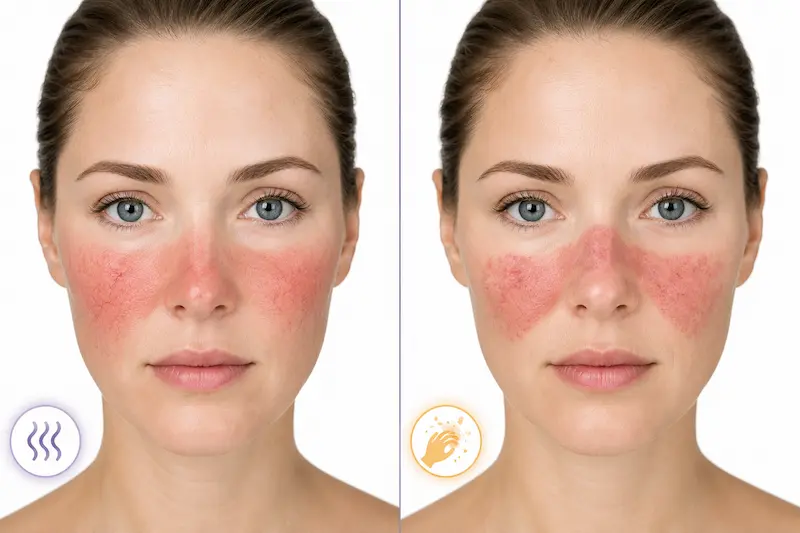
Acne Rosacea vs Lupus: The Visual and Symptomatic Differences
While rosacea and lupus can both produce facial redness, the pattern, duration, and accompanying features are meaningfully different. Here is what distinguishes them clinically:
Duration and Pattern
Rosacea: Episodic — symptoms come and go, frequently triggered and exacerbated by environmental and external factors including specific foods, sun exposure, heat, alcohol, and stress. Between flares, skin can return to a calmer baseline, though with sustained inflammation that baseline often becomes progressively more reactive over time.
Lupus: Tends to be more persistent and less episodically triggered by the everyday exposures that drive rosacea flares, though sun exposure can specifically trigger or worsen lupus skin involvement through photosensitivity.
Location and Shape
Rosacea: Typically affects the cheeks, across the nose, and the chin. In more advanced presentations, the nose can become significantly red with a thickened skin appearance (rhinophyma). The distribution is broader and less symmetrically defined.
Lupus: Classically more localized with a distinct butterfly (malar) shape — a symmetrical pattern across both cheeks and the bridge of the nose, typically sparing the nasolabial folds.
Surface Features
Rosacea: May be accompanied by papules and pustules — pus-filled bumps — and characteristically makes the underlying blood vessels more visible (telangiectasia).
Lupus: Usually does not present with pus-filled bumps. The malar rash tends to be flat or slightly raised without the pustular component typical of inflammatory rosacea.
Sensation
Rosacea: Typically does not itch. The characteristic sensation is heat, irritation, burning, or stinging rather than itchiness.
Lupus: May be itchy — a distinguishing sensory feature that can help differentiate the two conditions when the visual presentation is ambiguous.
These distinctions are useful starting points, but they are not a substitute for clinical and laboratory evaluation. If your presentation is ambiguous, has features of both, or has not been formally evaluated, a functional dermatological assessment including appropriate autoimmune screening is the appropriate first step.
Why Both Conditions Rarely Travel Alone
The acne rosacea vs lupus question becomes even more complex when you consider that both conditions rarely travel alone.
In my functional medicine practice, I consistently see that both rosacea and lupus do not present in isolation. They run in coexistence with a broader systemic symptom picture — joint pain, gastrointestinal dysfunction, and leaky gut are among the most consistent companions I observe regardless of which skin label applies. This pattern is clinically significant: it tells us that what is happening on the face is not a localized skin event, but the visible expression of a systemic immune and inflammatory process that is simultaneously affecting the joints, the gut, and likely other systems not yet symptomatic.
This is not a coincidental overlap. Research confirms that 40-60% of systemic lupus erythematosus patients have documented gastrointestinal involvement, affecting any part of the GI tract from the mouth to the anus. This statistic matters enormously through a functional medicine lens: it confirms that the same gut-immune dysregulation I observe clinically in rosacea patients — leaky gut, dysbiosis, impaired barrier function — is not unique to rosacea.
It is a consistent feature of the broader immune dysregulation spectrum, present at strikingly similar rates whether the immune system’s primary target is currently the skin, as in rosacea, or has progressed to multi-organ involvement, as in lupus. This shared GI signature reinforces the central argument of this post: rosacea and lupus are not separate diseases that happen to share some symptoms. They sit on the same continuum of immune dysregulation, with gut dysfunction as a consistent, measurable thread running through both — and a thread that, when addressed early, may be one of the most important opportunities to prevent worsening an progression from one end of that continuum toward the other.
This is precisely why the question “could my rosacea actually be lupus” matters less, clinically, than the question “what is creating this level of systemic immune activation in the first place.” Both conditions, in my clinical experience, frequently share the same underlying imbalances, triggers, and root causes — which means that through a functional medicine lens, rosacea can act as a precipitating factor on the pathway toward lupus and can increase autoimmune risk when the upstream picture remains unaddressed long enough.
The Shared Root Causes Behind Rosacea and Lupus
Understanding the acne rosacea vs lupus overlap requires looking upstream, at the root causes both conditions frequently share. The upstream drivers I see most consistently across both rosacea and lupus presentations include:
- Blood sugar dysregulation — sustaining the chronic low-grade inflammation that feeds both gut dysbiosis and systemic immune reactivity
- Thyroid dysfunction — impairing immune regulation, gut motility, and detoxification capacity simultaneously
- H. Pylori infection and other microbial overgrowth, including candida and parasitic infection — each carrying molecular mimicry risk for autoimmune tissue targeting
- Heavy metal toxicity, particularly mercury — one of the most consistently overlooked and most significant drivers in both conditions
- Mycotoxin burden — present in the Total Tox Burden results of nearly every rosacea and lupus-adjacent patient I assess
The Mercury Connection — And the Parasite-Heavy Metal Relationship
Mercury toxicity deserves particular attention in this conversation. Research has documented cases of autoimmune disease misdiagnosed as lupus and rheumatoid arthritis that were, on thorough investigation, mercury poisoning — with the explicit clinical recommendation that all clinicians test for heavy metal burden as a routine part of autoimmune workup. Mercury has also been directly implicated in Hashimoto’s thyroiditis, and a large population-based cohort study found that Hashimoto’s thyroiditis significantly increases the subsequent risk of new-onset systemic lupus erythematosus.
This creates a forward-feeding cycle that I see reflected clinically again and again: mercury exposure contributes to thyroid autoimmunity, thyroid autoimmunity increases lupus risk, and the underlying toxic burden that initiated the cycle continues to compound for as long as it remains unaddressed. Breaking this cycle — rather than waiting to see which autoimmune label eventually applies — is the central work of functional medicine.
There is an additional layer worth understanding: parasites can sequester heavy metals, including mercury, within the gut — meaning a parasitic infection can simultaneously worsen heavy metal burden while heavy metal burden simultaneously impairs the immune competence needed to clear the parasitic infection. This is one of the most clinically important vicious cycles I investigate in patients with chronic rosacea, autoimmune-adjacent presentations, or both — and a vicious cycle that compounds the same gut-rooted GI involvement discussed above, since parasitic burden is itself a direct driver of intestinal dysfunction.
The Pattern I See: What Toxic Burden Reduction Actually Looks Like
Rather than anchoring this post to a single dramatic diagnosis story, I want to show you something more clinically convincing: real, measurable lab results. One of my clients came to me with a symptom picture that, in isolation, could have been routed to half a dozen different specialists without anyone connecting the dots: itchy skin, pus-filled bumps alongside a rosacea-type rash, heart palpitations and arrhythmia that woke her every single night, constipation so consistent that she eliminated only every three to four days — which her doctor had told her was normal — sleep disruption, joint pain, an HbA1c that had remained elevated for over a decade despite dietary changes, low energy, and brain fog.
Notice that her presentation included both classic rosacea features (the pustules, the rash) and a feature more typically associated with lupus (the itching) — exactly the kind of overlapping picture that makes the rosacea-or-lupus question so difficult to answer from symptoms alone, and exactly why the upstream investigation matters more than the label. Notice too that her constipation — elimination only every three to four days, dismissed as normal — is itself a GI manifestation entirely consistent with the gut-immune dysregulation pattern described above, regardless of which skin label ultimately applied to her.
Her Total Tox Burden testing revealed significant mercury burden. After completing my VIP Functional Medicine Program in conjunction with my 9-Day Detox Program, her mercury level dropped from 1.73 to 0.17 — a reduction of roughly 90%. Her symptom picture across every system improved alongside that measurable laboratory change: the skin calmed, the heart palpitations resolved, her bowel function normalized, her sleep improved, and her decade-long elevated HbA1c finally began to respond.

This is the pattern I want you to understand: the body’s logic is consistent and traceable. When the toxic burden driving systemic immune activation is identified and cleared, multiple seemingly unrelated symptoms — skin, cardiac, digestive, metabolic, cognitive — improve together, because they were never separate problems. They were downstream expressions of the same upstream burden.
This pattern is exactly why the acne rosacea vs lupus question matters less, clinically, than identifying the upstream driver itself.
What Testing Helps Clarify Rosacea, Lupus, and the Territory Between Them
A comprehensive investigation for anyone asking “could my rosacea actually be lupus” should include: a full thyroid panel with both anti-TPO and anti-thyroglobulin antibodies run simultaneously, since thyroid autoimmunity is a documented risk factor for subsequent lupus development; Total Tox Burden testing for heavy metals — particularly mercury but ultimately any toxin primes immune system for hyper-vigilance — along with mycotoxins and environmental chemicals; Gut Zoomer assessment for gut dysbiosis, H. Pylori, parasitic infection, and intestinal permeability — particularly relevant given how consistently GI involvement accompanies both conditions; and where clinically indicated, standard autoimmune markers including ANA to clarify whether the presentation has crossed into classical autoimmune territory. Every workup is individualized based on your specific symptom picture and health history.
Two Pathways Forward, Depending on Where You Are
Not every person needs the same level of intervention, and I offer two distinct pathways depending on the complexity of your picture and your readiness for commitment.
For those who are not yet ready for a longer commitment, or whose picture is more contained, the 9-Day Detox Program offers a focused, science-based entry point into biotransforming and clearing heavy metals, mycotoxins, and environmental toxins — a meaningful first step that can be pursued on its own or as a precursor to deeper work.
For those managing multiple symptoms simultaneously — particularly when autoimmune conditions are confirmed or suspected, or when GI symptoms are a significant part of the picture — the VIP Functional Medicine Program is the more appropriate pathway.
Complex, multi-system presentations require practitioner-guided sequencing: identifying the upstream root causes in the correct order, addressing infections before detoxification where indicated, supporting the thyroid and gut simultaneously, and adjusting the protocol as testing and symptom response reveal more of the picture.
It’s Not About the Label
Every dis-ease dynamic has a logical explanation for what is driving it. The label — rosacea, lupus, or anything in between — is not what functional medicine treats. We treat the person: what symptoms are present, what has happened over the course of your lifetime, what the precipitating factors and contributors were, and what the final straw was that finally broke the camel’s back.
If you are searching anxiously to understand whether your rosacea could actually be lupus, I want to offer you something more useful than reassurance either way: the most important thing is not waiting to find out. If you continue living the same way — with the same toxic exposures, the same unaddressed gut burden, the same unsupported thyroid — nothing internally will change on its own, and the picture will most likely continue to progress rather than resolve.
It does not matter, ultimately, which label eventually applies. What matters is identifying what has been driving the immune activation in your specific body, across your specific lifetime, and addressing it before the picture progresses further. That is the work I do — and the case described above, with real laboratory data showing what is possible, is evidence of what that work can achieve.
Wherever your specific picture lands on the acne rosacea vs lupus spectrum, the underlying clinical principle remains the same: it’s not about the label.
→ Book your Initial Functional Medicine Health and Skin Assessment
P.S. If finances have been the only thing standing between you and starting your functional medicine journey — flexible payment options are available through Cherry. No interest, no impact on your credit score, quick approval, and affordable monthly payments. Apply in minutes on our website here.
Frequently Asked Questions
Q1: What are the visual differences between a rosacea rash and a lupus rash?
Rosacea typically presents as episodic redness across the cheeks, nose, and chin, often accompanied by visible blood vessels and pustules, without itching, and is triggered by heat, sun, alcohol, and certain foods. Lupus typically presents as a more persistent, symmetrical butterfly-shaped rash across the cheeks and nose bridge, sparing the nasolabial folds, without pustules, and may be itchy rather than simply hot or irritated.
Q2: Can heavy metal toxicity cause a lupus-like rash?
Yes — documented case studies describe autoimmune presentations initially diagnosed as lupus that were, on thorough investigation, found to be mercury poisoning. Heavy metal burden, particularly mercury, has been shown in research to exacerbate systemic autoimmunity, which is why comprehensive autoimmune workups should routinely include heavy metal testing.
Q3: Does mercury exposure increase the risk of autoimmune disease?
Research supports a connection between mercury exposure and autoimmune activation, including documented links to thyroid autoimmunity (Hashimoto’s thyroiditis) and exacerbation of lupus-like autoimmune responses. A large population-based cohort study additionally found that Hashimoto’s thyroiditis significantly increases the subsequent risk of new-onset systemic lupus — creating a forward-feeding cycle from mercury exposure through thyroid autoimmunity toward broader autoimmune risk.
Q4: Can rosacea turn into lupus over time?
Rosacea does not directly transform into lupus. However, both conditions can share the same upstream immune dysregulation and toxic burden drivers, which means that when those upstream factors remain unaddressed, the same internal environment that is sustaining rosacea can, in susceptible individuals, contribute to the immune dysregulation associated with autoimmune progression more broadly. This is why investigating and addressing root causes — rather than only managing the visible skin presentation — is the more protective long-term strategy.
Q5: What tests detect heavy metal toxicity linked to skin and autoimmune symptoms?
The Total Tox Burden panel is the most comprehensive test for identifying heavy metal burden — including mercury — alongside mycotoxins and environmental chemical exposure. This is typically combined with a full thyroid panel including both anti-TPO and anti-thyroglobulin antibodies, and Gut Zoomer testing to assess for the dysbiosis and parasitic infection that can both result from and contribute to heavy metal accumulation.
Q6: Why do dermatologists sometimes misdiagnose rosacea as lupus, or lupus as rosacea?
The visual overlap between the two conditions — facial redness, cheek and nose involvement — is real, and even experienced clinicians can find early or atypical presentations difficult to distinguish without laboratory confirmation. Misdiagnosis most commonly occurs when a presentation has mixed features — some pustules alongside some itching, for example — or when autoimmune blood work hasn’t yet been run. This is not a failure of medical competence; it reflects the genuine clinical overlap between the two conditions. If you’ve received one diagnosis but your symptoms don’t fully fit, or your treatment isn’t working as expected, requesting confirmatory testing — both antibody panels and, where appropriate, heavy metal and toxic burden assessment — is a reasonable and important next step.
Q7: How is Hashimoto’s thyroiditis connected to lupus risk?
A large population-based cohort study following over 15,000 Hashimoto’s thyroiditis patients found a significantly increased risk of subsequent new-onset systemic lupus erythematosus compared to matched controls. Since Hashimoto’s itself has been linked to mercury exposure and other shared upstream drivers with rosacea, this creates a documented pathway connecting toxic burden, thyroid autoimmunity, and lupus risk — reinforcing why comprehensive upstream investigation matters regardless of which skin label currently applies.
Q8: Is gastrointestinal involvement common in lupus, like it is in rosacea?
Yes — research confirms that 40-60% of systemic lupus erythematosus (SLE) patients have documented gastrointestinal involvement, affecting any part of the GI tract from the mouth to the anus. This mirrors what is consistently observed in rosacea: gut dysfunction — bloating, dysbiosis, leaky gut — running alongside the skin presentation in the vast majority of patients assessed. The consistency of this gut-immune connection across both conditions reinforces that they sit on the same continuum of immune dysregulation, rather than existing as unrelated diseases.
Written by Natalie Maibenko – a Certified Functional Medicine Practitioner and Master Esthetician with 22+ years of experience and founder of Unique Verve

As a Certified Functional Medicine Practitioner my Expertise Encompasses:
- Immune System: frequent illness, UTIs, yeast infections
- Allergies, Asthma
- Skin Problems: acne, cystic acne, rosacea, eczema, dermatitis, ichthyosis, psoriasis, vitiligo, melasma
- Inflammation: arthritis, rhinitis, joint & muscle pain, migraines, headaches
- Sleep Disturbunces, Insomnia
- Gut Problems: IBS/IBD, bloating, acid reflux, gas, constipation, diarrhea, parasites, fungal/yeast overgrowths
- Hormonal Imbalances: PCOS, PMS symptoms, weight problems/inability to lose weight, thyroid problems
- Hair Loss, Alopecia
- Mood Imbalances: anxiety, depression, irritability
- Metabolic Dysfunction, Insulin Resistance, Type 2 Diabetes
- Optimizing Wellness for Successful Pregnancy
- Autoimmune Conditions: Hashimoto’s thyroiditis, grave’s disease, reumatoid arthritis (RA), lupus, etc
- Bone Health: osteopenia/ osteoporosis
- Effective Anti-Aging Strategies without Injectables with the inside-out & outside-in approach
- Detoxification of Heavy Metals, Mycotoxins, Environmental Toxins
- Reversing Breast Implant Illness
- Preparation for the Explant Surgery and Optimization of Wellness & Vitality Post-Explant
With love and gratitude,
Natalie Maibenko
Functional Medicine & Skincare Expert – Helping You Take Control of Your Health and Achieve Lasting Skin Results Nationwide — Virtual Practice
