
Introduction
Why do antibiotics make eczema worse? If you have been prescribed antibiotics for an eczema-related skin infection and found your eczema significantly worsened in the weeks that followed — more reactive, more widespread, more resistant to the treatments that previously provided some relief — there is a precise clinical reason for this. And it has nothing to do with an unusual reaction to the medication.

Antibiotics make eczema worse because they disrupt the gut microbiome — the ecosystem of beneficial bacteria whose diversity and regulatory output the immune system depends on to maintain the balanced, non-hyperreactive state that keeps eczema in check. When that ecosystem is disrupted, the immune dysregulation already driving the eczema is amplified rather than resolved. The skin infection clears. The internal environment producing the skin’s vulnerability to infection deepens.
This post explains why this happens, why the conventional approach of prescribing antibiotics for infected eczema skin addresses the immediate problem while worsening the underlying one, and what the functional medicine investigation looks for instead — addressing the immune environment rather than only the pathogen it can no longer contain.
The Gut Microbiome and the Eczema Immune Connection
To understand why antibiotics make eczema worse, it helps to understand what is actually producing eczema in the first place. Eczema is not a skin condition that originates in the skin. It is an immune condition that expresses through the skin — specifically, an overactivation of the adaptive immune system characterized by a shift toward what researchers call Th2 dominance.
In a balanced immune state, the body maintains a regulatory system that keeps inflammatory responses proportionate. A key part of this regulatory system is a population of immune cells called regulatory T cells — or Tregs. These cells express a protein called FOXP3 that marks their regulatory function, and they act as the immune system’s dampening mechanism — preventing the inflammatory response from becoming disproportionate or self-directed. Research published in the Journal of Allergy and Clinical Immunology confirms that Treg cell dysfunction — specifically, reduced numbers of FOXP3-positive cells in skin lesions and impaired suppressive activity — plays a critical role in driving the unchecked Th2 inflammation that characterizes eczema. When Treg function is insufficient, the immune system cannot regulate its own inflammatory responses effectively. The Th2 pathway runs unchecked. And the skin becomes the visible site of the immune dysregulation that follows.
The gut microbiome is where a significant proportion of Treg development and calibration happens. The diverse community of beneficial bacteria in a healthy gut produces signals — particularly short-chain fatty acids from fermentation — that actively support Treg differentiation and FOXP3 expression. When the gut microbiome is diverse and intact, these signals continuously support the immune balance that keeps Th2 dominance in check. When the gut microbiome is depleted or disrupted, these regulatory signals are reduced, Treg function is impaired, and the immune system shifts progressively toward the hyperreactive Th2 state that eczema reflects.
Antibiotics deplete the gut microbiome indiscriminately. They do not distinguish between the pathogenic bacteria they are targeting and the beneficial bacteria whose regulatory signals the immune system depends on. A single course of antibiotics can significantly alter the gut microbiome composition — depleting the beneficial bacterial populations that support Treg function and leaving a less diverse, less regulatory ecosystem in their place. For an eczema patient whose gut microbiome was already insufficient before the antibiotic was prescribed, this disruption deepens an immune dysregulation that was already driving the condition.
The S. aureus Cycle That Antibiotics Cannot Break
The reason most eczema patients receive antibiotics in the first place is secondary skin infection — most commonly from Staphylococcus aureus, the bacterium most consistently found colonizing the skin of patients with atopic dermatitis. S. aureus takes advantage of the compromised eczema barrier, colonizes the lesional skin, and produces toxins and superantigens that amplify the Th2 inflammatory response and worsen the eczema significantly. The antibiotic prescribed for this infection is clinically reasonable. The infection is real. The S. aureus is genuinely causing harm. And the antibiotic clears it, temporarily.
What the antibiotic does not address is why S. aureus was able to colonize the skin in the first place.
Research confirms that S. aureus gains a selective growth advantage in the low-diversity skin microbiome characteristic of eczema flares. During active eczema, the normal microbial diversity of the skin is severely diminished — the commensal bacteria that would ordinarily compete with S. aureus for colonization sites, produce antimicrobial compounds, and maintain the skin’s ecological balance are depleted. S. aureus fills the vacancy. And a closely related organism, Staphylococcus epidermidis — long considered a beneficial skin commensal — can also act as a pathobiont in this low-diversity environment, producing proteases that further damage the already-compromised skin barrier and amplify inflammation.
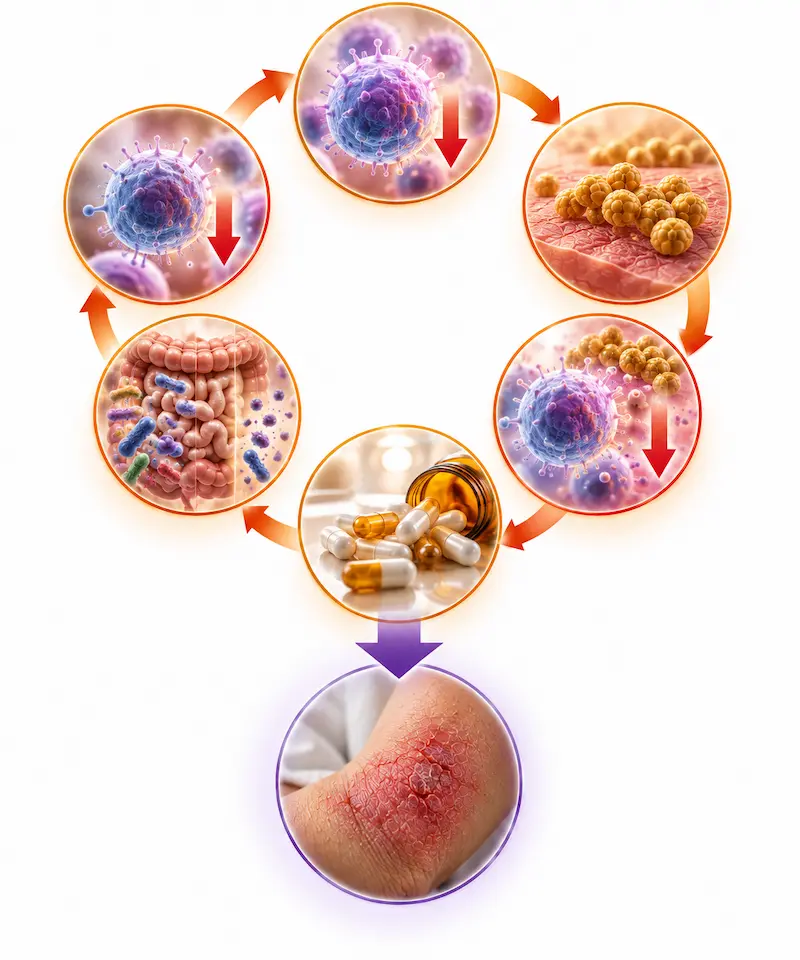
The antibiotic prescribed for S. aureus infection eliminates the targeted pathogen. It simultaneously eliminates the remaining commensal bacteria that were providing whatever competitive inhibition was still preventing the skin microbiome from becoming completely dominated by pathobionts. The infection clears. The skin microbiome is now even less diverse than it was before the antibiotic. The Treg-supporting signals from the gut microbiome are further depleted. The immune environment that allowed S. aureus to colonize in the first place is now more compromised than it was before treatment began. And S. aureus returns — faster, in a microbiome with less remaining resistance to its colonization.
This is the cycle that conventional antibiotic treatment cannot break: antibiotics address the S. aureus without addressing the immune environment that created the opportunity for S. aureus to dominate. The infection responds to treatment. The vulnerability to infection deepens with each course.
What S. aureus Does to the Immune System Directly
There is a further dimension to the S. aureus-eczema relationship that makes the antibiotic approach particularly insufficient. S. aureus does not merely colonize eczema skin and trigger inflammation as a bystander effect. It actively subverts the immune regulatory mechanisms that would otherwise contain it.
The superantigens produced by S. aureus — bacterial toxins that activate large populations of T cells simultaneously — directly impair the function of regulatory T cells. Research confirms that Treg cell dysfunction synergizes with cutaneous S. aureus exposure to drive eczema — meaning that S. aureus colonization in the context of insufficient Treg function produces eczema outcomes that neither factor alone would produce to the same degree. And S. aureus actively maintains this synergy by impairing the Treg function that would otherwise limit its own inflammatory impact.
An antibiotic clears S. aureus from the skin surface. The Treg insufficiency that made the skin unable to resist S. aureus colonization remains. The gut dysbiosis that is depleting the Treg-supportive microbial signals remains. And the antibiotic has now also further depleted the gut commensal populations that support whatever Treg function existed before the course was prescribed. The immune system returns to facing the next S. aureus exposure with less regulatory capacity than it had before treatment.
The Question That Changes the Clinical Approach
The conventional clinical question when an eczema patient presents with S. aureus-infected skin is: what antibiotic will eliminate this infection? This is an entirely reasonable question. The infection is real, it is worsening the eczema significantly, and it needs to be addressed.
The functional medicine question is different: why is this immune system unable to keep S. aureus from colonizing and proliferating in the first place? The answer to that question is not in the bacteria. It is in the Treg insufficiency, the gut dysbiosis depleting the regulatory signals that support Treg function, the nutrient insufficiencies depleting the immune system’s capacity to maintain Treg populations, and the Th2-dominant internal environment that S. aureus has learned to exploit and amplify.
Addressing this question requires a fundamentally different approach — one focused on restoring immune regulation rather than suppressing the pathogen that immune dysregulation has allowed to thrive.
What Supports Immune Rebalancing in Eczema
The functional medicine approach to eczema associated with recurrent S. aureus infection addresses three things simultaneously: eliminating the internal perpetrators that are activating the adaptive immune system and sustaining Th2 dominance, supporting the immune system with the key nutrients that Treg function depends on, and implementing natural antimicrobial strategies that counter the S. aureus and S. epidermidis overgrowth without further depleting the commensal microbiome.
Key Immune Nutrients That Support Treg Function
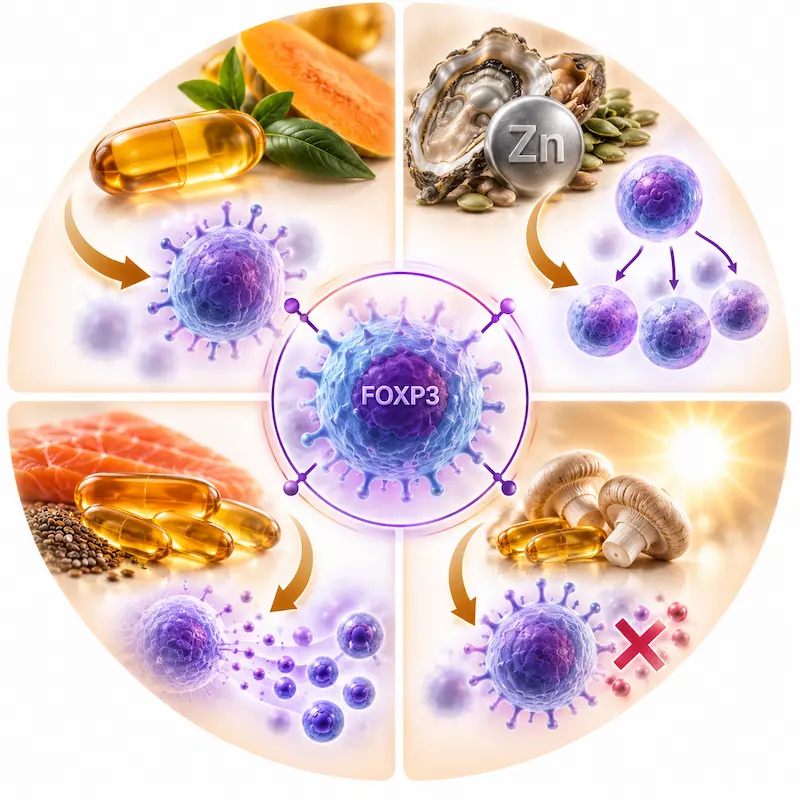
Four nutrients are particularly critical for supporting the regulatory T cell function that eczema patients are consistently found to be deficient in:
Vitamin A supports Treg differentiation directly — retinoic acid signaling through nuclear receptors promotes FOXP3 expression and the development of functional regulatory T cells. Vitamin A deficiency has been confirmed to exacerbate atopic dermatitis by amplifying Th2-mediated inflammation and mast cell activation — the precise immune picture that Treg insufficiency allows to go unchecked.
Zinc is essential for the development and function of both innate and adaptive immune cells, including Treg populations. Zinc deficiency is consistently documented in eczema patients and impairs the immune regulatory capacity that keeps Th2 responses proportionate. It also directly supports skin barrier integrity — addressing the barrier compromise that gives S. aureus its initial colonization opportunity.
Omega-3 essential fatty acids — EPA and DHA — reduce the inflammatory cytokine environment that Th2 dominance produces, support the resolution of inflammation rather than its perpetuation, and provide the essential fatty acid building blocks that both barrier repair and immune cell membrane function depend on. The omega-6 to omega-3 ratio is consistently elevated in eczema patients, reflecting a pro-inflammatory internal environment that Treg rebalancing alone cannot fully resolve.
Vitamin D is a critical regulator of immune balance — vitamin D receptor signaling promotes Treg differentiation, suppresses Th17 activity, and reduces the IL-6 and inflammatory cytokine production that sustains the eczema inflammatory cascade. Vitamin D insufficiency is one of the most consistent nutrient findings in atopic dermatitis patients and is directly associated with increased disease severity.
Restoring the Gut Microbiome
Because the gut microbiome is the primary source of the Treg-supportive microbial signals that antibiotic disruption depletes, gut microbiome restoration is a central element of the functional medicine approach to antibiotic-worsened eczema. This is not as simple as taking a probiotic after an antibiotic course — the restoration of commensal diversity sufficient to meaningfully support Treg function requires the comprehensive gut assessment that identifies the specific dysbiotic pattern and addresses it through a targeted and sequenced protocol. Research confirms that microbial interventions significantly reduce atopic dermatitis severity — but the clinical results that matter require individualized assessment rather than generic supplementation.
Natural Antimicrobial Support
Natural antimicrobial strategies that address S. aureus and S. epidermidis overgrowth without the broad-spectrum commensal depletion that antibiotics produce are a clinically important complement to the immune rebalancing work. These strategies — which belong to the clinical protocol explored in the Initial Functional Medicine Health and Skin Assessment — work alongside gut restoration and nutrient repletion rather than replacing the immune environment work that is the primary driver of genuine resolution.
The Antibiotic Was Treating the Consequence. The Functional Medicine Investigation Addresses the Cause.
Antibiotics for S. aureus-infected eczema skin treat the consequence of an immune environment that can no longer keep S. aureus in check. The functional medicine investigation addresses the cause — the Treg insufficiency, the gut dysbiosis, and the nutrient depletions that created the immune vulnerability in the first place. Restoring immune regulation produces the lasting improvement that treating the infection alone has never been able to sustain.
If your eczema consistently worsens after antibiotic courses, or if S. aureus infections have become a recurring feature of your eczema picture, the most important clinical question is not which antibiotic to use next. It is what internal environment is preventing the immune system from maintaining the Treg function and commensal diversity that would keep S. aureus from dominating in the first place — and what that environment needs in order to restore its own regulatory capacity.
→ Book your Initial Functional Medicine Health and Skin Assessment
P.S. Flexible payment options available through Cherry — no interest, no credit impact, quick approval. Apply on our website.
Frequently Asked Questions About Why Do Antibiotics Make Eczema Worse
Q1: Why do antibiotics make eczema worse?
Antibiotics disrupt the gut microbiome — the ecosystem of beneficial bacteria whose regulatory signals support the immune balance that keeps eczema in check. A diverse gut microbiome produces short-chain fatty acids that actively support regulatory T cell (Treg) development and function. Tregs are the immune system’s dampening mechanism, preventing inflammatory responses from becoming disproportionate. When antibiotics deplete the commensal bacteria producing these regulatory signals, Treg function is reduced, the Th2-dominant immune state driving eczema deepens, and the skin expresses that deepened dysregulation as a worsened flare. The S. aureus skin infection that prompted the antibiotic prescription may clear. The immune environment that made S. aureus colonization possible becomes more compromised with each course.
Q2: Can antibiotics cause eczema to flare up?
Yes — and the mechanism is precise. Antibiotics prescribed for secondary eczema skin infections simultaneously eliminate the remaining commensal bacteria providing competitive inhibition against the pathogens driving the flare. The infection resolves but the skin microbiome diversity is further depleted, removing the ecological barriers that were slowing pathobiont recolonization. The gut microbiome disruption that follows depletes the regulatory T cell-supportive signals that were already insufficient in most eczema patients. The next flare arrives in a less diverse skin microbiome, a less regulated gut immune environment, and an immune system with less Treg capacity than it had before the antibiotic was prescribed.
Q3: Why does eczema keep coming back after antibiotics?
S. aureus keeps coming back after antibiotic treatment because the conditions that allowed it to dominate — reduced skin microbiome diversity, Treg insufficiency, and the Th2-dominant immune environment — have not been addressed. Research confirms that Treg cell dysfunction synergizes with cutaneous S. aureus exposure to drive eczema. Antibiotics address the S. aureus without touching the Treg insufficiency or the gut dysbiosis producing it. Each antibiotic course further depletes the commensal diversity that would provide competitive inhibition against S. aureus recolonization. The pattern of infection and antibiotic, relapse and antibiotic, is a cycle that conventional treatment alone is not designed to break.
Q4: What should I do instead of antibiotics for infected eczema?
This is a clinical decision that should be made with your healthcare provider — secondary S. aureus skin infections are real and can be serious, and the decision about whether antibiotics are necessary requires individual clinical assessment. What functional medicine adds to that picture is the upstream investigation that asks why the immune system can no longer keep S. aureus from colonizing and proliferating, and what the internal environment needs in order to restore the immune regulation that would reduce the vulnerability to infection in the first place. Natural antimicrobial strategies, gut microbiome restoration, and nutrient repletion addressing the specific insufficiencies that impair Treg function are the clinical complements to the acute management that conventional medicine provides.
Q5: Do antibiotics affect the gut microbiome in eczema patients?
Yes — significantly and consequentially. The gut microbiome of eczema patients is already dysbiotic before antibiotics are prescribed. Research confirms that small intestinal bacterial overgrowth is present in up to 24 percent of atopic dermatitis patients, and that gut microbiome diversity is consistently lower in eczema patients than in healthy controls. When antibiotics further deplete this already-insufficient microbiome, the regulatory T cell-supportive signals that were already inadequate are reduced further. The result is a gut microbiome less capable of producing the immune calibration signals that Treg function depends on — and an eczema picture that becomes progressively more entrenched with each antibiotic course.
Q6: What nutrients help eczema immune rebalancing?
Four nutrients are particularly important for supporting the regulatory T cell function that is consistently insufficient in eczema patients. Vitamin A promotes Treg differentiation directly through retinoic acid nuclear receptor signaling and its deficiency amplifies the Th2 inflammation driving eczema. Zinc is essential for immune cell development including Treg populations and is consistently found low in eczema patients. Omega-3 essential fatty acids reduce the pro-inflammatory cytokine environment that Th2 dominance produces and support the resolution pathways that chronic eczema inflammation impairs. Vitamin D promotes Treg differentiation, suppresses Th17 activity, and reduces IL-6 production — and vitamin D insufficiency is directly associated with increased eczema severity. These nutrients work together to restore the immune regulatory balance that antibiotics and the dysbiosis they produce have progressively depleted.

Natalie Maibenko
Functional Medicine & Skincare Expert – Helping You Take Control of Your Health and Achieve Lasting Skin Results Nationwide — Virtual Practice
As a Certified Functional Medicine Practitioner my Expertise Encompasses:
- Immune System: frequent illness, UTIs, yeast infections
- Allergies, Asthma
- Skin Problems: acne, cystic acne, rosacea, eczema, dermatitis, ichthyosis, psoriasis, vitiligo, melasma
- Inflammation: arthritis, rhinitis, joint & muscle pain, migraines, headaches
- Sleep Disturbunces, Insomnia
- Gut Problems: IBS/IBD, bloating, acid reflux, gas, constipation, diarrhea, parasites, fungal/yeast overgrowths
- Hormonal Imbalances: PCOS, PMS symptoms, weight problems/inability to lose weight, thyroid problems
- Hair Loss, Alopecia
- Mood Imbalances: anxiety, depression, irritability
- Metabolic Dysfunction, Insulin Resistance, Type 2 Diabetes
- Optimizing Wellness for Successful Pregnancy
- Autoimmune Conditions: Hashimoto’s thyroiditis, grave’s disease, reumatoid arthritis (RA), lupus, etc
- Bone Health: osteopenia/ osteoporosis
- Effective Anti-Aging Strategies without Injectables with the inside-out & outside-in approach
- Detoxification of Heavy Metals, Mycotoxins, Environmental Toxins
- Reversing Breast Implant Illness
- Preparation for the Explant Surgery and Optimization of Wellness & Vitality Post-Explant
