
Introduction
Rosacea vs acne — it is one of the most common and most consequential diagnostic confusions in dermatology. The two conditions can look strikingly similar on the surface: redness, bumps, pustules, and a reactive skin that seems to worsen with everything you try. And yet they have meaningfully different origins, different skin characteristics, and critically different responses to treatment — which means that applying acne treatment to rosacea, or rosacea treatment to acne, can actively worsen the condition rather than improve it.
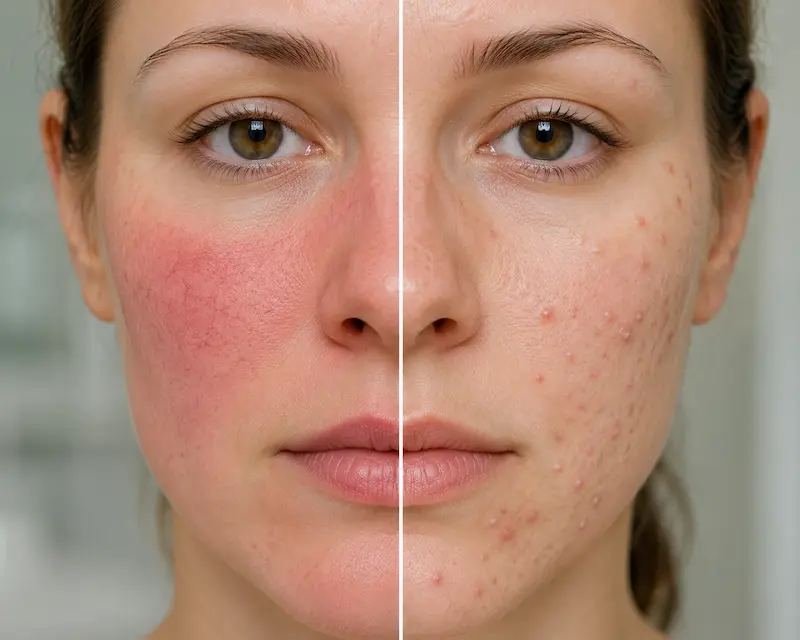
In my functional medicine practice, I see clients who have spent years — sometimes decades — confused about which condition they have. Their dermatologist diagnosed acne, then rosacea, then both, then neither. Each diagnosis came with a different treatment. Each treatment produced partial results, unexpected reactions, or no results at all. The confusion is understandable: without a clear visual framework for distinguishing the two, and without understanding the upstream drivers that produce each, both conditions resist the conventional treatment approach indefinitely.
This post provides that visual framework. But it also offers something more important: the functional medicine reframe that explains why, in a deeper clinical sense, the label matters less than most patients think. The upstream drivers of rosacea and acne overlap significantly — blood sugar dysregulation and hormonal imbalance are consistently present in both. What differs is how those shared upstream drivers are expressed in different people, through different genetic and physiological pathways. Functional medicine investigates the upstream picture regardless of which label applies — and addressing it often improves both conditions simultaneously, even when conventional medicine has been unable to resolve either.
Rosacea vs Acne: The Visual and Symptomatic Differences
Understanding the visual differences between rosacea and acne begins with the most important clinical differentiator: the presence or absence of comedones. Comedones — blackheads and whiteheads — are the hallmark of acne. True rosacea, regardless of grade, is characteristically absent of comedones. If you see blackheads or whiteheads alongside your pustules, the picture is more likely acne or a combination presentation than pure rosacea. If you see no comedones at all, rosacea becomes significantly more likely.
What Rosacea Looks Like
Rosacea typically begins as a persistent redness of the nose and cheeks that gradually becomes more permanent over time. In its early stages, the redness may come and go with triggers — heat, sun, alcohol, stress, and certain foods — but as the condition progresses, the redness becomes increasingly fixed rather than episodic. The skin may have a tight, shiny appearance that is frequently mistaken for oiliness.
This apparent oiliness is not oil production. It is accelerated trans-epidermal water loss through a compromised acid mantle and depleted ceramide barrier — the skin’s first line of defense — which gives the skin a wet appearance without the sebaceous activity of truly oily skin. Essential fatty acid deficiency is almost always part of this picture, further impairing the acid mantle and creating a barrier that cannot protect the underlying reactive vasculature from environmental triggers.
The visual analysis of rosacea includes: permanent diffused redness on the cheeks, couperose and visible red capillaries over the cheeks, chin, and nose wings, thin skin that marks and reacts easily, a sensation of tightness and dryness rather than oiliness, possible small blisters, and watery or itchy eyes in the ocular involvement pattern. Rosacea is more common in fair-skinned individuals but can develop in any skin tone. It is more prevalent in women between 30 and 50, though it can appear at any age and in either sex.
True grade 5 rosacea — the most advanced presentation — affects the face and is characterized by easy blushability, facial telangiectasia (visible dilated blood vessels), spider naevus, and central facial lesions that appear as elevated, palpable solid masses. These lesions are characteristically hot and sometimes itchy, similar to a hive. The marked absence of comedones remains consistent even at this advanced stage.
What Acne Looks Like — Grade by Grade
Acne presents differently depending on grade, and understanding the grade differences is essential to avoiding the most common misdiagnosis errors. The grade-by-grade picture is significantly more nuanced than the general acne description most patients receive:
Grade 1 — Typically presents with closed comedones on the chin, forehead, and nose wings with no inflammatory lesions or pustules. The T-zone may be slightly oily but there are no truly oily areas on the cheeks, neck, or back. This grade is frequently missed or dismissed as sensitive skin rather than recognized as the beginning of an acne pattern.
Grade 2 — Mostly open and closed comedones with some pustules located in the oilier areas of the face, particularly the chin and forehead. The presence of both open and closed comedones at this stage is one of the clearest visual differentiators from rosacea.
Grade 3 — Papules and pustules present in the T-zone and cheeks, with excess keratinization and open comedones, and a heavier skin texture overall. The skin may not be truly oily but has a sluggish, more viscous oil flow due to oxygenation loss. Most often found in late teens through the twenties. Scarring may begin at this grade due to inflammatory lesions.
Grade 4 — This grade carries the most significant misdiagnosis risk. Found primarily around the lower face — the chin, jawline, and neck — grade 4 acne contrary to common belief typically presents with lipid-dry or sensitive skin rather than oily skin. Some lesions are of a papule-nodular type and can be very tender. Critically, grade 4 typically does not present with open or closed comedones — which makes it the grade most frequently confused with rosacea by both patients and practitioners.
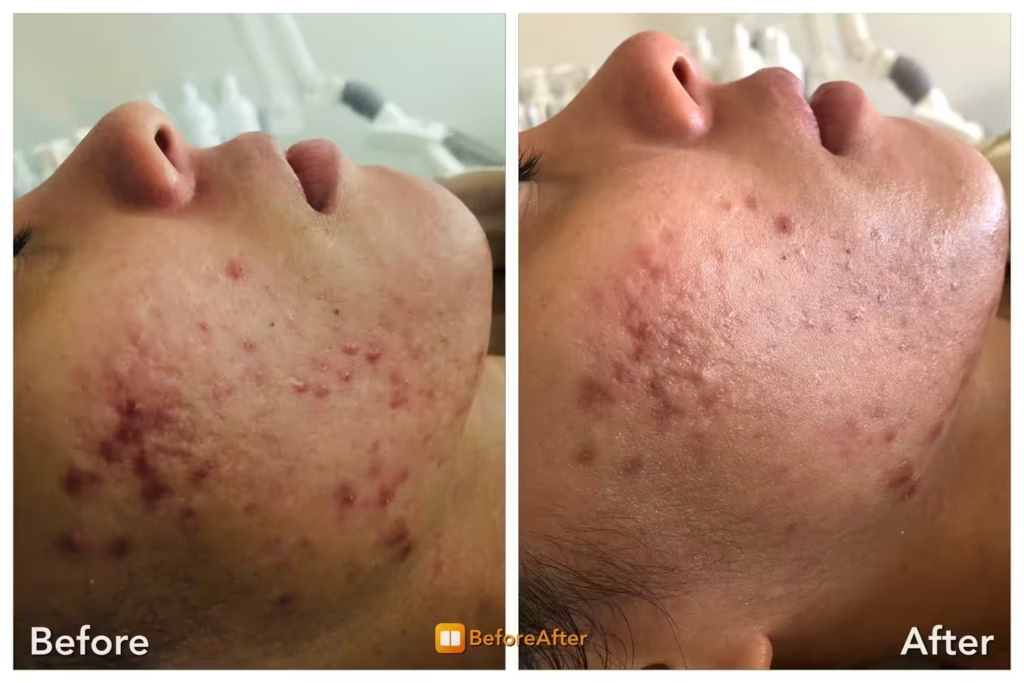
Grade 5 — Few comedones, some papules, many pustules, nodules, cysts, and abscesses. The cheeks are most often affected as well as the neck, chest, and back. Scarring is present and generally severe. The visual picture of grade 5 acne includes erythema around the cheeks and center of the face, slow-healing lesions with underlying redness, pigmentation or loss of pigmentation around scarring, skin that is easily aggressed and at times feels hot, itchy, and dry, and a buildup of dead skin cells.
The Single Most Important Visual Differentiator
The apparent oiliness distinction requires clinical nuance. Rosacea skin often appears oily due to accelerated trans-epidermal water loss from a compromised acid mantle and depleted ceramide barrier — the skin losing moisture through a damaged barrier rather than producing excess sebum. It will feel tight and dehydrated despite its wet appearance. Acne skin, however, does not always present as truly oily — this is one of the most common misconceptions about acne.
Grades 1-3 may have oiliness concentrated in the T-zone without true oiliness on the cheeks or neck, and grade 4 acne typically presents with lipid-dry or sensitive skin rather than oily skin, making skin type an unreliable differentiator at that grade.
The more reliable questions are: is the oiliness genuinely sebaceous, or does the skin feel dehydrated and tight beneath the surface appearance? And is the redness a persistent diffuse background redness with visible vessels — suggesting rosacea — or is it localized around individual inflammatory lesions — suggesting acne?
Why Acne Treatments Make Rosacea Worse — And Why This Distinction Matters
The clinical consequence of misdiagnosing rosacea as acne is not just ineffective treatment. It is actively damaging treatment. The most common acne interventions — benzoyl peroxide, salicylic acid, high-dose retinol, and aggressive exfoliation — are specifically contraindicated for rosacea-prone skin, and applying them to a rosacea presentation almost always worsens the condition in ways that can take months to reverse.The reason is the skin barrier. Rosacea skin already has a compromised acid mantle, depleted ceramides, essential fatty acid deficiency, and accelerated trans-epidermal water loss.
It is a barrier that is already struggling to protect the reactive underlying vasculature from the external environment. Every aggressive acne treatment that further strips the acid mantle or depletes barrier lipids amplifies the vascular reactivity, worsens the trans-epidermal water loss, and increases the reactive surface area that environmental triggers can reach. The skin that appeared to have acne gets redder, more reactive, and more sensitive — not because the acne treatment isn’t working, but because it is treating the wrong condition.
Benzoyl peroxide deserves particular attention in this context. Research published in Science documented the skin tumor-promoting activity of benzoyl peroxide — a free radical-generating compound that depletes antioxidant reserves in the skin including vitamin A and vitamin C. For rosacea skin that is already deficient in the vitamin A needed to normalize skin cell function and rebuild barrier integrity, benzoyl peroxide creates a vicious cycle: it addresses the surface pustules temporarily while depleting the very antioxidant reserves that the skin needs to rebuild the barrier and reduce the reactivity producing the pustules in the first place.
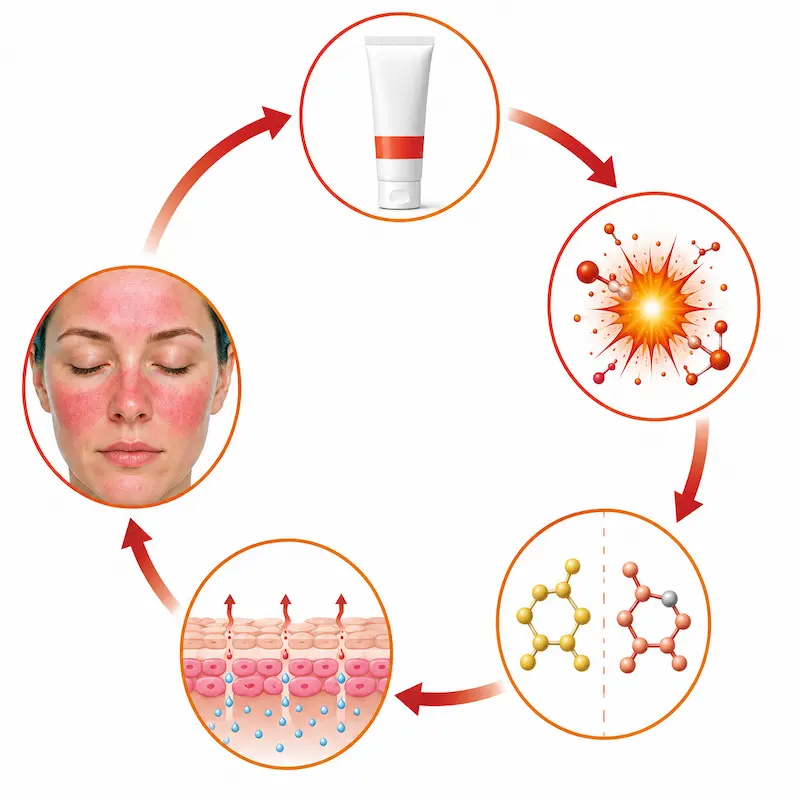
Long-term use can precipitate or significantly worsen the rosacea picture even when the initial diagnosis was acne, because the antioxidant and vitamin A depletion it produces creates the barrier vulnerability and immune dysregulation from which rosacea develops.
There is a third scenario that creates significant visual confusion between the two conditions: acne skin that has been over-stripped by aggressive topical treatment until it begins to look like rosacea — without actually being rosacea. When acne patients use drying, stripping topical agents over an extended period — benzoyl peroxide, high-concentration salicylic acid, aggressive retinol, and drying clay masks — the repeated disruption of the acid mantle and depletion of barrier lipids accelerates trans-epidermal water loss and produces a chronically inflamed, angry-looking redness across the skin. This is not the persistent background redness of true rosacea with its characteristic telangiectasia, couperose capillaries, and poor vascular tone.
It is reactive barrier-damaged skin that looks red and inflamed because the barrier has been compromised by the very treatments being used to address the acne. The distinction matters clinically: true rosacea redness is vascular in origin — driven by mast cell activation, histamine overload, and reactive vasculature — and is accompanied by visible blood vessels, spider naevus, and easy blushability that are absent in over-stripped acne skin. Over-stripped acne skin is barrier-damaged redness without the underlying vascular pathology.
The treatment response is also different: over-stripped acne skin responds to barrier restoration, gentle lipid replenishment, and removal of the stripping agents — while true rosacea requires the internal functional medicine investigation addressing the mast cell and vascular drivers alongside topical barrier support. Both require the same immediate response, however: stop stripping, start restoring.
The clinical implication for both conditions is the same: a baby-step approach is essential. Whether the picture is rosacea, acne, or a combination, both conditions should be treated as reactive and sensitive skin first — with the gentlest possible introduction of active ingredients, building tolerance progressively before increasing concentration or adding new actives. The aggressive acne treatment approach that works for some grade 2 or grade 3 presentations is contraindicated for any skin that shows signs of barrier compromise, essential fatty acid deficiency, or vascular reactivity — all of which are present in rosacea and in the lipid-dry sensitive presentations of grade 4 acne.
Can You Have Both Rosacea and Acne at the Same Time?
Yes — and this is more common than either patients or practitioners typically recognize. The same upstream environment of blood sugar dysregulation, hormonal imbalance, and gut dysfunction can simultaneously create the conditions for both rosacea and acne to develop in the same person, expressing through whichever physiological pathway their specific genetics, skin type, and hormonal profile makes most accessible.
When both are present simultaneously, the clinical picture is exactly the kind of confusing presentation that leads to decades of misdiagnosis: some comedones alongside persistent central facial redness, some dry reactive areas alongside some genuinely oily areas, some lesions that behave like acne pustules and others that behave like rosacea inflammatory papules. The conventional approach of diagnosing one or the other and treating accordingly produces partial results at best — because half the picture is being addressed and half is being ignored or actively worsened.
The functional medicine approach is not confused by this presentation because it does not begin with the label. It begins with the upstream investigation: what is driving the blood sugar dysregulation, what is producing the hormonal imbalance, what is the state of the gut microbiome and intestinal permeability, what is the thyroid and toxic burden picture. Addressing these upstream drivers often improves both conditions simultaneously — not because the treatment was designed for both, but because both were expressions of the same upstream environment.
The Shared Upstream Drivers — And How They Express Differently
Through a functional medicine lens, rosacea and acne are not fundamentally different diseases with different causes. They are different expressions of the same upstream dysfunction in different people. Blood sugar dysregulation and hormonal imbalance are consistently present in both — hormones are messengers that respond to the given internal environment, and when that environment is dysregulated by poor metabolic function, gut dysfunction, or toxic burden, the hormonal signaling that regulates skin cell turnover, sebaceous gland activity, immune reactivity, and vascular tone becomes dysregulated alongside it.
In acne, the hormonal dysregulation most commonly expresses through androgen excess and IGF-1 signaling that drives sebaceous gland overactivity, excess keratinization, and the follicular environment in which P. acnes thrives. In rosacea, the same hormonal dysregulation more commonly expresses through estrogen-mast cell activation, histamine overload, and vascular hyperreactivity that produces the flushing, redness, and inflammatory papule pattern characteristic of the condition. But these are tendencies, not fixed rules — the same person can carry both expressions simultaneously when the upstream environment creates conditions for both pathways to activate.
What determines which expression predominates is not the upstream driver itself but the person — their genetic skin type, their sebaceous gland density, their vascular reactivity, their mast cell sensitivity, capability to degrade histamine, their gut microbiome composition, and the specific hormonal and metabolic pattern their individual biochemistry produces in response to the shared upstream dysfunction. This is why functional medicine does not treat the label. It treats the person — and when the whole person is treated, both labels often improve together.
The Pattern I Consistently See: Years of Confusion, One Upstream Picture
One of the most consistent patterns I encounter in my functional medicine practice is the patient who arrives having been diagnosed with multiple different conditions by multiple different practitioners over multiple years — acne in her twenties, rosacea in her thirties, both simultaneously in her forties — each diagnosis accompanied by a different treatment protocol, each treatment producing partial results before the picture shifted and a new diagnosis replaced the old one.
The confusion is not a failure of the individual practitioners. It is a structural limitation of a diagnostic system that requires a condition label before it can prescribe a treatment, and that treats each label as a distinct disease rather than as a different expression of the same underlying terrain. When the terrain is never investigated, the labels change as the expression changes — because the upstream environment that is producing the skin symptoms is not static.
It evolves as the patient ages, as her hormonal landscape shifts, as her gut health changes, as her toxic burden accumulates, as her thyroid function declines. Each shift in the upstream environment produces a slightly different surface expression — and conventional medicine responds to each surface expression with a new label and a new treatment, while the terrain that is producing them remains unaddressed.
When the functional medicine investigation finally happens — sometimes after a decade or more of this cycle — the upstream picture is almost always clear: blood sugar dysregulation that has been feeding gut dysbiosis and driving hormonal imbalance for years, a full thyroid panel that reveals subclinical dysfunction invisible to TSH-only testing, a gut microbiome compromised by years of antibiotic treatment for the acne that was actually rosacea, a toxic burden that has been priming the immune system for mast cell hyperreactivity that looked like rosacea on top of the acne, and nutrient insufficiencies from impaired absorption that have been depleting the essential fatty acids, vitamin A, and zinc needed for barrier integrity and skin normalization.
Addressing this upstream picture does not require a definitive diagnosis of rosacea vs acne. It requires understanding what has been creating the skin’s inability to function normally — and systematically restoring the conditions in which it can. The label may be useful for describing what the skin looks like right now. The upstream investigation is what determines what the skin can look like from here.
The Label Doesn’t Matter. The Upstream Picture Does.
In functional medicine, the beauty of root-cause investigative medicine is that the label becomes secondary. Whether your skin is expressing rosacea, acne, or both simultaneously, the investigation asks the same question: what is creating the internal environment in which this is happening? And when that question is answered and the upstream picture is addressed, the surface expression — whatever label it carried — often resolves together.
If you have been confused for years about whether you have rosacea or acne — if you have tried treatments for both with inconsistent results — if your diagnosis has changed multiple times and you are no closer to understanding what is actually happening in your skin — the answer is almost certainly not a better diagnosis. It is an upstream investigation.
Both rosacea and acne should be approached as reactive and sensitive skin conditions regardless of grade or label. Both require a baby-step approach to active ingredients, progressive building of tolerance, and barrier support before any aggressive treatment is introduced. And both, in my clinical experience, respond most completely not to the most targeted topical treatment for their specific label, but to the functional medicine investigation that identifies and addresses the shared upstream environment producing them.
→ Book your Initial Functional Medicine Health and Skin Assessment
P.S. If finances have been the only thing standing between you and starting your functional medicine journey — flexible payment options are available through Cherry. No interest, no impact on your credit score, quick approval, and affordable monthly payments. Apply in minutes on our website.
Frequently Asked Questions
Q1: How do I know if I have rosacea or just acne?
The single most reliable visual differentiator is the presence or absence of comedones — blackheads and whiteheads. True rosacea does not produce comedones at any grade. If you have blackheads or whiteheads alongside your pustules and redness, the picture is more consistent with acne or a combination presentation. If you have no comedones at all alongside persistent central facial redness, visible blood vessels, and reactive pustules that worsen with heat, sun, and alcohol, the picture is more consistent with rosacea. The apparent oiliness is a second important differentiator: rosacea skin often looks oily due to trans-epidermal water loss from a compromised barrier — not actual sebaceous overactivity — and will feel tight and dehydrated rather than genuinely oily despite its appearance.
Q2: What are the visual differences between rosacea pustules and acne pustules?
Rosacea pustules appear in the context of persistent background redness, visible blood vessels (telangiectasia), and thin reactive skin — without accompanying blackheads or whiteheads, and typically distributed across the central face, cheeks, nose, and chin. Acne pustules appear alongside comedones in most grades, in areas of genuine sebaceous activity, and are associated with either oily skin (grades 1-3) or, in grade 4, with lipid-dry sensitive skin around the lower face and jawline without comedones. The sensation also differs: rosacea inflammatory lesions are characteristically hot and sometimes itchy like a hive, while acne pustules are more consistently tender and associated with underlying congestion in the follicle.
Q3: Can you have both rosacea and acne at the same time?
Yes — and this is more common than either patients or practitioners typically recognize. The same upstream environment of blood sugar dysregulation, hormonal imbalance, and gut dysfunction can simultaneously create conditions for both rosacea and acne to develop in the same person, expressing through whichever physiological pathway their specific genetics and skin physiology makes most accessible. When both are present, the clinical picture includes some comedones alongside persistent central facial redness, some dry reactive areas alongside oily areas, and lesions that behave like both conditions simultaneously. The functional medicine approach investigates the shared upstream drivers rather than attempting to diagnose one label or the other, which is why addressing the upstream picture often improves both conditions together.
Q4: Can acne treatments trigger or worsen rosacea?
Yes — significantly, and this is one of the most common reasons rosacea worsens over time without the patient or practitioner understanding why. Benzoyl peroxide, salicylic acid, high-dose retinol, and aggressive exfoliation are the most common acne treatments that actively damage the already-compromised rosacea barrier. Benzoyl peroxide specifically generates free radicals that deplete vitamin A and vitamin C reserves in the skin — the very antioxidants rosacea skin needs to rebuild barrier integrity and normalize skin cell function. Long-term use can precipitate or significantly worsen a rosacea picture even when the original diagnosis was acne, by creating the antioxidant depletion and barrier vulnerability from which rosacea develops. Both conditions should be treated as reactive and sensitive skin with a baby-step approach to active ingredients regardless of the label.
Q5: Why did my dermatologist diagnose me with acne and then rosacea?
Because the surface expression of the skin changes as the upstream drivers producing it evolve — and conventional medicine diagnoses the surface expression rather than the upstream environment. The same internal picture of blood sugar dysregulation, hormonal imbalance, gut dysfunction, and accumulating toxic burden can produce an acne-predominant expression in the twenties, a combination expression in the thirties, and a rosacea-predominant expression in the forties as the hormonal and metabolic picture shifts. Each shift in the upstream environment produces a different surface expression — and conventional medicine responds to each with a new label and a new treatment, while the terrain producing them remains unaddressed. A changing diagnosis is not evidence of diagnostic error. It is evidence that the upstream picture has never been investigated.
Q6: Why does my acne look like rosacea?
A common reason why acne looks like rosacea is because of the treatment-induced barrier damage. Acne patients who use stripping and drying topical agents over an extended period — benzoyl peroxide, high-concentration salicylic acid, aggressive retinoic acid — can develop a chronically red, inflamed, reactive skin appearance from repeated acid mantle disruption and accelerated trans-epidermal water loss. This is not true rosacea. It is over-stripped skin that appears angry and inflamed as a direct consequence of the treatment approach. The key visual distinction: true rosacea has telangiectasia, visible couperose capillaries, and poor vascular tone — structural vascular changes that over-stripped acne skin does not usually present. The redness of over-stripped acne skin is diffuse inflammation from barrier compromise, not the persistent vascular reactivity of rosacea. Removing the stripping agents and restoring the barrier typically resolves the rosacea-like appearance in over-stripped acne skin, while true rosacea requires the upstream internal investigation alongside topical barrier support.
Grade 4 acne is the most commonly confused with rosacea because it shares several features: it typically presents without comedones, often on sensitive or lipid-dry skin rather than oily skin, and produces tender inflammatory lesions around the lower face. The absence of comedones in grade 4 acne — the feature that most practitioners use to distinguish acne from rosacea — makes it look like rosacea to both patients and practitioners who haven’t seen the grade 4 presentation before. The location is the most useful differentiator: grade 4 acne tends to concentrate around the chin, jawline, and neck, while rosacea tends to concentrate on the central face, cheeks, and nose. If the lesions are primarily on the lower face and jawline with no central facial redness or visible blood vessels, grade 4 acne is more likely. If persistent central facial redness and visible vessels are present, rosacea or a combination is more likely.
Written by Natalie Maibenko – a Certified Functional Medicine Practitioner and Master Esthetician with 22+ years of experience and founder of Unique Verve

Natalie Maibenko
Functional Medicine & Skincare Expert – Helping You Take Control of Your Health and Achieve Lasting Skin Results Nationwide — Virtual Practice
As a Certified Functional Medicine Practitioner my Expertise Encompasses:
- Immune System: frequent illness, UTIs, yeast infections
- Allergies, Asthma
- Skin Problems: acne, cystic acne, rosacea, eczema, dermatitis, ichthyosis, psoriasis, vitiligo, melasma
- Inflammation: arthritis, rhinitis, joint & muscle pain, migraines, headaches
- Sleep Disturbunces, Insomnia
- Gut Problems: IBS/IBD, bloating, acid reflux, gas, constipation, diarrhea, parasites, fungal/yeast overgrowths
- Hormonal Imbalances: PCOS, PMS symptoms, weight problems/inability to lose weight, thyroid problems
- Hair Loss, Alopecia
- Mood Imbalances: anxiety, depression, irritability
- Metabolic Dysfunction, Insulin Resistance, Type 2 Diabetes
- Optimizing Wellness for Successful Pregnancy
- Autoimmune Conditions: Hashimoto’s thyroiditis, grave’s disease, reumatoid arthritis (RA), lupus, etc
- Bone Health: osteopenia/ osteoporosis
- Effective Anti-Aging Strategies without Injectables with the inside-out & outside-in approach
- Detoxification of Heavy Metals, Mycotoxins, Environmental Toxins
- Reversing Breast Implant Illness
- Preparation for the Explant Surgery and Optimization of Wellness & Vitality Post-Explant
