
Introduction
Why does stress make rosacea worse — and more importantly, why doesn’t reducing stress through meditation and yoga actually resolve it? If you have been told by your dermatologist to manage your stress and have diligently practiced mindfulness, adjusted your lifestyle, and reduced your emotional load without seeing meaningful improvement in your rosacea, you are not failing at stress management. You are experiencing the most important and most consistently overlooked clinical insight about the stress-rosacea relationship: emotional stress is only one of three sources of stress that drive rosacea, and it is rarely the most significant one.
The conventional advice to reduce stress for rosacea assumes that stress means emotional stress — work pressure, anxiety, difficult relationships. But the HPA axis — the hypothalamic-pituitary-adrenal system that produces cortisol in response to stress — cannot distinguish between a difficult conversation and a leaky gut producing LPS-driven immune activation. Between a work deadline and blood sugar dysregulation crashing between meals. Between a painful emotional experience and a toxic burden accumulating silently in the liver and kidneys. All of these signal the same biochemical stress response. All of them produce the same cortisol elevation. And all of them drive the same rosacea cascade through the same internal pathways — regardless of how much yoga is practiced in the meantime.

This post explains why stress makes rosacea worse through a complete functional medicine lens — the cortisol mechanisms that drive rosacea directly, the structural damage that cortisol-elevated blood sugar produces in rosacea skin, the three sources of stress that conventional medicine addresses at most one of, and why the pattern I see consistently in clinical practice is that rosacea begins to genuinely improve only when all three sources are investigated and addressed simultaneously.
What Actually Happens in Your Body When Stress Triggers Rosacea
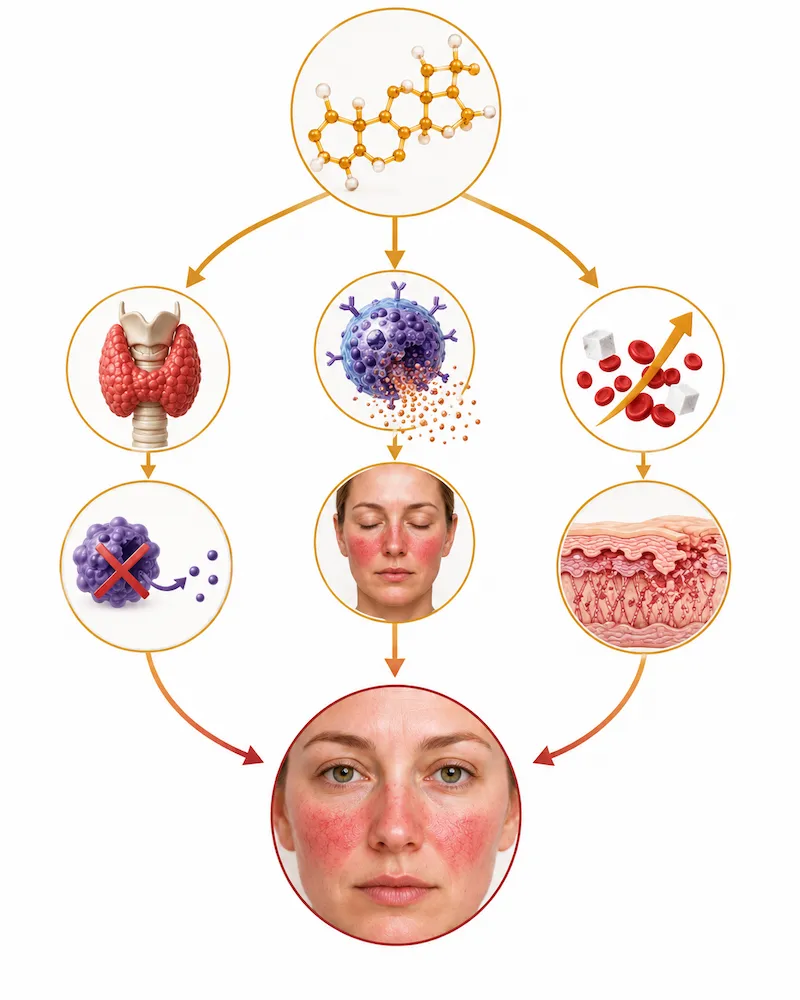
When your body perceives stress — from any source — it produces a stress hormone called cortisol. In small doses and short bursts, cortisol is protective and adaptive. But when cortisol is elevated day after day — from emotional pressure, poor gut health, blood sugar swings, and toxic burden all at once — it becomes one of the most significant drivers of rosacea progression.
Here is what elevated cortisol does to your skin and your body simultaneously:
It Quietly Suppresses Thyroid Function
Cortisol interferes with the thyroid hormones your body needs to function well. When thyroid function drops — even subtly, in a way that standard blood tests often miss — the enzyme that breaks down histamine in your gut becomes less active. Histamine builds up. And histamine is one of the primary drivers of the redness, flushing, and inflammatory bumps of rosacea. This is one of the reasons a rosacea patient can feel fine emotionally but still be flaring constantly — because the stress on the thyroid is physiological, not emotional.
It Triggers Immune Cells in Your Skin Called Mast Cells
Cortisol activates your body’s fight-or-flight response, which directly triggers immune cells in the skin called mast cells. When mast cells are activated, they release histamine — producing the immediate flushing and redness you recognize as a stress flare. Research published in the Journal of Investigative Dermatology confirmed that mast cells are the missing link between stress triggers and rosacea inflammation. Without mast cell activation, the rosacea inflammatory cascade does not occur.
When mast cells fire, they also release enzymes that damage the tiny blood vessels beneath the skin and begin breaking down the structural proteins — collagen and elastin — that normally keep those vessels contained and the skin resilient. Over time, this is what produces the visible blood vessels, the thinning reactive skin, and the progressive worsening of rosacea that conventional treatment cannot reverse.
It Raises Blood Sugar — Which Damages Skin Structure
Cortisol raises blood sugar directly — it is one of cortisol’s primary biological functions. For a rosacea patient who already has some degree of blood sugar dysregulation (which is extremely common in this population), chronically elevated cortisol compounds the problem significantly.
When blood sugar stays elevated over time, it produces compounds called advanced glycation end products — or AGEs — that attach to collagen and elastin and make them stiff, brittle, and less able to do their job. The same skin proteins that mast cell activation is simultaneously damaging are being further compromised by the structural changes from elevated blood sugar. And UV exposure — a known rosacea trigger — damages the same proteins yet again. Three simultaneous forces degrading the same structural foundation of rosacea skin — all driven by the same upstream stress picture that meditation was never designed to address.
The Three Sources of Stress Driving Your Rosacea — And Why Addressing Only One Never Works
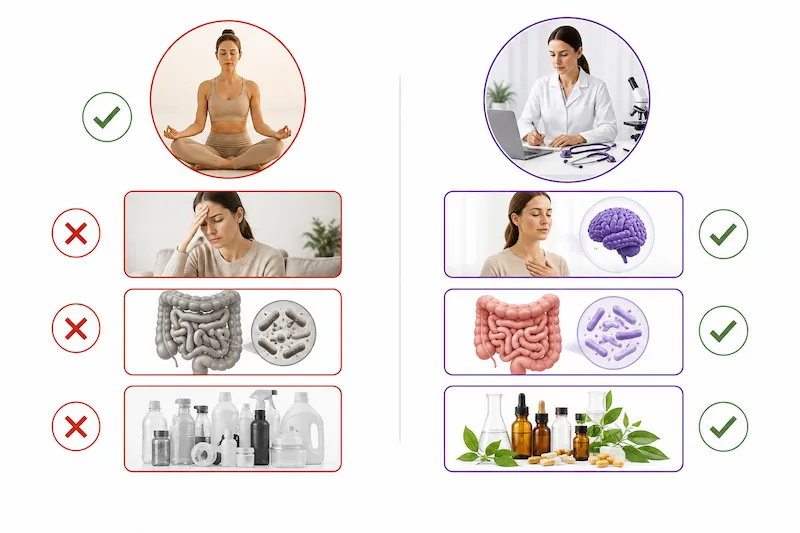
The reason why stress management so consistently fails to resolve rosacea is straightforward: emotional stress is only one of three simultaneous sources of the stress hormone that is driving the skin response. The other two are physical, internal, and completely unaffected by any emotional stress management practice.
Source 1 — Emotional and Psychological Stress
This is the one everyone talks about. Work pressure, anxiety, relationship difficulties, grief, major life events. Real, significant, and worth addressing. But managing this source alone addresses at most one-third of the stress burden driving the rosacea.
Source 2 — Physical Stress From Inside the Body
This is the source that explains why committed meditators still flare. Your body’s stress system responds to physical internal threats exactly the same way it responds to emotional ones. Poor gut health — including bacterial overgrowth, parasites, or a damaged gut lining — sends the same alarm signal as emotional anxiety. Blood sugar that crashes between meals, spikes after eating, or drops overnight forces the body to produce stress hormones to correct it. A buildup of heavy metals, mold toxins, or environmental chemicals keeps the immune system in a state of constant low-grade alarm. None of these respond to meditation. All of them sustain the cortisol-rosacea cascade regardless of how calm the emotional picture becomes.
Source 3 — The Stress of Having Rosacea Itself
This is the most self-reinforcing of the three and the one that makes the cycle so difficult to break from the outside. The visible redness, breakouts, and reactive skin of rosacea create real emotional distress — looking in the mirror and seeing an uncontrollable skin condition, feeling self-conscious in social situations, feeling frustrated that nothing is working. That distress activates the same stress response that produces the next rosacea flare. The rosacea worsens. The distress deepens. More stress hormones are produced. More immune cells are triggered. And the cycle sustains itself with no external emotional trigger required.
This is why rosacea can feel impossible to interrupt through lifestyle changes alone. Three self-reinforcing entry points, each sustaining the others. Emotional stress management helps but cannot reach the physical internal sources. Gut restoration helps but cannot immediately resolve the emotional burden. Topical treatment helps but cannot address either the gut or the stress picture producing the underlying reactivity. The functional medicine investigation — identifying and addressing all three sources together — is what creates enough simultaneous interruption points for genuine improvement to take hold.
Can Positive Stress Also Trigger Rosacea?
Yes — and this surprises many rosacea patients. Your body’s stress system cannot distinguish between a difficult experience and an exciting one at the hormonal level. A promotion, a wedding, an important trip, a big social event — all produce the same cortisol response as a difficult conversation or a painful experience, because the stress hormone is triggered by any state of heightened demand on the body, not by whether the experience feels good or bad.
This is why a holiday that was genuinely enjoyable produces a significant rosacea flare. Why a positive life event triggers the exact skin response a patient was hoping to avoid. The skin is not responding to whether the stress is good or bad. It is responding to the internal hormonal and immune cascade that any form of heightened demand activates — which is why the rosacea patient whose internal environment is already burdened has a much lower threshold for stress-triggered flares than someone whose body is not carrying that accumulated load.
The Pattern I Consistently See
In my clinical practice, patients who come to me having tried every stress management approach without meaningful improvement in their rosacea almost always share the same internal picture when we investigate together. Their thyroid is not functioning optimally — often within the range that standard blood tests call normal, but below the level where it supports good immune function, histamine breakdown, gut health and detoxification. Their gut is carrying some level of dysbiosis — often H. Pylori, bacterial overgrowth, or parasitic infection that has been quietly generating a physical stress signal for years. Their blood sugar is dysregulated in ways that produce cortisol surges between meals and overnight. Their nutrient levels are depleted in the specific vitamins and minerals the body needs to manage stress hormones and break down histamine. And they are carrying some level of toxic burden from heavy metals or environmental chemicals that is keeping their immune system in a state of constant alert.
None of these show up when a doctor checks for emotional stress. None of them respond to meditation. All of them are measurable, identifiable, and addressable through functional medicine investigation. And when they are addressed — not one at a time, but together as the interconnected picture they are — the stress threshold rises dramatically. The same emotional pressure that previously produced an immediate visible flare produces no response at all — not because the patient has become better at managing stress, but because the physical internal burden that was keeping her skin at the breaking point has been removed.
Stress Is Not Just in Your Head
Why does stress make rosacea worse? Because stress is not only coming from your mind. It is coming from inside your body — from the gut that is under chronic strain, from the blood sugar that is swinging and producing stress hormones in response, from the toxic load the body is working to clear, and from the visible skin condition itself creating the emotional distress that feeds the next flare. Addressing only the emotional piece while leaving the physical sources untouched is why stress management so consistently produces incomplete results for rosacea patients who are doing everything they have been told to do.
The investigation that addresses all three sources simultaneously — the gut, the metabolic picture, the toxic burden, the thyroid, the nutrient status, and the emotional picture together — is what produces the kind of improvement that lifestyle changes alone never achieved. Not because the patient finally managed her stress well enough, but because the internal environment that was amplifying every stress into a rosacea response was finally investigated and addressed.
If you have been managing your emotional stress diligently and your rosacea continues to worsen, the most important next step is not a better stress management technique. It is the upstream rosacea investigation that has never happened — the one that identifies what your body has been responding to all along that no amount of meditation was designed to reach.
→ Book your Initial Functional Medicine Health and Skin Assessment
P.S. If finances have been the only thing standing between you and starting your functional medicine journey — flexible payment options are available through Cherry on our website. No interest, no impact on your credit score, quick approval, and affordable monthly payments. Apply in minutes on our website.
Q1: Can stress really trigger rosacea flare-ups?
Yes — and through a more specific mechanism than most people realize. When your body perceives stress, it releases a stress hormone that simultaneously interferes with thyroid function (reducing the body’s ability to break down histamine), activates immune cells in the skin called mast cells (which release histamine producing the flushing and redness of a rosacea flare), and raises blood sugar (which over time damages the structural proteins in skin that keep blood vessels contained and protected). Research has confirmed that mast cells are the missing link between stress triggers and rosacea inflammation — without mast cell activation, the rosacea inflammatory cascade does not occur.
Q2: Does high cortisol cause rosacea?
Chronically elevated cortisol — the body’s primary stress hormone — is one of the most consistent drivers of rosacea progression. It interferes with thyroid function reducing histamine breakdown, activates mast cells triggering the skin’s inflammatory response, and raises blood sugar producing compounds that damage the skin’s structural collagen and elastin over time. Critically, cortisol is elevated not only by emotional stress but by poor gut health, blood sugar dysregulation, and a buildup of environmental toxins — which is why rosacea clients who manage emotional stress without addressing these physical internal sources see incomplete improvement.
Q3: Can anxiety make rosacea worse overnight?
Yes — and the response can be rapid. Anxiety activates the body’s fight-or-flight response, which directly triggers mast cells in the skin within minutes. These immune cells release histamine producing immediate flushing and redness, and other compounds that begin damaging the blood vessel walls and skin structure beneath. In a patient whose mast cells are already sensitized from poor gut health, hormonal imbalance, or toxic burden, the threshold for anxiety to produce a visible rosacea response is significantly lower than in someone without that underlying picture.
Q4: Why does my face turn red when I’m anxious?
When you experience anxiety, your body’s fight-or-flight response activates immune cells in the skin called mast cells. These cells release histamine, which causes the small blood vessels in the face to dilate — producing the visible redness and flushing. Simultaneously, the same immune cells release other compounds that further destabilize the blood vessels and sustain the inflammatory response beyond the initial anxiety trigger. In rosacea patients, the underlying skin environment is already primed for a stronger and faster response than in people without rosacea — which is why emotional triggers produce such immediate and visible skin reactions.
Q5: What’s the connection between stress and my rosacea?
Stress drives rosacea through three simultaneous sources that most patients — and most dermatologists — are only aware of one of. Emotional stress triggers the body’s stress hormone response, activating the immune and inflammatory cascade that produces rosacea flares. Physical internal stress from poor gut health, blood sugar dysregulation, and toxic burden produces the exact same hormonal response independently of emotional circumstances — which is why stress management alone produces incomplete results. And the psychological burden of rosacea’s own appearance creates real emotional distress that feeds the next flare — a self-reinforcing cycle. All three sources need to be identified and addressed together for the stress-rosacea cycle to be genuinely interrupted.
Q6: Can positive stress still trigger rosacea?
Yes — and this surprises many rosacea patients. The body’s stress system cannot distinguish between a difficult experience and an exciting one at the hormonal level. A promotion, a wedding, an exciting trip — all produce the same stress hormone response as negative stress, because the response is triggered by any state of heightened demand on the body, not by whether the experience feels good or bad. A patient whose internal environment is already carrying significant burden will experience rosacea responses from positive events as consistently as from negative ones — until the underlying picture is addressed and the threshold is raised.
Q7: Can anxiety cause permanent rosacea?
Anxiety alone does not cause permanent rosacea. But anxiety sustained alongside unaddressed gut dysfunction, blood sugar dysregulation, and toxic burden creates a progressively more entrenched internal environment in which rosacea becomes harder to resolve over time. The structural damage to skin collagen and elastin from chronically elevated blood sugar is cumulative. The lower the internal threshold for stress-triggered immune activation becomes, the more easily any stress — physical or emotional — produces a visible response. This is why earlier investigation and intervention produces more complete improvement than later — the picture is more reversible before it becomes more deeply established.
Written by Natalie Maibenko – a Certified Functional Medicine Practitioner and Master Esthetician with 22+ years of experience and founder of Unique Verve

Natalie Maibenko
Functional Medicine & Skincare Expert – Helping You Take Control of Your Health and Achieve Lasting Skin Results Nationwide — Virtual Practice
As a Certified Functional Medicine Practitioner my Expertise Encompasses:
- Immune System: frequent illness, UTIs, yeast infections
- Allergies, Asthma
- Skin Problems: acne, cystic acne, rosacea, eczema, dermatitis, ichthyosis, psoriasis, vitiligo, melasma
- Inflammation: arthritis, rhinitis, joint & muscle pain, migraines, headaches
- Sleep Disturbunces, Insomnia
- Gut Problems: IBS/IBD, bloating, acid reflux, gas, constipation, diarrhea, parasites, fungal/yeast overgrowths
- Hormonal Imbalances: PCOS, PMS symptoms, weight problems/inability to lose weight, thyroid problems
- Hair Loss, Alopecia
- Mood Imbalances: anxiety, depression, irritability
- Metabolic Dysfunction, Insulin Resistance, Type 2 Diabetes
- Optimizing Wellness for Successful Pregnancy
- Autoimmune Conditions: Hashimoto’s thyroiditis, grave’s disease, reumatoid arthritis (RA), lupus, etc
- Bone Health: osteopenia/ osteoporosis
- Effective Anti-Aging Strategies without Injectables with the inside-out & outside-in approach
- Detoxification of Heavy Metals, Mycotoxins, Environmental Toxins
- Reversing Breast Implant Illness
- Preparation for the Explant Surgery and Optimization of Wellness & Vitality Post-Explant
