
Introduction
Leaky gut and eczema. If you have been researching the gut connection to your skin, you may have encountered this pairing and wondered whether the gut is actually driving what is happening on the surface. The short answer is: in most cases, yes — and in ways that are significantly more specific and more clinically important than most eczema content explains.
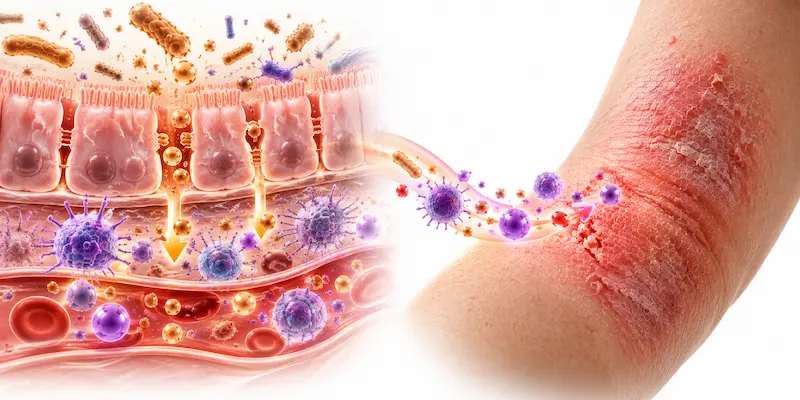
Eczema is not a skin condition that originates in the skin. It is a systemic inflammatory condition that expresses through the skin — and the gut is the primary site of the immune dysregulation that drives it. When the intestinal lining becomes more permeable than it is designed to be — the state commonly called leaky gut — bacterial fragments and toxins cross from the gut into the bloodstream, activating the immune system in ways that produce the exact inflammatory pattern that eczema represents. Treat the skin surface all you want: if the leaky gut feeding the immune activation is never addressed, the eczema has nowhere to go but back.
This post explains the leaky gut and eczema connection at clinical depth: what increases intestinal permeability, what the upstream perpetrators driving gut dysbiosis in eczema patients consistently are, why the picture worsens over time when the root cause is never addressed, and what the functional medicine investigation looks for instead.
What Leaky Gut Actually Means — and Why It Matters for Eczema
The term ‘leaky gut’ describes increased intestinal permeability — a state in which the tight junction proteins sealing the gaps between the cells lining the intestinal wall become compromised, allowing contents that should remain inside the gut lumen to cross into the bloodstream. In a healthy gut, the intestinal lining is selectively permeable: it allows nutrients to cross from the gut into circulation while maintaining a barrier against bacterial fragments, undigested food proteins, and the toxic metabolic byproducts produced by pathogenic bacteria. When tight junction integrity is impaired, this selectivity is lost.
What crosses through a leaky gut is immunologically significant. Fragments of bacterial cell walls called lipopolysaccharides — LPS — enter the bloodstream and activate immune receptors on cells throughout the body, producing a cascade of inflammatory signals including TNF-alpha, IL-6, and IL-1β. These are the same inflammatory cytokines that sustain the immune dysregulation driving eczema. Mast cells throughout the body are sensitized by this LPS-driven immune activation, lowering their threshold for degranulation in response to everyday triggers. And the immune system’s regulatory capacity — the T-regulatory cells that would normally keep inflammatory responses proportionate — is progressively depleted by the chronic, low-grade activation that a persistently leaky gut produces.
Research confirms that up to 24 percent of atopic dermatitis patients test positive for small intestinal bacterial overgrowth — one of the most direct drivers of leaky gut. Bacterial overgrowth in the small intestine produces toxic metabolites that directly injure the intestinal lining, further increasing permeability and deepening the systemic immune activation that the skin is expressing. The gut lining and the skin barrier are both downstream of the same dysbiotic, inflamed internal environment. Addressing the gut lining is not an alternative to addressing the eczema. It is the most direct path to addressing the immune environment the eczema is reflecting.
The Upstream Perpetrators — What Is Actually Driving Gut Dysbiosis
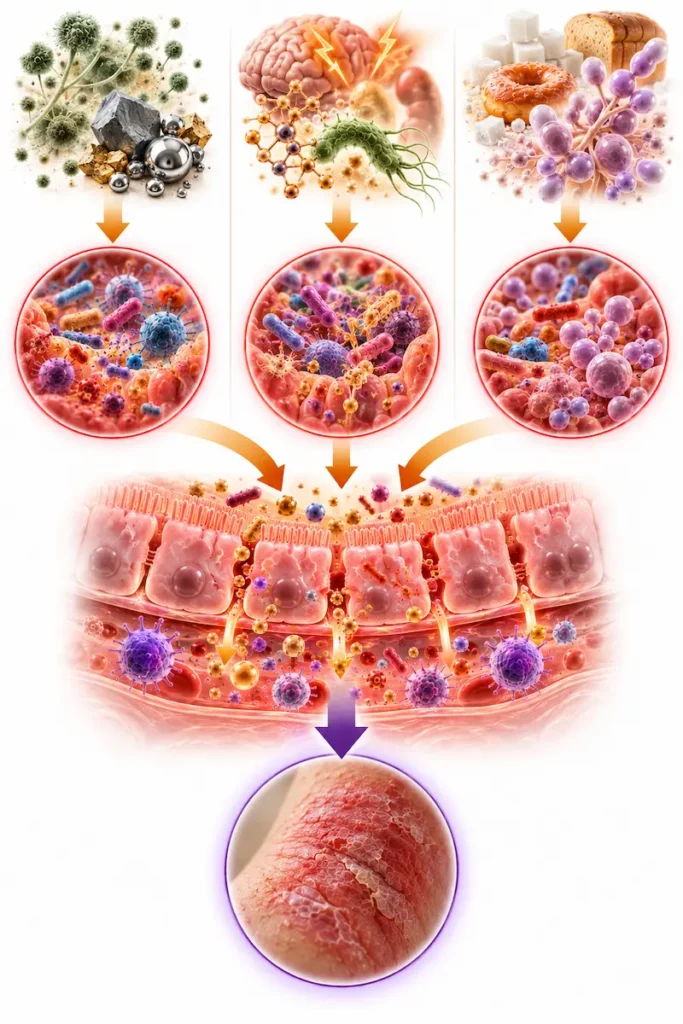
The most important clinical insight about leaky gut and eczema is one that most gut health content misses: gut dysbiosis is not the primary problem. It is the consequence of upstream perpetrators that have shifted the gut’s microbial environment toward a state in which pathogenic organisms thrive and the commensal bacteria that maintain intestinal integrity are progressively displaced.
Microbes respond to their environment. When the internal environment contains mycotoxins from mold exposure, heavy metals, chronic stress hormones, or a diet feeding pathogenic organisms, the microbial population shifts to reflect that environment. Treating the dysbiosis — with probiotics, with dietary changes, with gut-healing supplements — without identifying and removing what is producing the dysbiogenic environment produces temporary improvement and predictable relapse. This is precisely the pattern most eczema patients recognize from their own attempts at gut-focused self-treatment.
In my clinical practice, the upstream perpetrators behind gut dysbiosis in eczema patients fall into three consistent patterns:
Mycotoxins and Toxic Burden
Mycotoxins — the secondary metabolites produced by mold in water-damaged buildings, contaminated food, and environmental exposure — are present in the vast majority of my eczema clients when Total Tox Burden testing is performed. This is not coincidental. Research confirms that mycotoxin exposure disrupts the intestinal micro-ecological balance, enriching pathogenic organisms including E. coli while depleting the beneficial bacteria that maintain gut barrier integrity. Mycotoxins downregulate the tight junction proteins that prevent intestinal permeability — directly causing the leaky gut that drives systemic immune activation. And mycotoxins have been confirmed in clinical research to aggravate atopic dermatitis specifically by amplifying the Th2 immune response and the inflammatory signaling that eczema reflects.
Heavy metals — mercury, lead, and cadmium — operate through the same pathway: maintaining the immune system in a state of chronic hypervigilance, depleting the zinc and magnesium that gut repair and immune regulation depend on, and compounding the intestinal permeability that mycotoxin exposure produces. When Total Tox Burden testing reveals significant mycotoxin and heavy metal burden alongside eczema, the leaky gut and the immune dysregulation driving the skin are both explained by the same upstream toxic picture.
Stress — Physiological and Emotional
Chronic stress is one of the most consistent gut dysbiosis drivers in eczema patients — and it operates through mechanisms that are more specific than most people realize. Elevated cortisol from sustained stress directly increases intestinal permeability by disrupting tight junction protein expression. It reduces gastric acid production, creating the conditions for pathogenic bacterial overgrowth including H. Pylori. And the sustained catecholamine elevation that stress produces when the stress hormone clearance enzyme is insufficient — as it is when magnesium is depleted and when genetic variants reduce its efficiency — activates mast cells and amplifies the inflammatory response that leaky gut is feeding.
In clinical practice, I frequently see H. Pylori overgrowth emerging in patients following a particularly stressful period — a bereavement, a difficult year, a sustained professional pressure. The stress suppressed gastric acid, created the low-acid environment that H. Pylori thrives in, and the immune dysregulation that follows becomes the gut environment from which SIBO and leaky gut develop. The skin reflects the gut. And the gut reflects the stress history that conventional dermatology never asked about.
Dietary Patterns Feeding Pathogenic Overgrowth
Refined carbohydrates, sugar, and alcohol are among the most effective feedstocks for pathogenic gut organisms — particularly Candida and the bacterial strains that drive SIBO. A period of eating that heavily features these foods — a stressful year of convenience eating, a prolonged period of emotional eating, the dietary pattern of someone who has been prioritizing everything else over nutrition — can shift the gut microbial balance toward Candida overgrowth and the bacterial population shifts that produce SIBO. Candida, once overgrown, produces acetaldehyde that further damages the intestinal lining. The SIBO that follows produces toxic metabolites that increase permeability. The leaky gut amplifies the systemic immune activation that the dietary shift initiated. And the eczema arrives, or worsens, in a gut whose microbial balance has been shifted by what was feeding it.
The UTI Pattern — Another Downstream Signal of the Same Upstream Problem
One finding that consistently surprises my eczema clients when I explain the gut-skin connection is the relationship between recurrent urinary tract infections and gut dysbiosis. Many of the clients who come to me with eczema also have a history of recurrent UTIs — and most have never been told these two things might be connected.
The connection runs through E. coli. Research confirms that E. coli — the primary UTI pathogen — is also one of the dominant organisms in SIBO, and the gut serves as its primary reservoir. The same gut dysbiosis that is producing SIBO and leaky gut and driving eczema is also providing E. coli with the environment in which it can migrate to the urinary tract and cause infection. Antibiotics prescribed for the UTI clear the acute infection while depleting the commensal bacteria that were providing competitive inhibition against E. coli — producing a post-antibiotic E. coli bloom that deepens the gut dysbiosis, worsens the SIBO, and exacerbates the eczema. The eczema, the UTIs, and the antibiotic courses prescribed for the UTIs are not separate problems. They are one upstream problem expressing through multiple downstream channels simultaneously.
Why This Gets Worse Over Time — Not Better
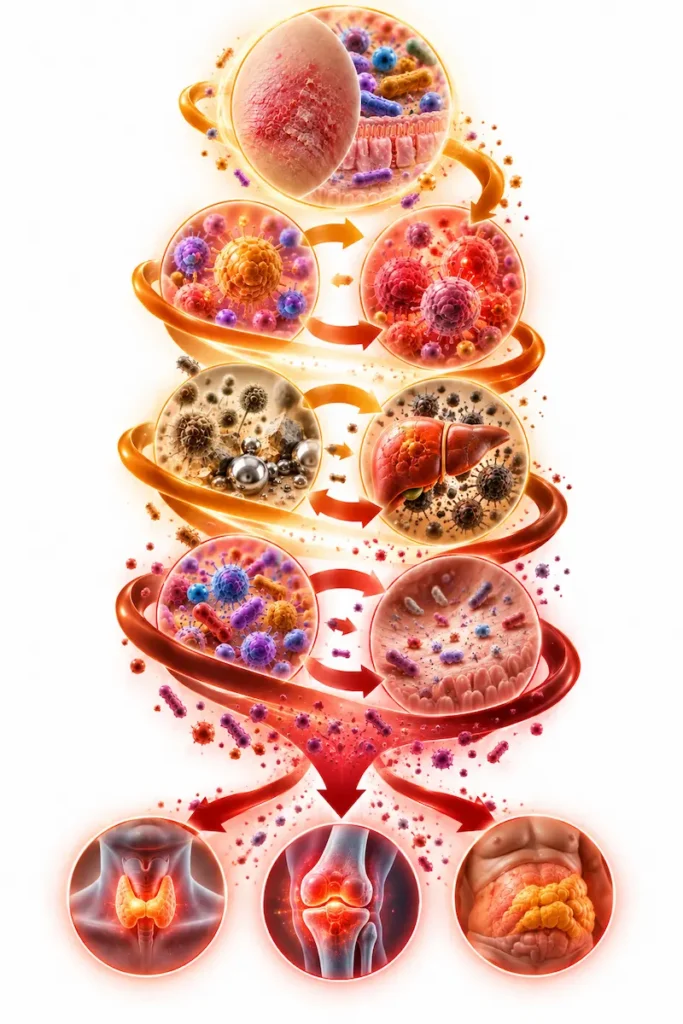
If you have noticed your eczema becoming more treatment-resistant, more widespread, or more difficult to control as the years pass — there is a clinical reason. The upstream picture driving the leaky gut and the eczema does not remain static. It compounds.
Inflammation produces more inflammation. The cytokines and immune signals generated by leaky gut-driven immune activation create a pro-inflammatory internal environment that makes the immune system progressively more reactive — lowering the threshold for mast cell degranulation, deepening the Th2 dominance that characterizes eczema, and sustaining the intestinal permeability that continues to feed systemic immune activation. Each flare sensitizes the immune system further. Each course of steroids impairs the skin barrier that was already compromised. The internal environment becomes progressively more inflamed and progressively less capable of the regulatory resolution that would calm it.
Toxins impair detoxification — which allows more toxins to accumulate. Heavy metals and mycotoxins deplete the glutathione, the selenium, and the zinc that the body’s primary detoxification pathways depend on. As these pathways are progressively depleted by the burden they are trying to clear, their efficiency falls — meaning each subsequent exposure clears more slowly, accumulates more completely, and maintains immune activation more persistently than the one before. The toxic burden that was contributing to gut dysbiosis and leaky gut is now harder for the body to clear than it was at the beginning of the picture.
Gut dysbiosis worsens with the natural aging process. The microbial diversity that buffers against pathogenic overgrowth declines progressively with age. Each antibiotic course — whether for a skin infection, a UTI, or a respiratory illness — removes more diversity from an already-thinning baseline. The commensal populations that produce the butyrate maintaining intestinal integrity, the SCFAs that support Treg immune function, and the antimicrobial compounds that keep pathobionts in check are progressively fewer in number and less diverse in function. The gut becomes progressively less capable of recovering from each dysbiotic insult.
And as the internal picture compounds, new symptoms and new conditions begin to emerge downstream. The thyroid that was compensating adequately can no longer compensate. The hormonal balance that was maintained through what reserves remained begins to shift. The joint symptoms, the fatigue, the hormonal irregularities, the cardiovascular changes that research has confirmed are associated with both rosacea and eczema — these do not arrive randomly alongside a chronic skin condition. They arrive because the same upstream environment that has been producing the skin condition has been building the same systemic inflammatory picture in every system it touches, for as long as the root cause has been left unaddressed.
Every year that the upstream picture goes uninvestigated, the cascade compounds. The eczema becomes harder to manage. The immune system becomes less capable of regulation. And the internal environment that has been producing the skin condition moves progressively closer to producing the systemic health consequences it has been predicting all along.
This is not a reason for alarm. It is a reason for urgency — and for a different question than the dermatology appointment has been asking. Not which topical to use next. But what is upstream of the gut, what is driving the dysbiosis, what internal environment has been building behind the surface of the eczema for as long as the eczema has been present, and what does it need in order to change.
What the Functional Medicine Investigation Looks For
The functional medicine approach to leaky gut and eczema does not begin with the gut. It begins with what is upstream of the gut — the perpetrators that shifted the microbial balance and impaired intestinal integrity in the first place.
Rather than running a comprehensive stool test in isolation, my clinical preference is to investigate the full toxic burden picture first — heavy metals, environmental chemicals, and mycotoxins through Total Tox Burden testing. The reason is specific: toxins are extraordinarily good at dysregulating the immune system and driving gut dysbiosis, and their presence often explains clinical findings that the gut test alone cannot. A client who tests positive for significant mycotoxin burden, mercury, and glyphosate on Total Tox Burden is a client whose gut dysbiosis has a clear upstream perpetrator — and whose dysbiosis will continue to reassert itself unless that perpetrator is identified and addressed alongside the gut restoration work.
The investigation also addresses the stress picture — including the physiological stressors of blood sugar dysregulation, toxic burden, and thyroid insufficiency that maintain cortisol elevation as surely as emotional stress does. And it examines the dietary history for the patterns that have been feeding pathogenic organisms: the refined carbohydrates and sugar feeding Candida, the alcohol feeding both Candida and dysbiotic bacteria, the periods of nutritional neglect that depleted the nutrient reserves that gut repair and immune regulation require.
Once the upstream perpetrators are identified, the clinical work proceeds in three simultaneous directions: removing or reducing the upstream perpetrators driving the dysbiosis, restoring the gut microbial balance through targeted and sequenced support, and supporting the immune system with the key nutrients — vitamin A, zinc, omega-3 fatty acids, and vitamin D — that Treg function and immune resolution depend on. The gut cannot heal in an environment that is still producing the conditions driving its dysbiosis. And the immune system cannot rebalance without the nutrient support that makes rebalancing biochemically possible.
Your Eczema Is Not a Skin Problem. Your Skin Is Reporting a Gut Problem.
Leaky gut and eczema are not two separate health concerns that happen to co-occur. They are the same upstream problem expressed through the intestinal lining and the skin barrier simultaneously. Addressing the gut — by identifying what is upstream of the dysbiosis, restoring the microbial balance, and supporting the immune system with what it needs to regulate itself — is what produces the improvement in eczema that topical management can never achieve, because it addresses the internal environment that topical management was never designed to touch.
The longer the upstream picture goes unaddressed, the more it compounds. The more it compounds, the more entrenched the eczema becomes — and the more likely new downstream symptoms and conditions are to emerge from the same internal environment that has been expressing as eczema all along.
The investigation that identifies what is upstream of your gut dysbiosis is not a luxury. For a skin condition that is progressively worsening despite every topical protocol you have tried, it is the most important clinical question available.
→ Book your Initial Functional Medicine Health and Skin Assessment
P.S. Flexible payment options available through Cherry — no interest, no credit impact, quick approval. Apply on our website.
Frequently Asked Questions About Leaky Gut and Eczema Connection
Q1: Can leaky gut cause eczema?
Yes — and the mechanism is precise. When the intestinal lining becomes more permeable than it is designed to be, bacterial cell wall fragments called LPS cross from the gut into the bloodstream and activate immune receptors throughout the body. This produces the inflammatory cytokines — TNF-alpha, IL-6, IL-1β — that sustain the immune dysregulation driving eczema, sensitizes mast cells throughout the body, and progressively depletes the regulatory T cell function that would otherwise keep inflammatory responses proportionate. Research confirms that up to 24 percent of atopic dermatitis patients test positive for small intestinal bacterial overgrowth, one of the most direct drivers of increased intestinal permeability. Treating eczema at the skin surface while the leaky gut feeding its immune activation remains unaddressed produces the temporary improvement and predictable relapse that most eczema patients know well.
Q2: Is eczema a gut problem or a skin problem?
Both — but the skin is the downstream expression and the gut is the upstream driver. Eczema is a systemic inflammatory condition that expresses through the skin. The immune dysregulation that produces the visible inflammatory picture on the surface — the Th2 dominance, the mast cell hyperreactivity, the barrier impairment — is driven and sustained by the gut’s microbial environment, the intestinal barrier’s integrity, and the immune calibration signals that a healthy, diverse gut microbiome produces. A skin condition that keeps returning despite every topical treatment is almost always expressing an upstream gut problem that no topical treatment was designed to address.
Q3: What causes leaky gut in eczema patients?
Three upstream perpetrators are most consistently present in eczema patients with gut dysbiosis and leaky gut. Mycotoxins from mold exposure — which disrupt the intestinal micro-ecological balance, deplete beneficial bacteria, enrich pathogenic organisms, and directly downregulate the tight junction proteins that maintain intestinal integrity. Chronic stress — which elevates cortisol, reduces gastric acid, creates conditions for H. Pylori and SIBO overgrowth, and directly increases intestinal permeability. And dietary patterns feeding pathogenic overgrowth — refined carbohydrates and sugar feeding Candida, alcohol compounding dysbiosis and impairing gut repair. In clinical practice, the upstream perpetrators driving the leaky gut are identified through the investigation rather than assumed — because the specific drivers determine the specific restoration approach.
Q4: Does healing leaky gut help eczema?
Yes — when the leaky gut is addressed as part of the upstream picture rather than in isolation. Probiotic supplementation and dietary changes that improve gut barrier integrity reduce the LPS-driven immune activation that sustains eczema’s inflammatory environment. Research confirms that microbial interventions significantly reduce atopic dermatitis severity. But the improvement is most complete and most lasting when gut restoration happens alongside identification and reduction of the upstream perpetrators — toxic burden, stress, dietary patterns — that were driving the dysbiosis in the first place. Healing the gut in an environment that is still producing the conditions causing dysbiosis produces temporary improvement and predictable relapse. Removing the upstream perpetrators alongside gut restoration produces the lasting improvement that gut treatment alone cannot achieve.
Q5: Why does eczema keep getting worse even when I eat well?
Dietary changes address one upstream driver of gut dysbiosis and leaky gut — but rarely the only one. If mycotoxin burden from mold exposure is maintaining the immune dysregulation and directly damaging the gut lining, dietary improvement cannot overcome that toxic load. If heavy metal burden is depleting the zinc and magnesium that gut repair depends on, diet cannot adequately replete those nutrients faster than the toxic burden is depleting them. If chronic stress is maintaining cortisol elevation that directly increases intestinal permeability, dietary discipline cannot counteract the physiological consequences of a sustained stress load. Eczema that worsens despite good dietary effort is almost always carrying upstream perpetrators that dietary change alone cannot address.
Q6: Can recurrent UTIs be connected to eczema?
Yes — through the shared upstream driver of gut dysbiosis. E. coli, the primary UTI pathogen, is also one of the dominant organisms in small intestinal bacterial overgrowth, and the gut serves as its primary reservoir. The same gut dysbiosis driving SIBO, leaky gut, and eczema is also providing E. coli with the overgrown gut population from which it migrates to colonize the urinary tract. Antibiotics prescribed for the UTI deplete the commensals that were providing competitive inhibition against E. coli, producing a post-antibiotic E. coli bloom that worsens the gut dysbiosis and eczema simultaneously. Recurrent UTIs alongside eczema are almost never a coincidence. They are the same upstream gut dysbiotic environment expressing through two different downstream systems at once.
Written by Natalie Maibenko – a Certified Functional Medicine Practitioner and Master Esthetician with 23+ years of experience and founder of Unique Verve

Natalie Maibenko
Functional Medicine & Skincare Expert – Helping You Take Control of Your Health and Achieve Lasting Skin Results Nationwide — Virtual Practice
As a Certified Functional Medicine Practitioner my Expertise Encompasses:
- Immune System: frequent illness, UTIs, yeast infections
- Allergies, Asthma
- Skin Problems: acne, cystic acne, rosacea, eczema, dermatitis, ichthyosis, psoriasis, vitiligo, melasma
- Inflammation: arthritis, rhinitis, joint & muscle pain, migraines, headaches
- Sleep Disturbunces, Insomnia
- Gut Problems: IBS/IBD, bloating, acid reflux, gas, constipation, diarrhea, parasites, fungal/yeast overgrowths
- Hormonal Imbalances: PCOS, PMS symptoms, weight problems/inability to lose weight, thyroid problems
- Hair Loss, Alopecia
- Mood Imbalances: anxiety, depression, irritability
- Metabolic Dysfunction, Insulin Resistance, Type 2 Diabetes
- Optimizing Wellness for Successful Pregnancy
- Autoimmune Conditions: Hashimoto’s thyroiditis, grave’s disease, reumatoid arthritis (RA), lupus, etc
- Bone Health: osteopenia/ osteoporosis
- Effective Anti-Aging Strategies without Injectables with the inside-out & outside-in approach
- Detoxification of Heavy Metals, Mycotoxins, Environmental Toxins
- Reversing Breast Implant Illness
- Preparation for the Explant Surgery and Optimization of Wellness & Vitality Post-Explant
