
Introduction
Hormones and rosacea are more connected than most people — and most dermatologists — realize. If your rosacea started or significantly worsened in your 20s or 30s, if you also struggle with irregular periods, hormonal acne, or a PCOS diagnosis alongside your rosacea, or if your skin never quite fits the simple rosacea or acne picture that your dermatologist describes — the hormonal picture is almost certainly part of what is driving it.
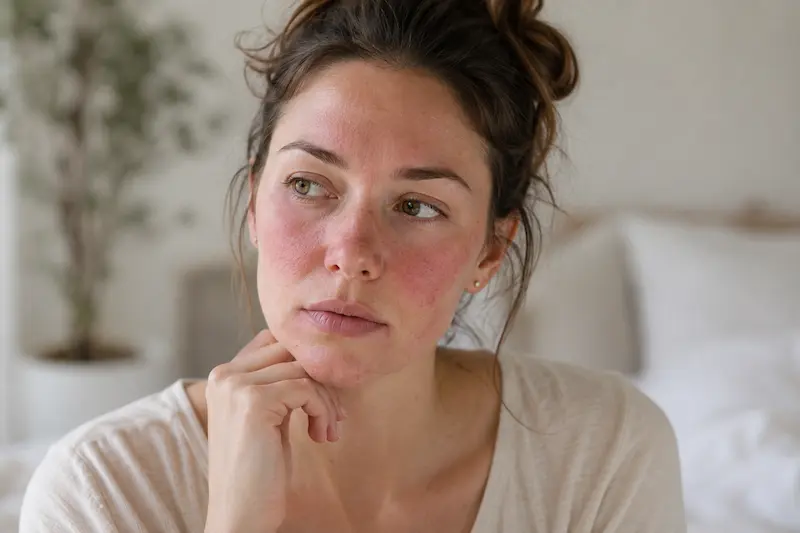
PCOS — polycystic ovarian syndrome — is one of the most consistently overlooked upstream drivers of rosacea in younger women. Not because the connection is obscure, but because dermatologists investigate the skin and gynecologists investigate the ovaries, and almost nobody is asking what both conditions share at the root. When the hormonal investigation finally happens through a functional medicine lens, the answer is usually the same: an upstream cascade of blood sugar dysregulation, insulin imbalance, and hormonal disruption that is simultaneously driving the skin and the hormonal picture from the same internal environment.
This post explains how PCOS and rosacea are connected, why the hormonal picture in PCOS is very different from perimenopause despite producing similar skin symptoms, what external factors are driving PCOS onset earlier and earlier in younger women, and why treating rosacea without investigating the hormonal picture leaves the most important upstream driver completely unaddressed.
Hormones and Rosacea — PCOS vs Perimenopause: An Important Distinction
Both PCOS and perimenopause produce a hormonal environment that drives rosacea — but they do so through different pathways, at different life stages, and for very different reasons. Understanding the distinction matters because the treatment approach, the testing required, and the upstream factors to address are meaningfully different between the two.
Perimenopause-driven rosacea is the result of a natural biological transition. Progesterone declines before estrogen does in the perimenopause years, creating a period of relative estrogen dominance that activates the immune cells in the skin and drives histamine release. This happens to every woman eventually — it is a universal hormonal shift, and the rosacea that emerges or worsens in the perimenopausal years reflects a predictable biological process that can be supported and managed but is not caused by anything the patient did or was exposed to.
PCOS-driven rosacea is fundamentally different. PCOS is not a natural hormonal transition — it is a hormonal disruption that is triggered and sustained by external and lifestyle factors. Diet high in refined carbohydrates and sugar, chronic emotional and physical stress, and exposure to hormone-disrupting chemicals in food, plastics, and cosmetics are the most consistent contributors. These factors drive blood sugar dysregulation and insulin imbalance that disrupts the entire hormonal chain — producing the androgen excess, progesterone suppression, and relative estrogen dominance that both produces PCOS symptoms and drives rosacea from the inside out. PCOS is a condition that something created — and that means it is a condition that addressing the upstream causes can genuinely reverse.
How PCOS Drives Rosacea — The Hormonal Cascade Explained Simply
The connection between PCOS and rosacea follows a logical hormonal chain that starts well upstream of the skin:
It begins with blood sugar and insulin. A diet high in refined carbohydrates and sugar causes blood sugar to spike frequently, which forces the body to produce large amounts of insulin to bring it back down. Chronic stress compounds this independently — stress hormones raise blood sugar directly as part of the body’s fight-or-flight response, meaning a woman under chronic stress is producing excess insulin even if her diet is reasonable. Endocrine-disrupting chemicals — particularly BPA and phthalates found in plastics and many cosmetics — further worsen insulin sensitivity through a separate pathway, contributing to the same problem from a different direction.
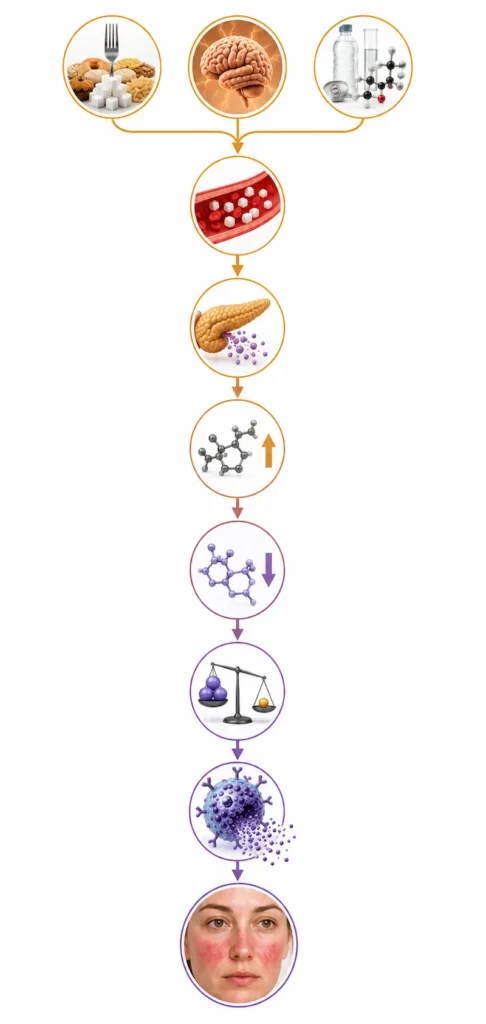
When insulin is chronically elevated, it disrupts the ovaries’ normal hormonal production. The ovaries begin producing more male hormones — androgens, particularly testosterone — than they normally would. This androgen excess is the defining feature of PCOS, and it produces several consequences for the skin simultaneously: it stimulates the oil glands in the skin to overproduce sebum, contributing to the pustules and inflammatory bumps that look like acne. And it suppresses progesterone production, because when the hormonal signaling that normally triggers ovulation is disrupted by high androgens, progesterone — the hormone produced after ovulation — either isn’t produced at adequate levels or isn’t produced at all.
Low progesterone leaves estrogen’s effects on the body relatively unopposed. And estrogen, in the absence of progesterone’s balancing influence, directly activates the immune cells in the skin called mast cells. Mast cells release histamine, which triggers the flushing, redness, and inflammatory cascade of rosacea. This is the hormonal mechanism connecting PCOS to rosacea — a chain that runs from blood sugar dysregulation and insulin excess through androgen elevation and progesterone suppression to the relative estrogen dominance that keeps mast cells chronically primed and histamine chronically elevated.
Why PCOS Patients Often Have Both Acne and Rosacea at the Same Time
One of the most diagnostically confusing aspects of PCOS-driven skin disease is that the same hormonal picture can produce what looks like both acne and rosacea simultaneously — from the same internal environment, through two different pathways.
The elevated androgens in PCOS stimulate oil gland activity and drive the inflammatory pustule picture that looks like hormonal acne — typically concentrated around the lower face, jaw, and chin. At the same time, the relative estrogen dominance from suppressed progesterone is activating mast cells and driving the histamine-mediated flushing, redness, and reactive skin of rosacea — typically concentrated across the central face and cheeks.
The result is a patient who presents with pustules on the lower face and jawline alongside diffuse redness and reactivity across the central face — a picture that doesn’t cleanly fit either a rosacea diagnosis or an acne diagnosis, and that conventional dermatology struggles to treat because the two conditions require different approaches and share no common conventional treatment. Antibiotics may temporarily reduce the pustule component while doing nothing for the redness and reactivity — and as we have established in a previous post, may simultaneously worsen the gut dysbiosis that is compounding the hormonal picture. Retinoids may help the acne component while worsening the barrier compromise of the rosacea skin.
The functional medicine investigation resolves the confusion by asking the upstream question: what is producing the hormonal environment that is simultaneously driving both presentations? When the blood sugar, insulin, androgen, and estrogen dominance picture is addressed together, both skin expressions improve together — because both were downstream consequences of the same upstream hormonal cascade.
Why PCOS — and Hormonal Rosacea — Is Appearing in Younger and Younger Women
One of the most significant and least discussed contributors to the rising prevalence of PCOS and hormonal rosacea in younger women is the increasing body burden of endocrine-disrupting chemicals — chemicals that interfere with the body’s hormonal signaling system.
BPA — bisphenol A — is found in plastic food packaging, water bottles, and the lining of canned foods. Phthalates are used as plasticizers in a remarkably wide range of products including many cosmetics, personal care products, nail polishes, hair sprays, and fragrances — meaning women with rosacea who are using multiple skincare products daily may be increasing their phthalate exposure through the very products they are using to manage their skin. Research published in PMC confirms that exposure to EDCs such as BPA and phthalates may promote insulin resistance — the same insulin dysregulation that drives the entire PCOS-rosacea hormonal cascade.
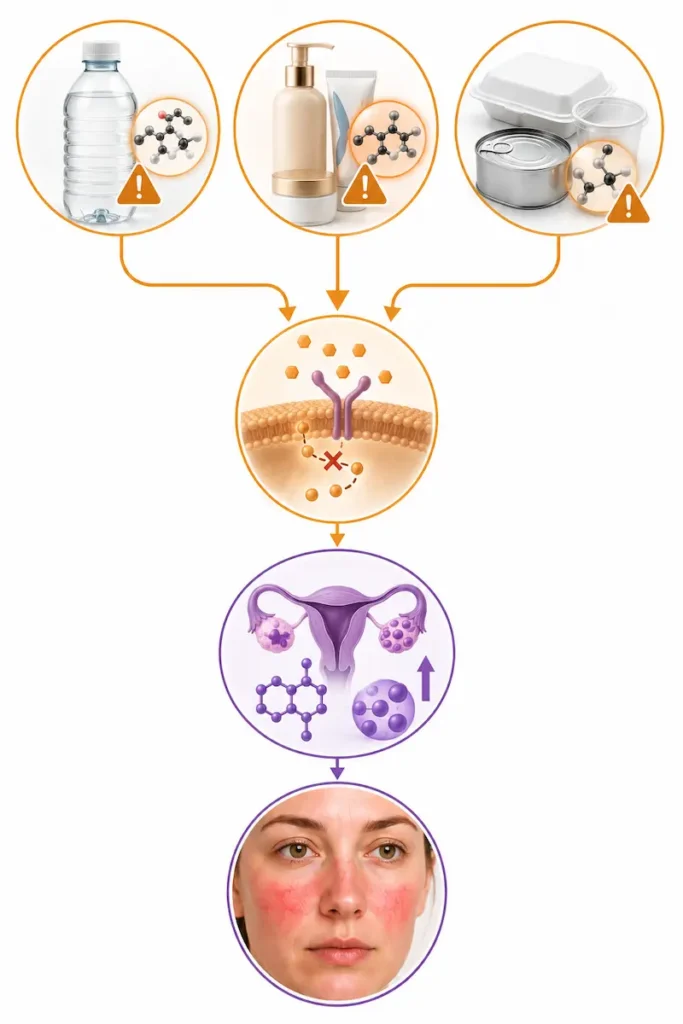
These chemicals mimic or block the body’s natural hormones, disrupt insulin signaling, and interfere with the ovarian hormone production that normally keeps androgens balanced and progesterone adequate. They do not require years of exposure to produce effects — chronic low-level exposure from daily products, food packaging, and environmental sources accumulates over time and creates hormonal disruption in women who have no other obvious explanation for why their PCOS or hormonal rosacea appeared in their teens or early 20s.
This is why PCOS is no longer a condition of women in their 30s. It is appearing in teenagers and women in their early 20s whose hormonal picture has been disrupted by the combination of refined diets, chronic stress, and daily chemical exposure before their hormonal systems have fully matured. And it is why addressing hormonal rosacea without investigating the toxic burden that may be driving the hormonal disruption leaves one of the most clinically important upstream factors completely unaddressed.
Birth Control and Hormonal Rosacea — A Nuanced Picture
Birth control is one of the most common conventional approaches to managing PCOS — and its effect on rosacea is clinically nuanced in ways that most patients are never told about.
Some birth control formulations help hormonal rosacea temporarily. Pills containing anti-androgenic progestins can reduce the androgen-driven oil gland activity that produces the pustule component of PCOS skin — which is why some women notice their skin improving on birth control. This is a real and valid short-term effect. The limitation is that it addresses the downstream hormonal expression — reducing androgen activity at the level of the oil gland — without addressing the upstream blood sugar, insulin, and hormonal cascade that is producing the androgen excess in the first place. When birth control is stopped, the upstream picture is unchanged and the androgen-driven skin symptoms return.
Other birth control formulations can worsen hormonal rosacea. Synthetic progestins in some formulations do not provide the mast cell-stabilizing effect of the body’s own natural progesterone. When these synthetic versions replace natural progesterone production — which birth control does by suppressing ovulation and therefore the progesterone that follows it — the relative estrogen dominance that activates mast cells may be sustained or worsened rather than improved. Some formulations containing androgenic progestins can further stimulate oil gland activity, worsening the acne component of the PCOS skin picture.
The post-pill rebound is perhaps the most overlooked trigger for hormonal rosacea. When birth control is stopped after long-term use, the suppression of the body’s own hormonal production is suddenly removed. The ovaries, which have been suppressed for months or years, often temporarily overproduce androgens in the weeks and months after stopping — a rebound effect that produces a significant worsening of acne and rosacea that many women and their practitioners mistake for a new condition rather than recognizing it as a consequence of stopping the medication. If the upstream insulin and hormonal picture has not been addressed during the time on birth control, the post-pill rebound reveals the full extent of the underlying PCOS-driven hormonal imbalance.
The Pattern I Consistently See
The typical PCOS-rosacea patient I see in my functional medicine practice is a woman in her late 20s to mid-30s who has been confused about her skin for years. She was told she had acne in her teens, then rosacea in her 20s, then a combination of both. Her dermatologist has prescribed antibiotics, retinoids, and topical treatments that produce partial and temporary results without ever asking about her menstrual cycle, her insulin levels, or her hormonal picture. She may or may not have a formal PCOS diagnosis — approximately 70% of PCOS cases remain undiagnosed, which means many women with the full hormonal picture driving their skin never receive the label.
When the functional medicine rosacea root-cause investigation happens, the picture is consistent: blood sugar dysregulation — often with fasting insulin elevated even when fasting glucose appears normal, reflecting the early insulin resistance that standard testing misses. A full hormonal panel showing elevated androgens, suppressed progesterone, and the relative estrogen dominance that is keeping mast cells chronically activated. Gut dysbiosis that is impairing estrogen clearance through the gut and recirculating free estrogen back into circulation, compounding the estrogen dominance from the hormonal side. Nutrient insufficiencies — particularly zinc, magnesium, and B vitamins — that are impairing both hormonal metabolism and the skin’s ability to manage histamine. And in many cases, a toxic burden including phthalates and BPA that is worsening the insulin resistance and hormonal disruption from yet another direction simultaneously.
The skin picture improves when the upstream hormonal and metabolic picture is addressed — not because a better topical was found, but because the internal environment that was simultaneously driving the androgen-acne component and the estrogen-mast cell-rosacea component was investigated and changed. Both skin expressions improve together because they were never separate problems. They were different faces of the same upstream hormonal cascade.
Hormones and Rosacea — The Upstream Investigation Changes Everything
Hormonal rosacea in the context of PCOS is not a skin condition that needs a better topical. It is a hormonal condition that needs an upstream investigation. The skin is showing you what is happening inside — the blood sugar dysregulation, the insulin imbalance, the androgen excess, the progesterone suppression, the chemical burden that is disrupting the hormonal system from outside. When those upstream drivers are identified and addressed, the skin changes. Not because it was treated, but because the internal environment that was producing it was finally changed.
If your rosacea started young, if it has a hormonal pattern — worse before your period, worse under stress, presenting alongside what looks like acne — or if conventional treatments have produced partial results that never hold, the hormonal investigation has not happened yet. It is available. It is measurable. And in my clinical experience, it is where the most meaningful and lasting skin improvement begins.
→ Book your Initial Functional Medicine Health and Skin Assessment
P.S. If finances have been the only thing standing between you and starting your functional medicine journey — flexible payment options are available through Cherry on our website. No interest, no impact on your credit score, quick approval, and affordable monthly payments. Apply in minutes on our website.
Q1: Is my rosacea hormonal or something else?
If your rosacea started in your 20s or 30s, flares in a pattern related to your menstrual cycle, appears alongside what looks like hormonal acne on the lower face and jaw, or has never fully responded to conventional rosacea treatment — a hormonal driver is almost certainly part of the picture. Hormonal rosacea typically reflects a pattern of blood sugar dysregulation, insulin imbalance, and the downstream hormonal cascade of elevated male hormones, suppressed progesterone, and relative estrogen dominance that keeps the skin’s immune cells chronically activated. This picture is measurable through functional medicine testing but is almost never investigated in a standard dermatology visit.
Q2: Can you get rosacea from hormonal changes?
Yes — and PCOS is one of the most consistent hormonal drivers of rosacea in younger women. The hormonal cascade of PCOS — blood sugar dysregulation driving insulin excess, insulin excess driving elevated male hormones, elevated male hormones suppressing progesterone, and low progesterone creating relative estrogen dominance that activates the skin’s immune cells — produces the same internal environment that drives rosacea’s flushing, redness, and inflammatory skin response. Unlike perimenopause, which is a natural hormonal transition, the hormonal changes driving PCOS are produced by external and lifestyle factors — diet, stress, and chemical exposure — which means they are addressable at the source rather than simply managed.
Q3: Does birth control trigger rosacea flare-ups?
It depends on the formulation. Some birth control pills containing anti-androgenic progestins can temporarily reduce the hormonal acne component of PCOS skin by reducing male hormone activity at the oil glands. Others — particularly those containing androgenic progestins — can worsen the pustule picture. And all hormonal birth control suppresses the body’s own progesterone production by preventing ovulation, which can sustain or worsen the relative estrogen dominance that is activating the skin’s immune cells and driving the rosacea component. Birth control manages the hormonal expression without addressing the upstream blood sugar, insulin, and hormonal cascade that is producing it.
Q4: Can stopping birth control clear rosacea?
Stopping birth control is unlikely to clear rosacea on its own — and in many cases initially makes skin significantly worse through what is known as the post-pill rebound. When birth control is stopped after long-term use, the ovaries temporarily overproduce male hormones in the weeks and months after the synthetic suppression is removed. This androgen rebound produces a significant worsening of both the acne and rosacea picture that many women mistake for a new condition. If the upstream blood sugar and insulin picture that was driving the PCOS hormonal cascade has not been addressed during the time on birth control, stopping it simply reveals the full extent of the underlying hormonal imbalance that was being suppressed rather than resolved.
Q5: Why is my rosacea worse in certain months?
A cyclical rosacea pattern — worse at specific points in the menstrual cycle — is one of the clearest indicators of a hormonal driver. Rosacea typically worsens in the luteal phase of the cycle, the two weeks between ovulation and menstruation, when estrogen levels are higher relative to progesterone. Estrogen activates the skin’s mast cells and drives histamine release, while progesterone normally provides the balancing countereffect. In women with PCOS, progesterone is often inadequately produced even when it should be at its highest — meaning the luteal phase estrogen-mast cell activation occurs without the progesterone buffer that would normally contain it. The skin flares not because of the estrogen itself but because the progesterone that should balance it is not present in adequate amounts.
Q6: Is rosacea worse during certain life stages?
Yes — and the pattern follows the hormonal landscape across a woman’s life. Rosacea often first appears or significantly worsens in the late 20s and early 30s when PCOS-driven hormonal disruption is most actively expressed — reflecting the blood sugar, insulin, and androgen picture that has been building from dietary, stress, and chemical exposure factors. It often intensifies again in the late 30s and into the 40s as perimenopause begins and progesterone starts its natural decline, removing the mast cell-stabilizing effect even in women who did not previously have a significant PCOS picture. Understanding which life stage is driving the current rosacea picture — and what upstream factors are most relevant to that stage — is essential for knowing which investigation will be most informative and which intervention will be most effective.
Written by Natalie Maibenko – a Certified Functional Medicine Practitioner and Master Esthetician with 23+ years of experience and founder of Unique Verve

Natalie Maibenko
Functional Medicine & Skincare Expert – Helping You Take Control of Your Health and Achieve Lasting Skin Results Nationwide — Virtual Practice
As a Certified Functional Medicine Practitioner my Expertise Encompasses:
- Immune System: frequent illness, UTIs, yeast infections
- Allergies, Asthma
- Skin Problems: acne, cystic acne, rosacea, eczema, dermatitis, ichthyosis, psoriasis, vitiligo, melasma
- Inflammation: arthritis, rhinitis, joint & muscle pain, migraines, headaches
- Sleep Disturbunces, Insomnia
- Gut Problems: IBS/IBD, bloating, acid reflux, gas, constipation, diarrhea, parasites, fungal/yeast overgrowths
- Hormonal Imbalances: PCOS, PMS symptoms, weight problems/inability to lose weight, thyroid problems
- Hair Loss, Alopecia
- Mood Imbalances: anxiety, depression, irritability
- Metabolic Dysfunction, Insulin Resistance, Type 2 Diabetes
- Optimizing Wellness for Successful Pregnancy
- Autoimmune Conditions: Hashimoto’s thyroiditis, grave’s disease, reumatoid arthritis (RA), lupus, etc
- Bone Health: osteopenia/ osteoporosis
- Effective Anti-Aging Strategies without Injectables with the inside-out & outside-in approach
- Detoxification of Heavy Metals, Mycotoxins, Environmental Toxins
- Reversing Breast Implant Illness
- Preparation for the Explant Surgery and Optimization of Wellness & Vitality Post-Explant
